
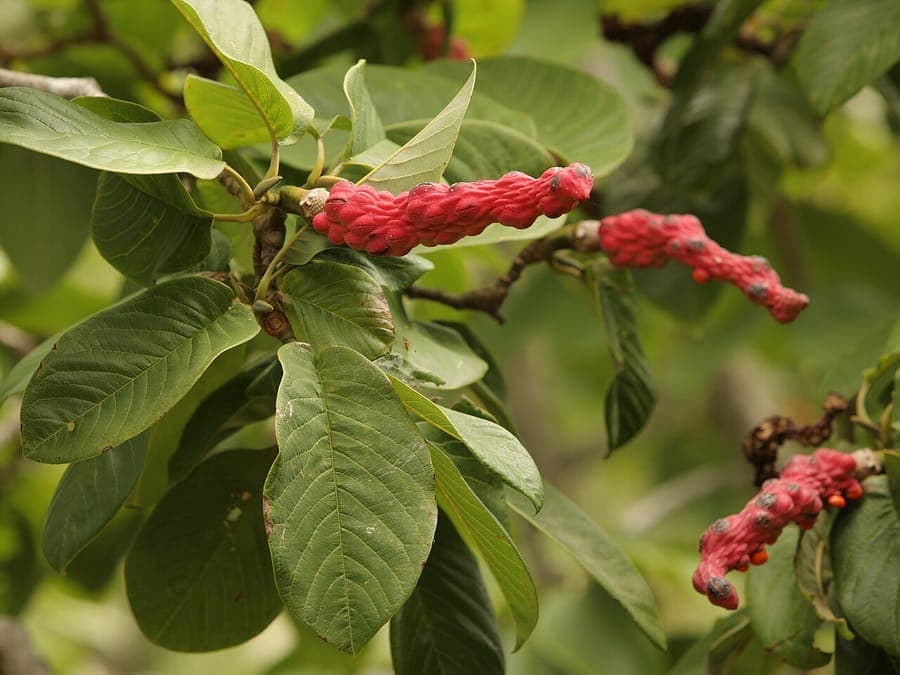
Mfield, Matthew Field, http://www.photography.mattfield.com / CC BY-SA 3.0, via Wikimedia Commons
Magnolia campbellii: complete guide
Magnolia campbellii
Want to see Magnolia campbellii: complete guide in your garden?
1 minute, no credit card
Overview
Magnolia campbellii, named after botanist Archibald Campbell, is a magnificent evergreen tree native to the Himalayan regions of Nepal, Tibet, and China. This magnolia ranks among the world's most spectacular flowering trees, celebrated for its gigantic, voluptuous pink blooms appearing in earliest spring.
This Himalayan beauty grows slowly into an imposing, broad-crowned tree reaching 10-15 meters tall and equally wide. With deep green foliage and dozens of flowers simultaneously, it becomes the absolute focal point of any garden.
Appearance and bloom
Magnolia campbellii develops as a broad, symmetrical tree with dense foliage. Leaves are large, leathery, and deep green, providing a rich backdrop for spectacular flowers.
Flowers appear January through March, often before leaves fully emerge. These enormous cup-shaped blooms can reach 20-25 centimeters in diameter! Color ranges from deep pink to nearly white, depending on cultivar.
Following bloom, characteristic magnolia fruits develop-elongated green pods ripening red, releasing spectacular red seeds.
Ideal location
Give Campbell's magnolia a well-sheltered, sunny to dappled shade location. It appreciates afternoon shade in very warm climates, but in the Benelux prefers full sun, especially for abundant flowering.
It's vulnerable to late frost damage on flowering buds. Avoid planting in frost pockets where cold air collects. An elevated position with good air circulation is ideal.
The tree appreciates some wind protection, especially when laden with flowers.
Soil
Campbell's magnolia grows best in nutrient-rich, well-draining soil. A mix of garden loam with compost, leaf mold, and some perlite is perfect.
The tree appreciates higher humus content than many shade trees. Ensure soil is acidic to neutral (pH 5.5-6.5). In very heavy clay or extremely acidic soil, it struggles.
Good surface drainage is essential-no waterlogged roots.
Free design
Want to see Magnolia campbellii: complete guide in your garden? Make a free design now.
Watering
Once well-established (after 2-3 years), Campbell's magnolia is fairly drought-tolerant. During the growing season (March-October), water regularly, especially during dry periods and when the tree is in full bloom.
After the growing period (November-February), water much less-rainfall usually suffices. In winter, minimal watering.
Ensure consistent moisture for young trees (first 3 years) through regular watering.
Pruning
Campbell's magnolia requires minimal pruning-it naturally develops an attractive form. Remove only dead or damaged branches.
If the tree becomes too large, carefully remove lower branches after flowering (April-May) to create a taller canopy. Large pruning wounds heal slowly on magnolias, so be cautious.
Never prune during bloom!
Maintenance calendar
January-March: Bloom period, ample water during dry springs. April-May: Careful post-bloom pruning, light feeding. June-September: Regular watering, disease monitoring. October-November: Winter prep, reduced water. December: Winter dormancy.
Winter hardiness
Campbell's magnolia is hardy to about -15 degrees Celsius (USDA zone 7). Throughout most of the Benelux it grows well, except during extreme northern winters.
Late March frost can damage flowers. Unfortunately, this cannot be prevented-hope for mild early years.
Companion plants
Campbell's magnolia pairs beautifully with:
- Rhododendron (especially pink and purple varieties)
- Camellia japonica (Japanese camellia)
- Acer palmatum (Japanese maple)
- Pieris japonica (Japanese andromeda)
- Ilex crenata (Japanese holly)
- Helleborus (Christmas rose)
These combinations create a luxurious, Himalayan-like atmosphere.
Closing
Magnolia campbellii rewards long-term investment in your landscape. This slow-growing tree provides decades of spectacular spring blooms. With proper placement and moisture management, you'll enjoy a legacy tree for generations.
Source young Campbell's magnolia trees from specialized nurseries. Plant in autumn or early spring for best results.
Discover more magnolia inspiration and garden designs on gardenworld.app.
Want to see Magnolia campbellii: complete guide in your garden? Make a free design now.
Upload a photo, pick a style, and get a photorealistic design with plant list in under a minute.
No credit card required


Similar plants
Saucer magnolia: complete growing guide
Magnolia × soulangeana Soul.-Bod.
Saucer magnolia is a hybrid featuring spectacular pink-white flowers appearing before leaf emergence. Ideal as specimen plant. Winter-resistant to -15°C.
Magnolia delavayi: complete guide
Magnolia delavayi
Delavay magnolia is an imposing shrub from southern China with large glossy leaves and fragrant creamy-white flowers. Learn about cultivation, hardiness, and care for this rare species.
Sweet michelia: complete guide
Magnolia doltsopa
Discover the sweet michelia, a majestic tree from the Himalayas. Learn everything about this impressive specimen, blooming, and perfect growing conditions.