
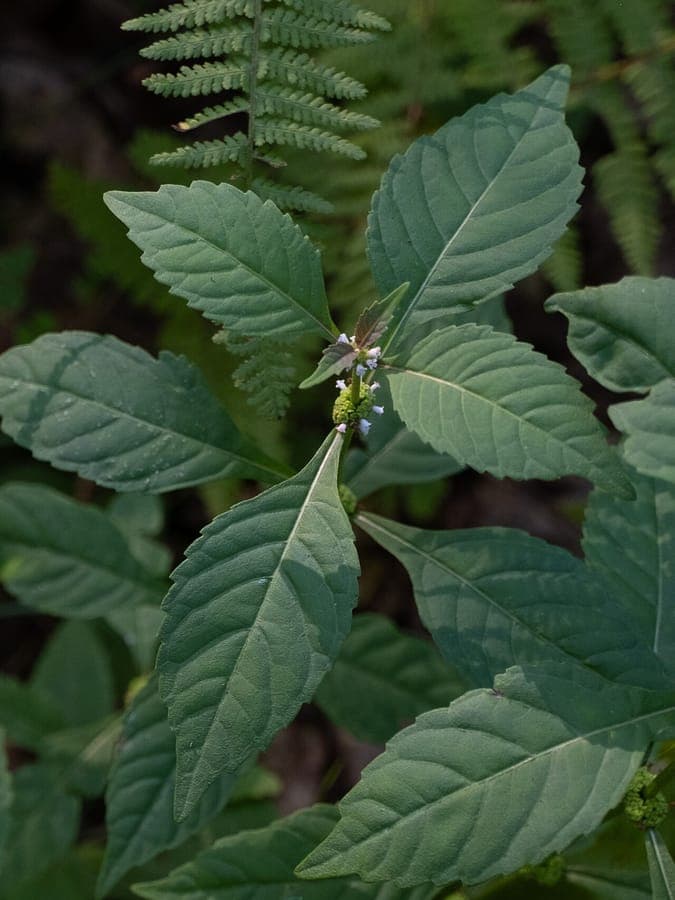
Alex Abair / CC BY 4.0, via Wikimedia Commons
Virginia bugleweed: complete guide
Lycopus virginicus
Want to see Virginia bugleweed: complete guide in your garden?
1 minute, no credit card
Overview
Virginia bugleweed (Lycopus virginicus) is a perennial herbaceous plant in the mint family (Lamiaceae), native to central and eastern North America. Its range spans from Florida and Texas north to Maine and Vermont, west to Nebraska and Kansas. The species grows naturally along streambanks, riverbanks, lakeshores, marshes, and wet meadows - anywhere moisture is consistently available.
The plant is closely related to the European water horehound (Lycopus europaeus), and shares many of its characteristics: upright square stems, opposite lance-shaped leaves, and small white tubular flowers. The genus name Lycopus comes from the Greek for "wolf foot," a reference to the lobed leaf shape of some species. The species name virginicus refers to Virginia, one of its native states.
In garden cultivation, Virginia bugleweed is valued primarily as a marginal aquatic or bog-garden plant. It thrives at pond edges, in rain gardens, and in low-lying areas that receive regular flooding. Its stoloniferous growth - spreading by underground runners - allows it to form dense colonies that stabilize banks and provide cover for wetland wildlife. The white flowers, though small, attract bees, small butterflies, and hoverflies during the long July-to-September bloom period.
For garden designers working on naturalistic water features, Virginia bugleweed fills an important niche: a medium-height plant (30-80 cm) that transitions gracefully between open water and drier ground. Explore design ideas incorporating moisture-loving plants like this species at gardenworld.app.
Appearance & bloom cycle
Lycopus virginicus forms upright clumps with characteristically square stems, typical of the Lamiaceae family. The stems reach 30 to 80 cm tall and are lightly hairy to nearly smooth, often tinged with reddish-purple at the nodes. The opposite leaves are lance-shaped to ovate, 4-10 cm long, with coarsely toothed margins and clearly visible veins. Leaf color is medium to dark green, providing a clean backdrop for the delicate flowers.
Flowering occurs from July through September. The individual blooms are tiny - just 3-4 mm long - and white with purple-tinged markings inside the corolla tube. They are arranged in dense whorls (verticillasters) in the leaf axils along the stem, creating a textured, elegant appearance when the plant is in full bloom. While each flower is modest, the cumulative effect of dozens of flower clusters along a single stem is quite attractive.
After flowering, small black nutlets develop and are dispersed by water - an adaptation to the plant's wetland habitat. These nutlets persist and can germinate in moist conditions the following spring. The seed heads also provide food for small birds in autumn and winter.
The stoloniferous growth habit means Virginia bugleweed spreads underground, producing new shoots at intervals along the runners. Under optimal conditions, a single plant can expand 30-60 cm per year in each direction. This makes management straightforward: simply cut back runners with a spade at whatever boundary you set.
Ideal location
Virginia bugleweed thrives in full sun to partial shade. In its native habitat, it often grows under light tree canopy or among tall herbaceous plants that provide some midday shade. In the garden, a site receiving at least four to six hours of direct sunlight per day is ideal. With more shade, the plant remains healthy but produces fewer flowers.
The best positions are: at the edge of ponds and water features (in soil that stays permanently moist), in dedicated bog gardens, in rain garden basins, and in naturally low-lying areas with poor drainage. The plant can also be grown in containers submerged in shallow water (up to 5 cm deep) or in pond baskets with aquatic compost.
In temperate European climates - the Netherlands, Belgium, northern Germany, northern France - Virginia bugleweed adapts well without special protection. It tolerates wind without difficulty and needs no shelter except in the most exposed situations. Plant spacing of 30-45 cm is recommended for new plantings; the plant will fill gaps naturally within one to two growing seasons.
Soil requirements
Virginia bugleweed requires consistently moist to wet soil. It is best suited to clay, loam, or organically rich substrates that retain moisture well. Ideal soil pH ranges from 5.0 to 6.3 - slightly to moderately acidic. On alkaline or calcareous soils, growth and flowering are typically reduced.
Before planting, incorporate 5-8 cm of well-rotted garden compost or leaf mould into the planting area to improve moisture retention and organic content. On naturally wet clay soils, no additional preparation is needed. On sandy soils, generous additions of compost (up to 20-25% by volume) are essential to improve water-holding capacity and create conditions approaching the plant's natural habitat.
The root system of Virginia bugleweed is adapted to low-oxygen conditions typical of waterlogged soils. Roots can survive periods of complete submersion, making this plant particularly valuable for garden areas that flood after heavy rainfall. Planting depth should be 15-20 cm - just enough to settle the root ball comfortably, with the crown at soil level.
Avoid very dry or free-draining soils and lime-rich substrates. On these soil types, the plant will struggle to establish and may fail entirely without constant supplementary irrigation. Mulching the surface around plants with 4-5 cm of bark chippings or leaf mould helps retain moisture and keeps roots cool during summer.
Free design
Want to see Virginia bugleweed: complete guide in your garden? Make a free design now.
Watering
As a bog and marginal water plant, Virginia bugleweed requires consistently moist to wet conditions throughout the growing season. Plants situated directly at the pond's edge or in submerged baskets will receive sufficient water through capillary action and direct contact with the water table. For plants positioned farther from standing water, regular irrigation is essential.
During dry periods in spring and summer, water two to three times per week, applying water slowly so it penetrates to at least 10 cm depth. Drip irrigation is particularly effective, as it delivers water directly to the root zone without wetting the foliage - reducing the risk of fungal leaf issues. Avoid watering in the heat of the day; early morning or late evening watering is most efficient.
In autumn, as the plant begins to die back, watering frequency can be reduced. Over winter, the dormant root system needs only occasional moisture - the soil should not dry out completely, but active irrigation is unnecessary. A mulch layer of 5-8 cm applied in late October or early November will help retain soil moisture and protect roots during cold periods.
Rainwater or low-mineral tap water is preferred. High-alkalinity tap water (pH above 7.5) used repeatedly can gradually raise soil pH above the plant's preferred range of 5.0-6.3, reducing nutrient availability and overall vigor over several years.
Pruning
Lycopus virginicus requires minimal pruning to remain healthy and attractive. The main maintenance task is cutting back the dead stems in early spring - once new shoots start emerging from the ground in March or April, remove the previous year's stems at ground level with sharp shears or secateurs. Add the cut material to the compost pile.
During the growing season, spent flower stems can be cut back by one-third after the main flush of bloom to encourage fresh lateral shoots and a second, lighter flowering later in the season. This is optional; many gardeners prefer to leave the seed heads in place through winter as food for birds and cover for beneficial insects.
Spread management is straightforward: use a sharp spade to cut back stolons that encroach beyond their allotted space, then lift and remove the severed sections. Do this in late spring or early autumn when the soil is workable. Lycopus virginicus does not require any structural pruning, deadheading regime, or annual cutting to the ground - unlike some ornamental grasses or vigorous perennials.
Maintenance calendar
March: Remove dead stems from previous year at ground level. Add a top-dressing of compost around plants. Check spreading stolons and cut back any that have extended beyond their boundary.
April-May: First new shoots emerge. Ensure consistent moisture. Divide overcrowded clumps if desired; replant divisions at 30-45 cm spacing.
June: Active growth phase. Water as needed. Inspect for aphids and other soft-bodied insects; Virginia bugleweed is generally resistant to most pests and diseases.
July-September: Flowering period. Enjoy the white flower whorls. Water during dry spells. Remove spent flower clusters if desired.
October: Flowering ends. Reduce watering. Leave stems standing for wildlife value.
November-February: Minimal care. Apply mulch if hard frosts are expected. Roots remain viable underground throughout the dormant period.
Winter hardiness
Virginia bugleweed is fully hardy in USDA zones 3-8, tolerating minimum temperatures of -40 degrees C in the coldest zones. In northwest Europe - the Netherlands, Belgium, Germany, northern France - the plant overwinters without any protection in the ground. These regions fall within USDA zones 7-8, where winter minima rarely exceed -15 degrees C.
The aerial portions of the plant die back completely at the first hard autumn frost, typically in October or November. The stoloniferous rhizomes survive the winter in the soil and reliably regenerate in spring when soil temperatures warm above 10 degrees C. This complete die-back and regeneration cycle makes Virginia bugleweed a true herbaceous perennial in European climates.
For container-grown specimens left outdoors, additional protection may be advisable in areas with prolonged periods below -10 degrees C. Wrap containers with horticultural fleece or bubble wrap and move them against a sheltered wall or into an unheated greenhouse. In the open ground, a 8-10 cm mulch layer of leaf mould or straw provides additional root protection during very cold winters.
Companion plants
Virginia bugleweed combines well with other moisture-loving perennials that share its habitat preferences. Consider these companions for a naturalistic water garden planting:
- Lythrum salicaria (purple loosestrife): bold purple-pink flower spikes bloom simultaneously with Virginia bugleweed, creating a striking contrast. Plant 40-60 cm apart.
- Iris pseudacorus (yellow flag iris): tall structural plant providing height contrast. Plant 50 cm from Lycopus; the iris's bold yellow flowers in May-June precede Lycopus's blooming.
- Caltha palustris (marsh marigold): bright yellow flowers in April-May extend the seasonal interest before Virginia bugleweed blooms. Plant at 30 cm spacing.
- Filipendula ulmaria (meadowsweet): taller plant (80-120 cm) with creamy white flower heads; provides a complementary backdrop. Plant 60-80 cm away.
- Mentha aquatica (water mint): a close relative in the mint family with similar growing conditions and aromatic foliage. Space 30 cm apart; both can spread, so contain as needed.
- Carex riparia (greater pond sedge): offers year-round structure and green foliage contrast. Plant at 40 cm spacing for a natural edge effect.
Conclusion
Virginia bugleweed is an underappreciated but genuinely valuable plant for wet garden situations. Its long flowering season, wildlife value, soil-stabilizing properties, and resilient winter hardiness make it a reliable choice for pond edges, bog gardens, and rain gardens. Minimal care requirements and predictable behavior make it suitable even for gardeners without specialist knowledge of aquatic or marginal plants.
Plan your water garden or moisture-loving planting scheme using the design tools at gardenworld.app, where you can explore combinations of marginal and bog plants suited to your specific garden conditions.
Want to see Virginia bugleweed: complete guide in your garden? Make a free design now.
Upload a photo, pick a style, and get a photorealistic design with plant list in under a minute.
10,000+ gardens designed already
No credit card required


Similar plants
Apple mint (Mentha x villosa): complete guide
Mentha x villosa
Meet apple mint (Mentha x villosa): a fruity-scented kitchen herb with woolly leaves, perfect for tea and mojitos.
Salvia peyronii: complete guide
Salvia peyronii
Discover Salvia peyronii, a rare Lebanese mountain sage. Growing tips, hardiness, and companion planting for a Mediterranean gravel garden.
Bigleaf mint (Mentha x rotundifolia): complete guide
Mentha x rotundifolia
Discover bigleaf mint: cultivation, care tips, and garden uses. Learn how to grow this aromatic herb with soft, hairy leaves.