
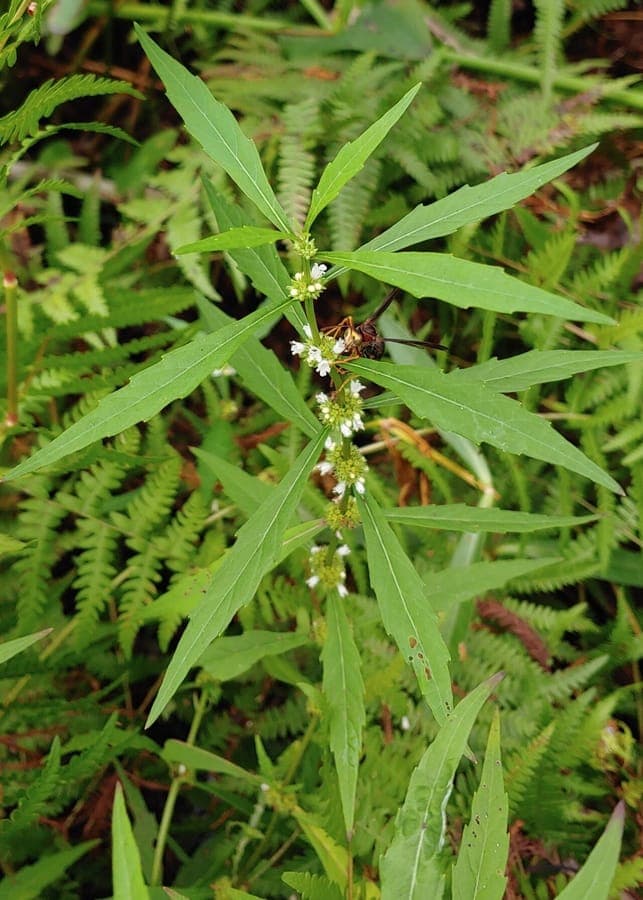
Tom and T Herman / CC BY 4.0, via Wikimedia Commons
Taperleaf water horehound (Lycopus rubellus): complete guide
Lycopus rubellus
Want to see Taperleaf water horehound (Lycopus rubellus): complete guide in your garden?
1 minute, no credit card
Overview
Lycopus rubellus, commonly known as taperleaf water horehound, stalked bugleweed, or taper-leaved water-horehound, is a perennial herbaceous plant in the family Lamiaceae - the large mint family that also includes lavender, rosemary, and sage. Described by the German botanist Moench as early as 1802, it is one of the earlier-documented North American species in the genus Lycopus. It grows naturally in the central and eastern United States, from Colorado and Kansas in the west to the Atlantic coastal states in the east, and from Maine in the north to Florida and Texas in the south. It is a plant of wet, low-lying habitats: river banks, marsh margins, wet meadows, ditch edges, and damp woodlands near watercourses. The species epithet 'rubellus', meaning reddish, may refer to the reddish tinge that stems and leaf stalks sometimes develop under certain conditions. For gardeners designing naturalistic water edges or wet borders, this is a rewarding species with good ecological value. At gardenworld.app you can explore planting designs for wet garden areas featuring moisture-loving natives and near-natives.
Appearance and bloom cycle
Lycopus rubellus is an upright, perennial plant typically reaching 40 to 90 cm in height. The stems are green, sometimes with a faint reddish tinge, and distinctly square in cross-section - a defining feature of the entire mint family. The leaves are the most distinctive feature of this species: they are lance-shaped with a noticeably long-tapering tip, clearly stalked, and coarsely toothed along the margin. This tapering tip gives the plant its English name 'taperleaf'. The leaf surface is green and somewhat coarser in texture than the European relative Lycopus europaeus. The flowers are small and white, tightly clustered in whorls around the stem at each leaf axil - a typical growth form for the genus. They are modest in appearance but readily attract small bees, hoverflies, and other small pollinators. The plant blooms in summer, typically from July to September. The small brownish nutlets that follow are a food source for small birds. The plant spreads slowly via underground stolons, gradually forming loose colonies.
Ideal location
The location requirements of Lycopus rubellus are clear: moisture-loving to wet, preferably in full sun or light partial shade. In its natural range it grows wherever water is never far away - river and stream banks, marsh edges, wet hay meadows, and damp woodland edges alongside watercourses. In the garden it is especially suitable for the margins of a pond, water feature, or ditch, for a bog or rain garden, and for wet to moist borders that do not dry out completely in summer. Avoid dry, free-draining soils and dense shade. A combination of ample moisture and warmth encourages the fullest flowering. Plants growing at pond margins or in low-lying wet garden areas are the most vigorous and floriferous. Visit gardenworld.app to see how pond-margin plants like this can be worked into a broader garden design.
Soil
Lycopus rubellus requires a moist to wet, humus-rich substrate. It is most at home on loamy or clay-based soils that retain moisture well. The ideal pH range is between 5.2 and 7.2 - slightly acid to neutral - which aligns with ecological survey data for this species. On dry, sandy, or strongly calcareous soils this species is not suited; it needs consistent moisture to thrive. On lighter soils, incorporate compost, peat, or clay material around the planting position to improve water retention. Fertilising is generally not necessary and can in fact lead to excessive leafy growth at the expense of flowering. A moderately nutrient-poor but permanently moist to wet substrate is the ideal starting point.
Free design
Want to see Taperleaf water horehound (Lycopus rubellus): complete guide in your garden? Make a free design now.
Watering
As the name 'water horehound' suggests, this is a plant of wet habitats. At a pond margin or ditch edge, supplemental watering is rarely needed. In a conventional border, however, the soil must be kept consistently moist; mulching with organic material helps retain moisture and keeps the soil cool. During dry summer spells, watering two to three times per week is advisable to prevent the soil drying out. In autumn and winter, when the plant dies back above ground, no supplemental watering is needed. For container cultivation, ensure the pot stands in a saucer of water or is positioned close to a reliable water source.
Pruning
Lycopus rubellus requires minimal pruning attention. After flowering, the stems may be left standing as winter structure; they provide shelter for overwintering insects and food for seed-eating birds. In early spring - typically March - the old, dead stems are cut back to ground level to make way for new emerging stolons. If the clump spreads too vigorously, it can easily be restricted by cutting around the edge of the clump with a spade in spring, or by removing surplus stolons. The plant is not aggressively invasive but can spread noticeably in favourable, wet conditions.
Maintenance calendar
March: remove old stems, new shoots emerge from the rootstock. April and May: active growth, divide if the clump has grown too wide. June and July: strong leafy growth, check for adequate soil moisture. July to September: flowering period, small white blooms attract pollinators. October: leave stems standing for insect overwintering sites. November to February: the plant rests underground, no maintenance required. Use gardenworld.app to plan wet borders and choose companion plants for a cohesive planting scheme.
Winter hardiness
Lycopus rubellus is reliably winter-hardy, corresponding to USDA hardiness zones 4 to 8. It grows naturally across a wide range of climates from severe continental winters in the midwest to the milder coastal conditions of the eastern seaboard, demonstrating considerable adaptability. The above-ground parts die back completely in autumn; the plant overwinters through underground rootstocks and stolons that remain protected even during extended frost periods. In northern European gardens it survives the vast majority of winters without any difficulty. No additional winter protection is needed at a wet pond-margin position.
Companion plants
Lycopus rubellus fits naturally into wet, naturalistic plantings. Lythrum salicaria (purple loosestrife) with its graceful purple flower spikes makes a visually powerful partner. Iris pseudacorus (yellow flag iris) adds height and structure at the water's edge. Caltha palustris (marsh marigold) brings golden colour in early spring. Veronicastrum virginicum (Culver's root) adds elegant white candles later in the season. Filipendula ulmaria (meadowsweet) contributes a creamy, sweetly scented flowering period in June and July. Carex (sedge) species provide year-round texture and structural interest throughout wet marginal plantings.
Closing
Lycopus rubellus is a modest but ecologically valuable marginal plant that deserves a place in any wet or semi-wet garden. Its distinctive tapering leaves and robust nature make it a reliable choice for pond edges and wet borders. It is available from specialist aquatic and wetland nurseries; mainstream garden centres rarely stock it. For anyone designing a complete, sustainable pond-margin planting, gardenworld.app offers the tools to visualise plant combinations and plan the full scheme.
Want to see Taperleaf water horehound (Lycopus rubellus): complete guide in your garden? Make a free design now.
Upload a photo, pick a style, and get a photorealistic design with plant list in under a minute.
10,000+ gardens designed already
No credit card required


Similar plants
Rough bugleweed (Lycopus asper): complete guide
Lycopus asper
Everything about Lycopus asper, the rough bugleweed of North America: location, soil, watering and use in wet, wildlife-friendly garden borders.
Lycopus europaeus: complete guide
Lycopus europaeus
Discover Water-bugleweed (Lycopus europaeus), a water plant with white flowers and medicinal properties. Learn everything about care in water gardens.