
Robert Tatina / Public domain, via Wikimedia Commons
Rough bugleweed (Lycopus asper): complete guide
Lycopus asper
Want to see Rough bugleweed (Lycopus asper): complete guide in your garden?
1 minute, no credit card
Overview
Lycopus asper, commonly known as rough bugleweed or rough water-horehound, belongs to the mint family Lamiaceae - the same large plant family that includes lavender, sage, and catnip. Described by the American botanist Greene in 1898, it is native to western and central North America, ranging from the Canadian provinces of Alberta, British Columbia, Saskatchewan, and Manitoba south through the western and midwestern United States as far as Texas, New Mexico, and Arizona. It also extends eastward into states such as Ohio, Indiana, and New York. In its natural habitat, it grows along riverbanks, in wet meadows, at the margins of marshes and swamps, and along ditches - wherever the soil remains consistently moist to wet. For gardeners, it is a valuable choice for pond margins, rain gardens, bog beds, and wet borders. At gardenworld.app you will find inspiration and planning tools for creating naturalistic, wildlife-friendly garden schemes that incorporate moisture-loving plants like this one.
Appearance and bloom cycle
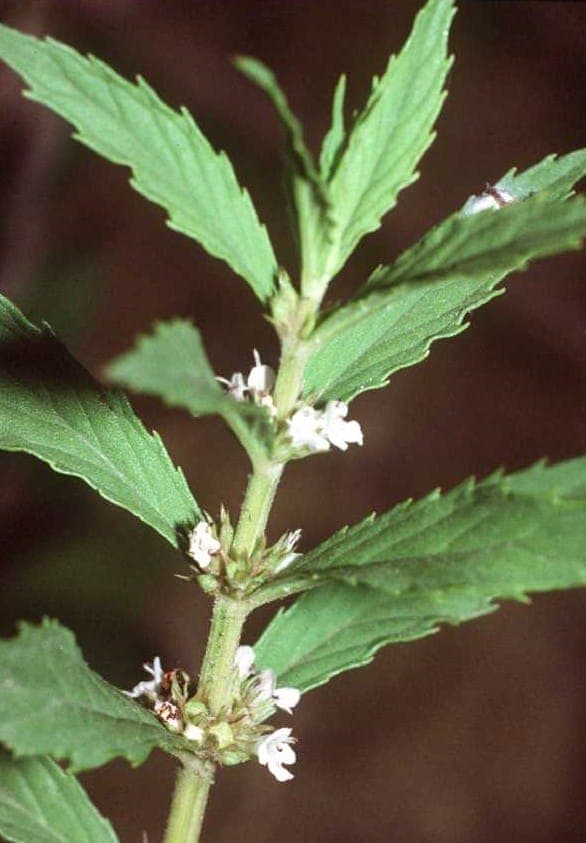
Lycopus asper is an upright, perennial herbaceous plant reaching 30 to 80 cm in height. Its stems are distinctly rough and lightly hairy - a characteristic reflected in the species epithet 'asper', meaning rough or harsh in Latin. The leaves are green, lance-shaped, coarsely toothed, and rough to the touch on both surfaces. Like all members of the mint family, it has characteristically square stems in cross-section. The flowers are small, white to pale pink, and arranged in dense whorls around the stem at each leaf axil. They are modest in size but readily visited by small bees, hoverflies, and other pollinators. The flowering period runs through summer, typically from July to September. The fruits are small, brown nutlets. The plant slowly spreads via underground stolons to form loose clumps over time.
Ideal location
Lycopus asper is a plant for consistently wet, open to lightly shaded positions. In its native range it colonises riverbanks, stream margins, and the edges of marshes, in full sun or with only light shade from surrounding riparian vegetation. In the garden it is perfectly suited to pond margins, wet borders, ditch edges, bog gardens, or rain beds where water collects and drains slowly. It tolerates temporary flooding and does well in positions that stand waterlogged in winter. Avoid dry or heavily fertilised spots - on such ground the plant weakens and flowers poorly. A position in full sun to light partial shade is optimal for the best flowering display.
Soil
The soil preference of Lycopus asper is straightforward: consistently moist to wet, humus-rich, and slightly acid to neutral. It thrives on loamy or clay-based substrates that retain moisture well. A pH range of 6 to 8 is acceptable, though it performs best in the neutral to slightly acid range (pH 6-7). On sandy, dry, or strongly calcareous soils it struggles and will deteriorate quickly. Incorporating peat, rich compost, or clay material around the planting site improves moisture retention. The plant does not require fertilising; a moderately nutrient-poor but moist substrate is ideal and prevents excessive leafy growth at the expense of flowering.
Free design
Want to see Rough bugleweed (Lycopus asper): complete guide in your garden? Make a free design now.
Watering
As a plant of wet habitats, Lycopus asper requires consistent moisture. At a pond margin or ditch edge, supplemental watering is rarely needed. In a conventional border, however, the soil must be kept moist, particularly during dry summer spells. Mulching with organic material helps retain soil moisture and prevents the shallow roots from drying out. During dry summers, watering two to three times per week is necessary for border plantings. In winter, no supplemental watering is required; the plant retreats underground and rests.
Pruning
Lycopus asper requires very little pruning attention. After flowering, the spent stems can be cut back, but they may also be left standing as winter structure and as a food source for seed-eating birds. In early spring - around March - the old, dead stems are cut back to ground level to allow new shoots space to emerge. The plant spreads via stolons and can expand noticeably on fertile, moist ground. When the clump becomes too large, it is easily divided in spring by cutting through the root mass with a spade and removing surplus sections.
Maintenance calendar
March: remove old stems, new stolons becoming visible. April and May: growing season starts, divide if the clump has spread too far. June and July: active growth, check for adequate soil moisture. July to September: flowering period, small white flowers attract pollinators. October: stems can be left standing to provide winter habitat for insects. November to February: rest period, no maintenance required. Use gardenworld.app to plan how pond-margin and bog plants can be integrated into a wider garden design.
Winter hardiness
Lycopus asper is reliably winter-hardy. The species is native to regions that experience severe frost, such as the Canadian prairies and the northern US states, corresponding to USDA hardiness zones 3 to 7. It survives all normal winters across northern Europe without difficulty. The above-ground growth dies back in autumn; the plant overwinters through its rootstock and underground stolons, which remain protected even under prolonged freezing conditions. At a completely frozen pond margin, additional protection is seldom required.
Companion plants
In a wet, naturalistic border or pond-margin planting, Lycopus asper pairs well with a range of moisture-loving species. Lythrum salicaria (purple loosestrife) adds a vivid purple flower spike alongside it. Iris pseudacorus (yellow flag iris) provides height and structural contrast. Caltha palustris (marsh marigold) blooms early in the year and creates bright colour in spring. Mentha aquatica (water mint), a close relative in the same family, belongs naturally at the water's edge. Filipendula ulmaria (meadowsweet) adds a creamy flowering period in June and July. For pollinator value, Eupatorium (joe-pye weed) makes an excellent neighbour.
Closing
Lycopus asper is an undervalued but worthwhile marginal plant for anyone creating a wet, ecologically rich garden. Its modest flowers and robust nature make it an ideal species for pond margins, wet borders, and rain gardens. Specialist aquatic and wetland nurseries are the best places to source it, as it is not commonly stocked at mainstream garden centres. Those building a complete and sustainable marginal planting scheme will find gardenworld.app a valuable tool for visualising and planning the full picture.
Want to see Rough bugleweed (Lycopus asper): complete guide in your garden? Make a free design now.
Upload a photo, pick a style, and get a photorealistic design with plant list in under a minute.
10,000+ gardens designed already
No credit card required


Similar plants
Taperleaf water horehound (Lycopus rubellus): complete guide
Lycopus rubellus
Everything about Lycopus rubellus, the taperleaf water horehound of eastern North America: location, soil, care and use in wet garden borders.
Lycopus europaeus: complete guide
Lycopus europaeus
Discover Water-bugleweed (Lycopus europaeus), a water plant with white flowers and medicinal properties. Learn everything about care in water gardens.