
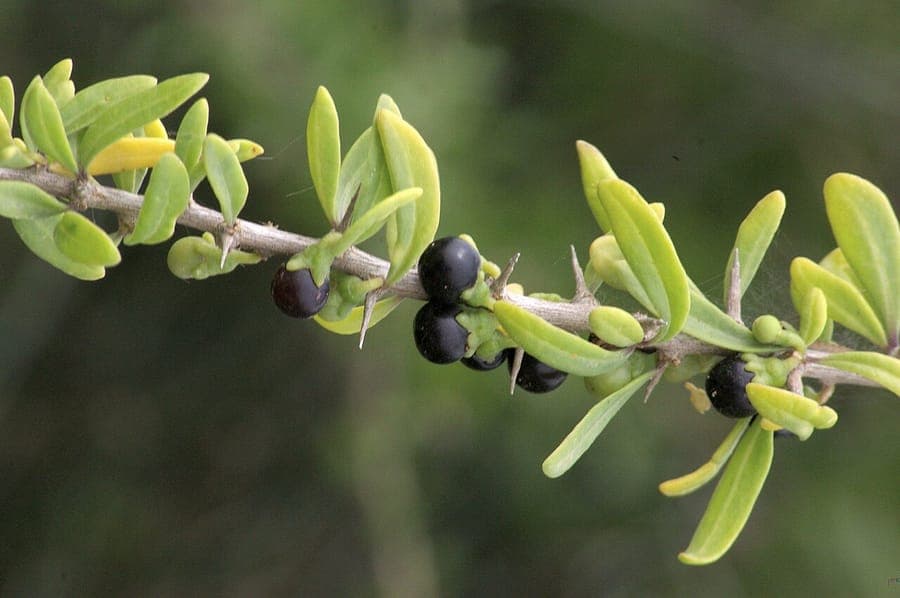
איתן פרמן / CC BY 3.0, via Wikimedia Commons
Schweinfurth's tea-tree: complete guide
Lycium schweinfurthii
Want to see Schweinfurth's tea-tree: complete guide in your garden?
1 minute, no credit card
Overview
Schweinfurth's tea-tree (Lycium schweinfurthii) is a fascinating plant originating from the Mediterranean region, specifically from Sicily to southern and eastern Mediterranean lands. This robust shrub is adapted to dry, warm climates and makes an excellent choice for gardeners seeking a low-maintenance plant with natural charm.
Although this plant belongs to the Solanaceae family, it distinguishes itself from many family members through its extreme tolerance for drought and heat. The plant grows wild in stony, arid environments and therefore offers interesting possibilities for xeriscaping and Mediterranean landscaping.
The plant is also known as Schweinfurth's matrimony vine and has interesting historical connections with ancient tea cultures of the Mediterranean region.
Appearance and bloom
Schweinfurth's tea-tree grows into an open, spreading shrub with a naturally elegant appearance. The plant can reach 1-3 meters in height, depending on growing conditions. The foliage is small, gray-green, and narrow, giving it a characteristic Mediterranean appearance.
The flowers are small and come in purple or lilac tones, though they are less spectacular than many other flowering shrubs. They appear in spring and summer and attract insects. After blooming, small red berries form, providing bird food.
The plant retains its leaves year-round, meaning it is evergreen. The natural, open growth gives the plant an organic appearance without requiring extensive pruning.
Ideal location
Schweinfurth's tea-tree thrives in full sun with at least 6-8 hours of direct sunlight daily. This is not a plant for shady spots; sun is essential for healthy growth and drought tolerance.
The plant prefers excellent drainage and cannot cope well with waterlogged soil. Elevations or slopes are ideal, as heavy rainfall drains away quickly.
This plant works excellently in coastal formations where salty wind is not a problem; indeed, many individuals grow wild in such environments. Winter temperatures below -5 to -10 degrees Celsius can be problematic.
Soil
The plant prefers very well-draining soil, even poor, stony soil. Synthetic supplementation is not necessary and can actually be detrimental. A pH between 6.5 and 8.0 (neutral to slightly alkaline) is ideal.
Heavy potting mixes can create sterile conditions; use sandy or stony mixtures with minimal organic matter instead. Perlite or coco peat can be added for better structure, but add no more than 20-30 percent.
Plants can grow in extremely lean soil without fertilizer, although some basal mineral richness helps. Mulch is not recommended, as it can promote moisture retention, which is undesirable.
Free design
Want to see Schweinfurth's tea-tree: complete guide in your garden? Make a free design now.
Watering
This is a very drought-tolerant plant. Once well established, it can survive months without rain. Young plants, however, need more water until they are fully grown.
When planting, water regularly for the first 2-3 weeks until roots are well established. After that, watering can be significantly reduced.
In containers: water sparingly, only when soil is completely dry. Overwatering is a much greater risk than underwatering for this plant. During growth (spring and summer), water can be given every 2-3 weeks.
In the winter season, practically no watering needed. This plant thrives better under dry conditions than wet conditions.
Pruning
Minimal pruning is needed. The plant has a natural, pleasantly untidy form. Dead branches can be removed and very long growth can be shortened if desired, but aggressive pruning is not recommended.
When necessary, prune after blooming (late summer). Prefer light pruning over drastic cutting. This plant does not tolerate pruning as well as many other shrubs.
Dead wood can be removed year-round. The plant can regenerate, but feels better when disturbed minimally.
Maintenance calendar
Spring: Minimal maintenance, enjoy growth Summer: Occasional brief watering in extreme drought, enjoy bloom Fall: Winter preparation, possibly light pruning Winter: No maintenance needed in dry conditions
Winter hardiness
The plant is reasonably winter hardy. In much of Europe (USDA zones 8-11), it can overwinter outdoors, although warm spots are preferred. Extreme frost below -15 degrees Celsius can cause problems.
Within northern Europe (zones 6-7), protection is recommended. Potted plants can be brought indoors during very cold winters.
Companion plants
Schweinfurth's tea-tree works well with:
- Herb plants (thyme, oregano)
- Lavender (shared Mediterranean aesthetic)
- Salvia (related species, similar notes)
- Calendula (yellow contrast)
- Roses (classic Mediterranean pairing)
Closing
Schweinfurth's tea-tree is a unique plant for gardeners seeking drought-tolerant, low-maintenance structural plants. With very limited care, it thrives in hot, dry environments where many other plants would fail. It's ideal for xeriscaping, Mediterranean gardens, and coastal formations.
Available at major garden centers throughout Europe. Visit gardenworld.app for more inspiration.
Want to see Schweinfurth's tea-tree: complete guide in your garden? Make a free design now.
Upload a photo, pick a style, and get a photorealistic design with plant list in under a minute.
No credit card required


Similar plants
Solanum dolichosepalum: complete guide
Solanum dolichosepalum
Discover Solanum dolichosepalum, an Andean nightshade with striking long sepals. Growing tips, hardiness, and companion planting for your patio.
Solanum ripense: complete guide
Solanum ripense
Discover Solanum ripense, a moisture-loving Andean nightshade for pond edges and conservatories. Growing tips, hardiness, and companions.
Solanum tomentosum: complete guide
Solanum tomentosum
Discover Solanum tomentosum, a thorny South African nightshade with felted leaves. Growing tips, hardiness, and companion planting ideas.