
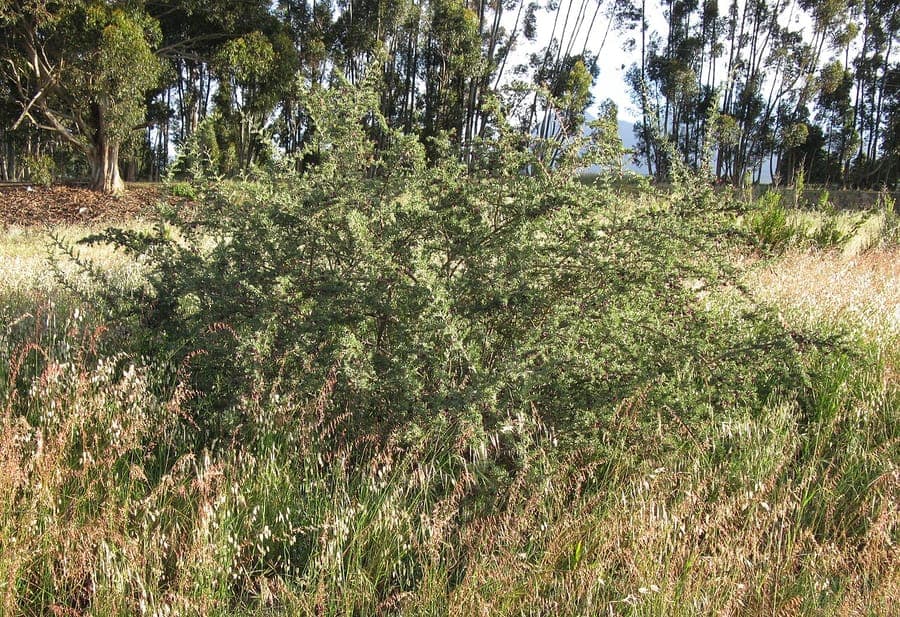
JonRichfield / CC BY-SA 3.0, via Wikimedia Commons
Kaffir boxthorn: complete guide
Lycium afrum
Want to see Kaffir boxthorn: complete guide in your garden?
1 minute, no credit card
Overview
The Kaffir boxthorn, scientifically Lycium afrum, is a beautiful thorn shrub native to South Africa. This plant is known for its purple flowers and robust thorny branches. The Kaffir boxthorn grows as a compact to medium-sized shrub and thrives in dry, well-draining soils.
This plant is particularly suited for Mediterranean gardens and xeric landscapes where it adapts to drought. It is also popular as an ornamental screen or hedge element.
Appearance & bloom
The Kaffir boxthorn grows as a densely branched shrub with fine leaves and striking thorns. The leaves are small and linear. The flowers are small but very beautiful, purple to violet in color, and appear in spring and early summer.
Blooming occurs particularly from April to June. The flowers are followed by small round fruits that turn orange to red.
Ideal location
The Kaffir boxthorn thrives in full sun. Place it in complete sunlight for optimal growth and richest blooming. It thrives in warm, dry locations. In colder climates it may grow better in a more sheltered spot.
A location with good air circulation is pleasant as it prevents diseases.
Soil
The Kaffir boxthorn prefers well-draining soil. Sand, sandy soil and gravel are ideal. Heavy clay or water-holding soils should be improved with sand.
This plant accepts poor soils well. A pH of neutral to slightly alkaline (6.5 to 7) is optimal.
Watering
The Kaffir boxthorn is drought-tolerant after establishment. Water thoroughly once after planting then greatly reduce frequency. In growth periods regular water can help but always ensure soil dries between waterings.
Excessive water is more harmful than too little water for this plant.
Free design
Want to see Kaffir boxthorn: complete guide in your garden? Make a free design now.
Pruning
Regular pruning is not strictly necessary. You can remove damaged or dead branches. Light pruning helps achieve a more compact form without significantly slowing growth.
Remove spent flowers rarely as fruits are decorative.
Maintenance calendar
Spring: Plant grows actively. Add water upon establishment. Check for diseases.
Summer: Plant blooms and bears fruit. Minimize watering. Enjoy the fruits.
Autumn: Plant grows slower. Gradually reduce feeding.
Winter: Plant rests. No special care needed in mild climates.
Winter hardiness
The Kaffir boxthorn is winter hardy to about -8 to -12 degrees Celsius, depending on the specimen. In the Netherlands it can grow outdoors in sheltered locations in mild climate areas but in harsher climates precautions are needed.
In Belgium and Germany extra protection in hard winters may be useful.
Companion plants
The Kaffir boxthorn forms beautiful group plantings with other drought-tolerant plants such as lavender, rosemary and other Mediterranean herbs. It works well as a screen or hedge plant. In rock gardens it adds characteristic sharpness.
Combine with grey-foliaged plants for contrast.
Closing thoughts
The Kaffir boxthorn is a beautiful, robust plant for warm, dry gardens. With minimal care it develops into an attractive plant that blooms for years. For more advice on Mediterranean garden plants visit gardenworld.app.
Want to see Kaffir boxthorn: complete guide in your garden? Make a free design now.
Upload a photo, pick a style, and get a photorealistic design with plant list in under a minute.
No credit card required


Similar plants
Solanum dolichosepalum: complete guide
Solanum dolichosepalum
Discover Solanum dolichosepalum, an Andean nightshade with striking long sepals. Growing tips, hardiness, and companion planting for your patio.
Solanum ripense: complete guide
Solanum ripense
Discover Solanum ripense, a moisture-loving Andean nightshade for pond edges and conservatories. Growing tips, hardiness, and companions.
Solanum tomentosum: complete guide
Solanum tomentosum
Discover Solanum tomentosum, a thorny South African nightshade with felted leaves. Growing tips, hardiness, and companion planting ideas.