
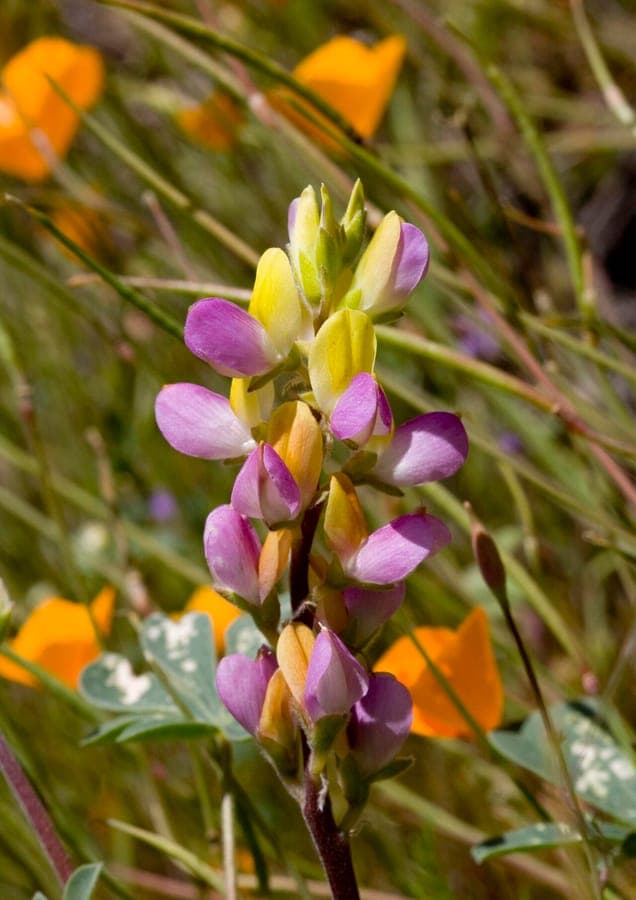
Velo Steve / CC BY-SA 2.0, via Wikimedia Commons
Lupinus stiversii: complete guide
Lupinus stiversii
Want to see Lupinus stiversii: complete guide in your garden?
1 minute, no credit card
Overview
Lupinus stiversii, commonly known as Harlequin lupine or Harlequin annual lupine, is a remarkable annual wildflower native to California. This fast-growing plant is renowned for its spectacular multicolored flowers featuring purple, pink, and white blooms all on the same spike. The species belongs to the Fabaceae family.
This lupine is a unique choice for those seeking something different from typical single-colored lupines. It offers a brief but highly impressive bloom period with an attractive color mix.
Appearance and Bloom
The Harlequin lupine grows to approximately 30 to 50 centimeters in height. The plant forms upright stems with divided, grey-green foliage. The leaf texture is somewhat coarser than many other lupines.
The flowers are the spectacular highlight of this plant: on the same plant, flowers can bloom in purple, pink, and white. This gives the plant its characteristic "Harlequin" name, referencing the colorful costumes of Harlequin figures. The flower spikes are moderately dense and reach approximately 12 to 15 centimeters in length.
The bloom period is brief but intense, usually April through May. Following bloom, small seed pods develop and naturally disperse seeds.
Ideal Location
The Harlequin lupine thrives in very sunny locations receiving at least eight hours of direct sunlight daily. The plant cannot tolerate shade or partial shade and will perform poorly in low-light conditions.
Warm, dry positions are ideal. This plant is perfect for desert-like gardens, dry flower meadows, and open terrain. It also works well in containers with good drainage.
Free design
Want to see Lupinus stiversii: complete guide in your garden? Make a free design now.
Soil
Sandy to gravelly soils are ideal. The Harlequin lupine thrives on very poor soils and actually grows better with minimal fertility. Heavy clay and wet soils must be avoided.
The plant accepts variable pH, though slightly acidic to neutral is preferred. A poor, well-draining soil is far superior to rich, wet soil.
Watering
This annual plant tolerates drought far better than excessive moisture. In nature it grows on minimal rainfall. Sow seed in early spring and provide light water until seedlings are established.
Afterwards, the plant can usually rely on rainwater. Excessive feeding or supplemental water promotes foliage at the expense of flowers.
Pruning
Pruning is unnecessary. This annual plant completes its life cycle in a single season. Spent flowers can be removed for a slightly longer bloom period.
Maintenance Calendar
Spring: Sow seed directly in prepared soil.
Summer: Let the plant grow with minimal intervention.
Autumn: Allow seed pods to ripen and split.
Winter: No plant present.
Winter Hardiness
Winter hardiness does not apply. This is an annual that does not overwinter and dies after seed production. In cold climates, seed will not germinate.
Companion Plants
The Harlequin lupine pairs beautifully with other annual wildflowers:
- Red poppy
- Yellow cosmos-like flowers
- Other lupine species
- Orange calendula
- Blue borage
Closing
Lupinus stiversii offers a unique, multicolored bloom period for dry, sunny gardens. This annual plant is perfect for those wishing to create wild flower meadows in California or Mediterranean style. Resow each spring and enjoy this multicolor flower show! This is why many adore this rare lupine. Build your colorful wildflower mix on gardenworld.app.
Want to see Lupinus stiversii: complete guide in your garden? Make a free design now.
Upload a photo, pick a style, and get a photorealistic design with plant list in under a minute.
No credit card required


Similar plants
Tall Silky Lupine: complete guide
Lupinus elatus
Tall silky lupine is a fast-growing Californian perennial with silvery foliage and blue-purple flower spikes, ideal for a prairie-style garden.
Garfield Lupine: complete guide
Lupinus garfieldensis
The Garfield lupine is a rare, fast-growing American perennial for alkaline, dry grassland gardens, with striking blue flower spikes.
Lupinus elegans: complete guide
Lupinus elegans
Lupinus elegans, the elegant lupine, is a spectacular blooming plant from Mexico with blue flower spikes. Care, cultivation and garden use.