
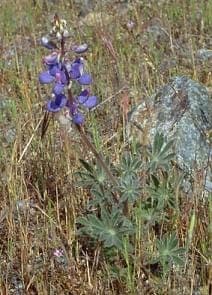
United State Bureau of Land Management / Public domain, via Wikimedia Commons
Lupinus spectabilis: complete guide
Lupinus spectabilis
Want to see Lupinus spectabilis: complete guide in your garden?
1 minute, no credit card
Overview
Lupinus spectabilis, commonly known as Shaggyhair lupine or Shaggy lupine, is a rare and attractive mountain flower native to central California's mountains. This unique lupine is extremely rare in nature and occurs only in specific highland areas of California. The species is renowned for its distinctive heavily-haired leaves and stems, justifying its common name.
This lupine is a prized addition for serious plant collectors and alpine gardeners who enjoy cultivating botanical rarities. The plant is hardy and can thrive for many years under suitable conditions.
Appearance and Bloom
The Shaggyhair lupine forms a compact, bushy plant reaching approximately 20 to 40 centimeters in height. The most characteristic feature is the dense hairiness on stems, petioles, and leaf margins. This gives the plant a distinctly rough, hairy appearance that strikingly contrasts with smooth-leaved lupines.
The divided leaves are narrow and fine, displaying the same hairiness as the rest of the plant. This hairiness apparently serves as protection against ultraviolet radiation and water loss in mountain climates.
Flowers appear in moderately compact spikes displaying purplish-blue to violet tints. The bloom period extends from May through July, depending on elevation and snowmelt timing.
Ideal Location
The Shaggyhair lupine thrives best in full sun at dry, rocky locations. Alpine rock gardens, mountain slopes, and well-drained raised beds are ideal. The plant tolerates windy conditions better than most lupines.
The plant requires good air circulation, so do not position it densely against other plants. Open, rocky terrain with some shelter from extreme wind is perfect.
Free design
Want to see Lupinus spectabilis: complete guide in your garden? Make a free design now.
Soil
Sandy to stony soil with excellent drainage is essential. Shaggyhair lupine grows naturally on very poor, silica-rich soils. A mixture of garden soil with sand and gravel in a 1:1:1 ratio is ideal.
The plant tolerates acidic to neutral pH. Avoid heavy clay and water-retaining soils entirely, as these will certainly cause failure.
Watering
Once well-established, this mountain flower is moderately drought-tolerant. During the first growing season, provide regular water so the soil remains moist but never wet. This is critical!
At maturity, minimal supplemental water is needed. The plant tolerates mild drought well but abhors wet feet. In winter, excessive moisture can be problematic.
Pruning
Pruning is unnecessary. If spent flowers are removed, this can stimulate additional bloom production, but it is not essential. Seed pods can be left on the plant.
Maintenance Calendar
Spring: Check for slugs and birds. Water carefully.
Summer: Remove spent flowers if desired. Ensure good drainage.
Autumn: Allow seed pods to ripen. Begin careful drying.
Winter: The plant rests fully. Do not water unless very wet conditions occur (less is better).
Winter Hardiness
The Shaggyhair lupine is hardy to approximately -15 degrees Celsius with proper precautions. In very wet winters, frost damage can occur. Well-drained growing location and prevention of water around the crown in winter are essential.
Companion Plants
The Shaggyhair lupine combines beautifully with other alpine rarities:
- Alpine roses
- Mountain sedums
- Alpine alpines
- Alpine sage
- Mountain dwarf plants
Closing
Lupinus spectabilis is an exceptional mountain flower for those willing to provide special care. This rare plant requires perfect drainage and careful water management but rewards the grower with unique, hairy beauty. This is a true rarity in the lupine world. Purchase seed through specialized alpine plant seed suppliers. Enjoy this scarce jewel in your alpine garden. Build your rarities collection on gardenworld.app.
Want to see Lupinus spectabilis: complete guide in your garden? Make a free design now.
Upload a photo, pick a style, and get a photorealistic design with plant list in under a minute.
No credit card required


Similar plants
Tall Silky Lupine: complete guide
Lupinus elatus
Tall silky lupine is a fast-growing Californian perennial with silvery foliage and blue-purple flower spikes, ideal for a prairie-style garden.
Garfield Lupine: complete guide
Lupinus garfieldensis
The Garfield lupine is a rare, fast-growing American perennial for alkaline, dry grassland gardens, with striking blue flower spikes.
Lupinus elegans: complete guide
Lupinus elegans
Lupinus elegans, the elegant lupine, is a spectacular blooming plant from Mexico with blue flower spikes. Care, cultivation and garden use.