
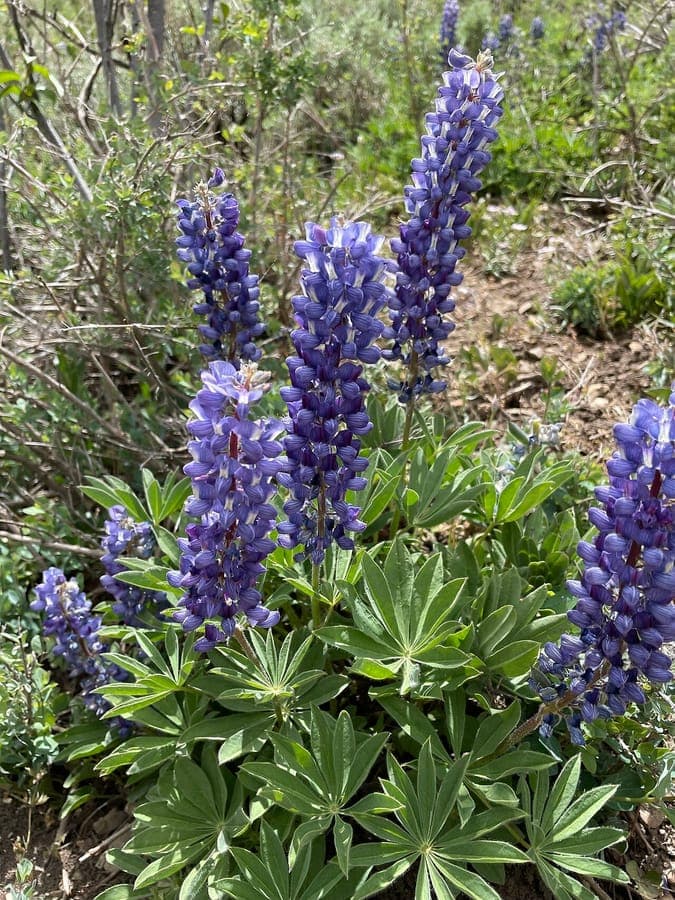
Matt Berger https://www.inaturalist.org/people/sheriff_woody_pct / CC BY 4.0, via Wikimedia Commons
Hairy bigleaf lupine: complete guide
Lupinus prunophilus
Want to see Hairy bigleaf lupine: complete guide in your garden?
1 minute, no credit card
Overview
The hairy bigleaf lupine (Lupinus prunophilus) is a robust North American perennial found naturally across the western and west-central United States, including Oregon, Washington, Colorado, Nevada, Utah, Wyoming, Montana and New Mexico. A member of the pea family, Fabaceae, it improves soil fertility through nitrogen fixation by root nodule bacteria - a trait shared across the lupine genus. Described by botanist M.E. Jones in 1910, it has also been known under earlier names including Lupinus amplus and Lupinus polyphyllus var. prunophilus, reflecting its close relationship with the familiar garden lupine.
The species name prunophilus refers botanically to a resemblance of the leaves to those of Prunus (plum), highlighting the characteristically broad, lush leaf structure. For gardeners who want a lupine that steps away from standard hybrid cultivars available at most garden centres, the hairy bigleaf lupine offers both botanical authenticity and impressive garden presence.
At gardenworld.app you will find garden designs demonstrating how North American perennials like this lupine can be woven into a coherent and beautiful front or back garden planting.
Appearance and bloom cycle
Lupinus prunophilus is a striking herbaceous perennial forming a robust clump of several strongly upright stems. At its best it reaches heights comparable to cultivated lupine hybrids, with broad, palmately compound leaves that give the plant a lush, full appearance. The leaflets are relatively wide compared to many other wild lupine species, finely hairy on the underside and green to greyish-green in colour.
Flowers appear on substantial upright racemes showing the butterfly-flower architecture characteristic of the Fabaceae family: a wide banner, two wing petals and a keel. Flower colour is blue-purple to violet, sometimes with a lighter throat or yellow markings on the banner. In its native mountain habitats it blooms from May through summer depending on elevation. In temperate European gardens, the main flowering period falls in May and June.
After flowering, hairy seed pods develop. When ripe they split open and scatter seed - a welcome self-seeding tendency in a naturalistic border, where the plant can gradually colonise open ground around it.
Ideal location
In its natural range this lupine grows on open, sunny sites: mountain meadows, forest edges, rocky slopes and occasionally along stream banks. In the garden this translates to a preference for full sun or very light partial shade, with at least five to six hours of direct sunlight per day for good flowering performance.
Good air circulation around the plants is important: in sheltered, still corners lupines can develop powdery mildew during warm, humid summers. Choose a more open position in the border. A south- or south-west-facing bed with some shelter from harsh northerly winds produces the best results.
Soil
Growth data indicate a pH range of 5 to 7.5, giving this lupine a broad soil adaptability from slightly acidic to slightly alkaline. As a nitrogen fixer it has limited nutrient requirements. Rich, heavily fertilised soils actually work against it, encouraging excess leaf and stem growth at the expense of flowering.
The single most important factor is drainage: waterlogged roots are fatal. On heavy clay soil, work in coarse sand or perlite to improve permeability. Light sandy or loamy soils are ideal. In containers, use a standard compost mix with a generous proportion of perlite or coarse grit. The pH range of 5 to 7.5 covers most temperate garden soils.
Watering
Once established, the hairy bigleaf lupine is reasonably drought-tolerant, consistent with its origins in the semi-arid mountain regions of western North America. In the first growing season, consistent moisture helps the plant develop a strong root system.
From the second year onwards, normal rainfall is usually sufficient in most temperate climates. During extended dry spells in summer - more than ten to fourteen days without rain - supplementary watering is sensible. Always water at the base of the plant, never over the foliage, to reduce the risk of fungal disease. A deep, thorough weekly soak is more effective than small daily amounts.
Avoid waterlogging: on poorly drained soils the plant is more vulnerable to root rot, particularly in wet winters. On light, well-drained soils, overwatering is rarely a problem.
Free design
Want to see Hairy bigleaf lupine: complete guide in your garden? Make a free design now.
Pruning
Little needs to be done before flowering. After blooming, once the racemes lose their colour, you have a choice: cut spent spikes back to the basal foliage promptly to encourage a second, smaller flowering flush, as many lupines respond well to quick deadheading. Alternatively, allow the pods to ripen if you want to collect seed or encourage self-seeding - harvest the pods before they split open for the cleanest seed collection.
In autumn, when the foliage dies back, cut the stems down close to the ground but leave some hollow stems in place through winter as nesting habitat for solitary bees and other beneficial insects. Clear away the dead growth in February or March when new basal shoots begin to emerge.
Maintenance calendar
January-February: Rest period; light mulch around the base during sustained frost. March: Remove last season's dead stems; watch for new basal growth. April: Thin self-sown seedlings if the colony is becoming overcrowded. May-June: Peak flowering period; bumblebees and bees visit intensively. June-July: Deadhead spent spikes for possible second bloom, or leave pods to ripen. August: Monitor for drought; deep-water at the base if more than ten days without rain. September-October: Foliage dies back gradually as the plant withdraws to its roots. November-December: Full dormancy; leave hollow stems for overwintering insects.
Winter hardiness
The hairy bigleaf lupine is a true perennial that overwinters as a root system. Its native distribution across states known for severe winters, including Montana and Wyoming, indicates strong cold tolerance. The species falls in USDA hardiness zones 4 to 7, making it suitable for most temperate garden climates.
Above-ground parts die back with frost - this is completely normal. Roots survive underground and reshoot in spring. On well-drained soils the plant typically overwinters without problems. On heavy, wet soils, crown and root rot are a risk in prolonged wet winters. A mulch layer of 5 to 8 cm around the base in November provides extra insulation and improves soil structure as it breaks down over winter.
Companion plants
The hairy bigleaf lupine suits a naturalistic or semi-wild border alongside perennials with similar site preferences. Natural partners include meadow cranesbill (Geranium pratense), yarrow (Achillea millefolium), oxeye daisy (Leucanthemum vulgare) and tufted vetch (Vicia cracca). Ornamental grasses such as Deschampsia cespitosa or Molinia caerulea provide good structural contrast.
Yellow day lilies (Hemerocallis) look striking alongside the blue flowers of the lupine. For a pollinator-focused planting, combine with wild marjoram (Origanum vulgare), Agastache and Echium to create a long sequence of bloom that supports diverse bee species. Avoid very compact, low-growing ground covers planted directly against the lupine, as they compete for space and moisture in the root zone.
For more inspiration on combining naturalistic perennials in a beautiful garden design, visit gardenworld.app where personalised planting plans are developed to match your soil, climate and personal style.
Closing
The hairy bigleaf lupine is a robust, ecologically valuable perennial that produces an impressive display of flowers year after year with minimal care. Its nitrogen-fixing roots benefit the surrounding soil and neighbouring plants. The large, colourful flower racemes are a magnet for bumblebees and other pollinators, making it an excellent choice in a biodiversity-friendly garden. Give it a sunny, well-drained position on lean to moderately fertile soil and it will reward you season after season with wild, authentic beauty.
Want to see Hairy bigleaf lupine: complete guide in your garden? Make a free design now.
Upload a photo, pick a style, and get a photorealistic design with plant list in under a minute.
10,000+ gardens designed already
No credit card required


Similar plants
Plumas lupine: complete guide
Lupinus onustus
Full guide to Plumas lupine (Lupinus onustus): location, soil, watering, pruning and garden design for UK and US gardens.
Washington lupin: complete guide
Lupinus polyphyllus
Everything you need to know about Washington lupin (Lupinus polyphyllus): care, planting, bloom season, and ideal garden companions for vibrant summer borders.
Lupinus argenteus: complete guide
Lupinus argenteus
Lupinus argenteus brings silvery shine and beautiful blue flowers to your garden. Read everything about this American flower.