
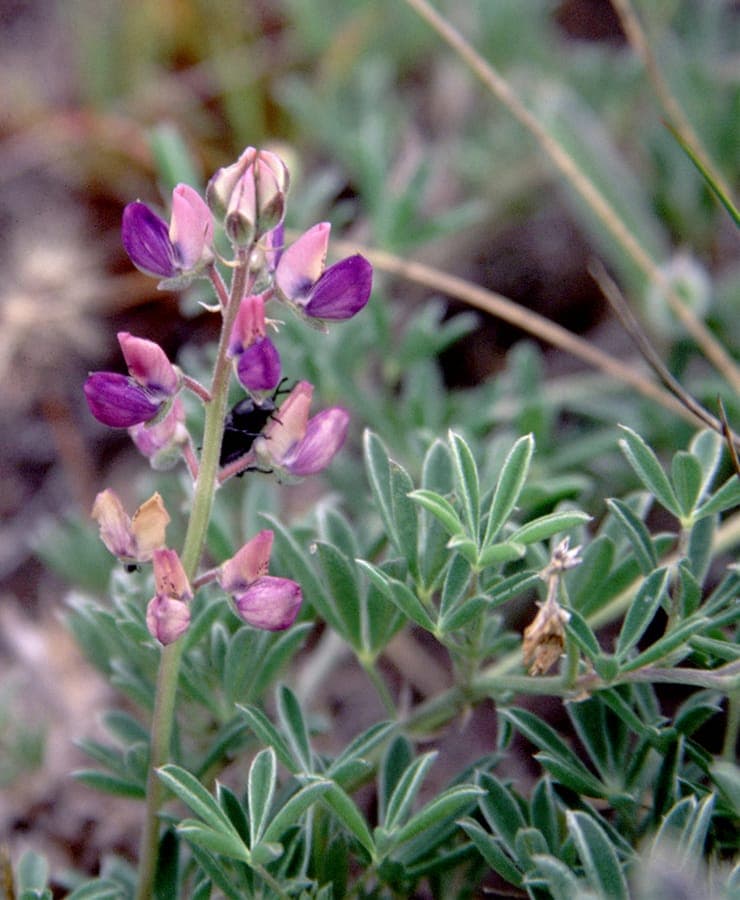
Gordon Leppig & Andrea J. Pickart / Public domain, via Wikimedia Commons
Lupinus littoralis: complete guide
Lupinus littoralis
Want to see Lupinus littoralis: complete guide in your garden?
1 minute, no credit card
Lupinus littoralis, known as Seashore Lupine in English and Lupin des rivages in French, is an enchanting wildflower originating from the coastal shores of western North America. This plant belongs to the Fabaceae family (pea family) and grows naturally from British Columbia along the Pacific coast to northern California and western Oregon. The plant is a short-lived to semi-permanent perennial that adapts perfectly to salt, windy, and dry coastal areas and sand dunes.
Appearance and Bloom
Lupinus littoralis reaches 30 to 60 centimetres in height and forms dense tufts of finely divided foliage, characteristic of the Lupinus genus. Leaves are palmately compound, with 7 to 9 narrow, linear leaflets spreading like fingers from a hand. Foliage is grey-green to silvery in colour, perfectly suited to dry growing conditions.
The primary attraction is undoubtedly the flowers. From June to August (depending on season), dense, upright flower spikes (racemes) appear at stem tips. Each spike is 20 to 40 centimetres long and consists of dozens of small, two-lipped flowers in deep blue to purple-blue shades. Flowers display the characteristic pea-flower form with prominent standard and banner petals. The spikes are highly visible and attract pollinators effectively.
After blooming, seed pods form. The plant contains alkaloids in its seed and young leaves, so raw consumption is inadvisable.
Ideal Location
Lupinus littoralis grows best in full sun, requiring 6 to 8 hours direct sunlight daily. In shade, the plant grows weakly and blooms poorly. The plant is highly adaptable to windy conditions, something important given its coastal-stream origin.
The plant grows in USDA zones 7 to 9 (winter temperature -17°C to -1°C), so it grows better in southern European regions, but can also grow in more temperate zones. In Netherlands and Belgium, it can be cultivated, though very cold winters may damage it.
The plant naturally grows in sandy, gravelly, salt-tolerant soils near seashores. In gardens, it thrives in well-drained, slightly drier locations. It is ideal for coastal garden styles, Mediterranean borders, dry rock walls, and xeriscaping projects.
Soil Requirements
Lupinus littoralis grows in virtually all soils provided drainage is excellent. The plant hates moisture stagnation and will quickly develop root rot in heavy, wet soils. In clay soils, add abundant sand, gravel, and compost for drainage.
The plant tolerates salt in soil (hence its coastal origin) and thus grows in slightly saline gardens. Acidic to neutral soil is acceptable; very alkaline soil may be problematic.
In containers, use draining seed compost mixed with coarse sand in a 1:1 ratio.
Watering Practices
Once established, Lupinus littoralis is extremely drought-tolerant and can grow for years without supplementary watering. During the growing period (April to June, before flowering), provide moderate watering if natural rainfall is lacking. After blooming (July-August), extra water is unnecessary.
In very dry, hot summers, you may provide light watering every 2 to 3 weeks, but preventing excess moisture is essential. The plant suffers more from excessive water than from too little.
In winter, almost no watering is needed. Ensure soil never remains constantly wet.
Free design
Want to see Lupinus littoralis: complete guide in your garden? Make a free design now.
Pruning and Maintenance
Lupinus littoralis requires minimal pruning. You can cut spent flower spikes to prevent further seed setting and keep the plant tidy. This sometimes stimulates secondary flowering. After the blooming period, you can remove dead stem material.
The plant is not long-lived (usually 5 to 10 years) and naturally dies after several years, especially in warm climates. This is normal behaviour; ensure it produces seed if you want recurrence.
Maintenance Calendar
April-May: Growing period. Moderate water if needed. No feeding necessary.
June-August: Flowering. Enjoy blue flower spikes. Cut spent blooms.
September-October: Seed formation. Ensure seed ripens. Reduce watering.
November-March: Dormancy. No water needed in normal winters.
Winter Hardiness
Lupinus littoralis is fairly frost-hardy in USDA zones 7 to 9, surviving winter temperatures to approximately -17°C. In very cold winters (below -20°C), plants may be damaged. In Netherlands, it is at the boundary of hardiness; in warm years or warm locations, it grows well; in cold winters, it may die.
Ensure well-drained soil - frozen water in wet soil can be fatal. Light dry mulch in very cold areas may help, but over-mulching can cause moisture problems.
The plant grows better in southern gardens and warm microclimates.
Companion Plants
Lupinus littoralis pairs beautifully in dry borders and alpine gardens with other drought-tolerant flowers. Ideal companions include sunflowers, lavender, silvery Artemisia, low rosemary, gaura, and other drought-tolerant bloomers. Ensure companions have the same water needs.
In Mediterranean or coastal garden styles, a grouping of lupines creates a lovely focal point. Blue flowers contrast well with the grey foliage of silver-artemisia and silver-foliaged plants.
It also grows well on rocky slopes, dry gravel paths, and between stones.
Propagation
Lupinus littoralis grows easily from seed. Seed requires cold stratification (winter preparation): plant seed in late autumn or allow seed to overwinter. You can also chill seed in refrigerator for 4 weeks before sowing. Seeds germinate in 2 to 4 weeks at room temperature.
The plant produces seed that self-sows naturally in appropriate conditions. For recurrence, allow seed formation and natural self-seeding.
Conclusion
Lupinus littoralis is a beautiful wildflower for gardeners with dry, sunny locations. Its blue flower spikes, silvery foliage, and adaptability to wind and salt make it ideal for coastal garden styles, dry borders, and alpine gardens. Provide good drainage and a sunny, windy spot, and you will enjoy years of flowering pleasure.
Gardenworld.app helps you find ideal growing conditions for Lupinus littoralis. Questions about dry soil or coastal styles? Visit gardenworld.app for more guidance.
Want to see Lupinus littoralis: complete guide in your garden? Make a free design now.
Upload a photo, pick a style, and get a photorealistic design with plant list in under a minute.
10,000+ gardens designed already
No credit card required


Similar plants
Tall Silky Lupine: complete guide
Lupinus elatus
Tall silky lupine is a fast-growing Californian perennial with silvery foliage and blue-purple flower spikes, ideal for a prairie-style garden.
Garfield Lupine: complete guide
Lupinus garfieldensis
The Garfield lupine is a rare, fast-growing American perennial for alkaline, dry grassland gardens, with striking blue flower spikes.
Lupinus elegans: complete guide
Lupinus elegans
Lupinus elegans, the elegant lupine, is a spectacular blooming plant from Mexico with blue flower spikes. Care, cultivation and garden use.