
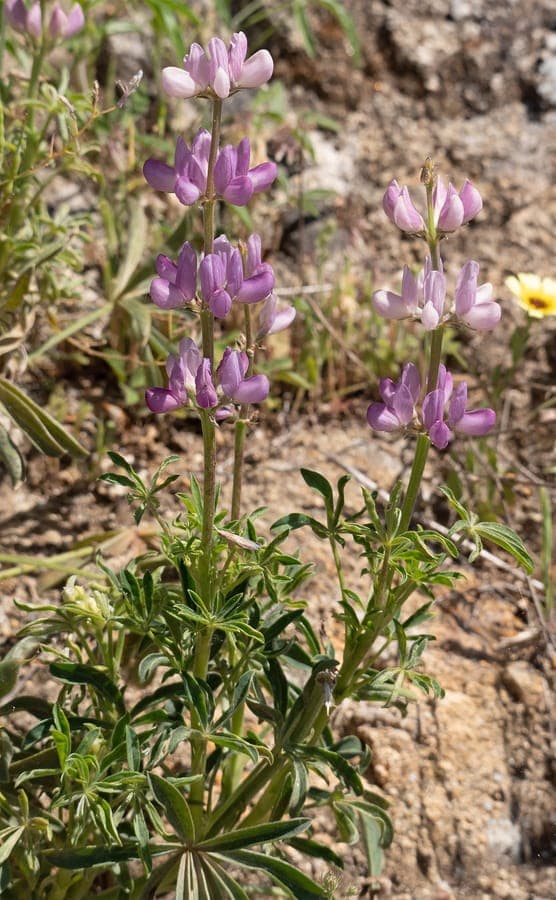
Luis Fernández García / CC BY-SA 4.0, via Wikimedia Commons
Spanish lupine: complete guide
Lupinus hispanicus
Want to see Spanish lupine: complete guide in your garden?
1 minute, no credit card
Overview
Spanish lupine (Lupinus hispanicus), also called Iberian lupine, is a striking Mediterranean perennial native to the Iberian Peninsula. This robust garden plant grows naturally in mountain meadows and dry slopes of Spain and Portugal, having adapted to hot, dry summers and cold winters. With spectacular blue flower spikes and nitrogen-fixing root systems, it makes a valuable addition to borders and wild-style gardens.
Appearance and Bloom
Spanish lupine forms upright, branching plants of 50-80 centimetres tall with beautiful palmate compound foliage. The leaves are grey-green and hairy. Flowers appear from April through June in dense, elongated racemes. Individual flowers are deep blue to violet-blue, some cultivars feature white markings or pink tints. Flower spikes can reach 20-30 centimetres in length. The plant attracts pollinators with its abundant nectar.
Ideal Location
Spanish lupine performs best in full sun locations. A minimum of six to eight hours of direct sunlight daily is essential for rich flowering. Partial shade is acceptable but leads to fewer flowers. The plant appreciates well-drained, slightly elevated positions.
Soil Requirements
Soil must be well-draining, preferably sandy to stony. Heavy clay causes root rot. Spanish lupine thrives on moderately fertile soils, even on poor sands. It prefers acidic pH, neutral to slightly acidic is optimal. Its nitrogen-fixing roots improve soil fertility naturally.
Free design
Want to see Spanish lupine: complete guide in your garden? Make a free design now.
Watering
Once established, Spanish lupine requires minimal supplemental watering. During the growing season, water when the upper soil layer becomes dry. In autumn and winter, restrict watering. The plant tolerates drought better than excessive moisture.
Pruning and Maintenance
After blooming, deadhead spent racemes to encourage secondary flowering. In early spring, remove dead stems. Spanish lupine thrives on poor soils and prefers not being over-pruned. Growth aggressiveness is moderate.
Maintenance Calendar
March/April: Growing season begins, remove dead foliage. April-June: Peak bloom, deadhead regularly. July-August: Growth slows, minimal watering. September-October: Winter preparation. November-February: Dormancy, protective structure remains.
Winter Hardiness
Spanish lupine is reasonably hardy to USDA zone 8 (-12 to -7 degrees Celsius) and suits many European gardens. In much colder zones, provide mulch protection. In maritime regions with milder winters, it thrives excellently.
Companion Planting
Spanish lupine pairs beautifully with other Mediterranean herbs and drought-tolerant perennials. For colour contrast, plant with yellow bloomers, pink geraniums, and lavender. Wild tulips make excellent spring companions.
Closing Thoughts
Spanish lupine delivers spectacular flowering and nutritional contributions. Once established, it truly demands minimal attention. Find young plants at major garden retailers. Learn more at gardenworld.app/en and gardenworld.app/nl.
Want to see Spanish lupine: complete guide in your garden? Make a free design now.
Upload a photo, pick a style, and get a photorealistic design with plant list in under a minute.
No credit card required


Similar plants
Tall Silky Lupine: complete guide
Lupinus elatus
Tall silky lupine is a fast-growing Californian perennial with silvery foliage and blue-purple flower spikes, ideal for a prairie-style garden.
Garfield Lupine: complete guide
Lupinus garfieldensis
The Garfield lupine is a rare, fast-growing American perennial for alkaline, dry grassland gardens, with striking blue flower spikes.
Lupinus elegans: complete guide
Lupinus elegans
Lupinus elegans, the elegant lupine, is a spectacular blooming plant from Mexico with blue flower spikes. Care, cultivation and garden use.