
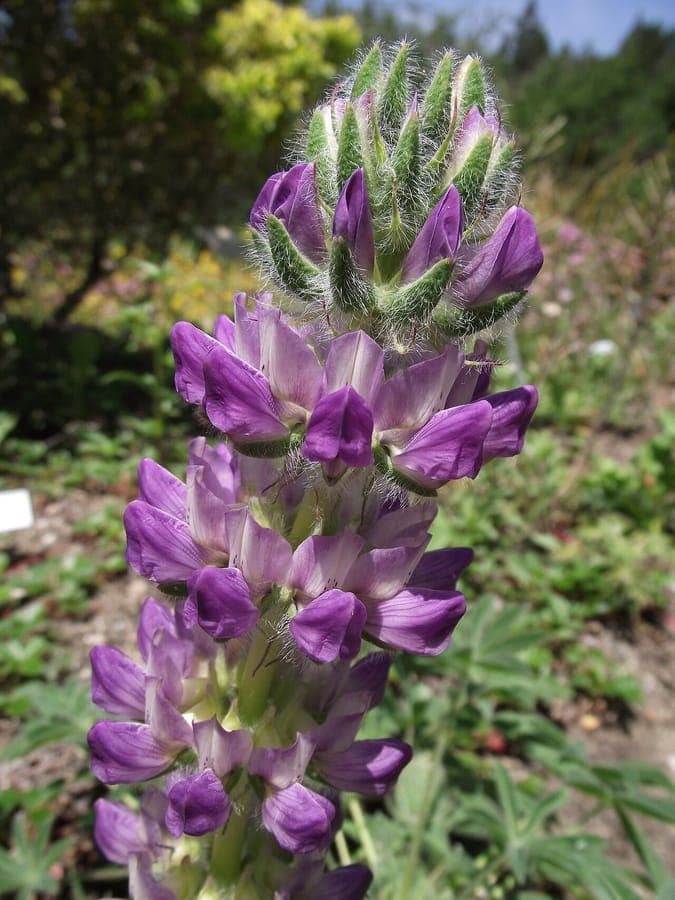
Stickpen / CC0, via Wikimedia Commons
Lupinus densiflorus: complete guide to Whitewhorl lupine
Lupinus densiflorus
Want to see Lupinus densiflorus: complete guide to Whitewhorl lupine in your garden?
1 minute, no credit card
Overview
Lupinus densiflorus, known as Whitewhorl lupine, is a fascinating semi-shrubby lupine native to the Pacific Northwest coast of North America. The species naturally occurs from southeastern Vancouver Island to northwestern Baja California, spanning an extensive region. This lupine belongs to the legume family (Fabaceae) and distinguishes itself through its dense, compact flower spikes.
This is a highly adaptable species that functions well in many different growing conditions. In temperate climates, the plant thrives readily. Once established, the plant is quite self-reliant and demands minimal intensive management.
Appearance & Bloom
The Whitewhorl lupine grows to 60-75 centimeters height and forms a compact, semi-evergreen shrub. The foliage is very characteristic of lupines: feathery, soft to touch, with many small fingered leaflets on a central rachis.
Flowers grow in exceptionally dense, short spikes - hence the scientific name "densiflorus" (densely flowering). Blooms display colors from white to cream, sometimes with light purple or pinkish accents at the center. This contrast gives the plant its common name.
Individual flowers follow the papilionaceous form of legumes, always small but numerous. The blooming period extends from late spring through early summer. Following flowering, small hairy pods develop containing seeds.
The plant is semi-evergreen in mild climates, offering interesting foliage even outside the blooming season.
Ideal Location
This lupine thrives in full sun, meaning at least 6-8 hours of direct sunlight daily. In shade, blooming becomes noticeably reduced. Partial shade is tolerated but not ideal.
Wind exposure poses no problem. In fact, the plant naturally grows in windy coastal areas, weathering wind well.
Drainage is absolutely critical. Waterlogging is devastating. Slopes and raised beds are ideal.
Soil Requirements
The Whitewhorl lupine is extremely undemanding regarding soil nutrients. Like all lupines, it forms a symbiosis with nitrogen-fixing bacteria in its roots. This means artificial nitrogen fertilizers are unnecessary.
What is crucial is that the soil drains well. Heavy clay soils can be improved with sand and organic matter. For optimal growth, the plant prefers a pH between 6 and 7.
Proper soil preparation makes a significant difference. Mix compost and organic material to at least 30 centimeters depth.
Free design
Want to see Lupinus densiflorus: complete guide to Whitewhorl lupine in your garden? Make a free design now.
Watering
Once established, the Whitewhorl lupine is fairly drought-tolerant. In the first growing year, provide regular water until roots are well-established. This might be every 3-4 days.
Once the plant is established, water needs decrease significantly. In temperate climates with adequate soil moisture, supplementary water is usually unnecessary after the first growing year.
Always guard against water stagnation, the plant's greatest enemy.
Pruning
Pruning is not essential, but you can lightly cut back the plant after flowering. This promotes more compact growth. Remove dead or diseased branches whenever noticed.
After flowering, you can remove seed-bearing pods, which may contribute to extended blooming. However, this requires considerable handwork.
Use sharp, clean tools to prevent damage and disease transmission.
Maintenance Calendar
Spring: Check that the plant emerged well from winter. Remove dead wood. Perform light shape pruning. Begin regular watering.
Summer: Flowering period is in full glory. Ensure adequate water. After flowering, seed pods can be removed.
Fall: Growth slows. Gradually reduce watering. Apply no more fertilizer.
Winter: In frost zones, protection may be needed. In milder climates, the plant can remain outdoors.
Winter Hardiness
The Whitewhorl lupine is well winter hardy in temperate climates. In many European regions, it survives outdoor winter on well-drained sites. The plant originates from cool temperate zones, so frost can be tolerated.
In very severe winters, protection can be helpful, such as applying mulch around the base and possibly jute wrapping.
Companion Plants
Other interesting Lupinus species include L. perennis (perennial lupine), highly hardy, and L. polyphyllus (turk's cap). Also Californian wildflowers like Achillea and Eschscholzia pair well.
For height and structure: Limonium, Artemisia, and sedums are wonderful companions.
Conclusion
Lupinus densiflorus is a beautiful plant for those who love compact, densely-flowering structures. The off-white to cream color with subtle markings provides elegance. For seeds and plants, consult specialized retailers, and visit gardenworld.app for inspiration and design ideas.
Want to see Lupinus densiflorus: complete guide to Whitewhorl lupine in your garden? Make a free design now.
Upload a photo, pick a style, and get a photorealistic design with plant list in under a minute.
No credit card required


Similar plants
Tall Silky Lupine: complete guide
Lupinus elatus
Tall silky lupine is a fast-growing Californian perennial with silvery foliage and blue-purple flower spikes, ideal for a prairie-style garden.
Garfield Lupine: complete guide
Lupinus garfieldensis
The Garfield lupine is a rare, fast-growing American perennial for alkaline, dry grassland gardens, with striking blue flower spikes.
Lupinus elegans: complete guide
Lupinus elegans
Lupinus elegans, the elegant lupine, is a spectacular blooming plant from Mexico with blue flower spikes. Care, cultivation and garden use.