
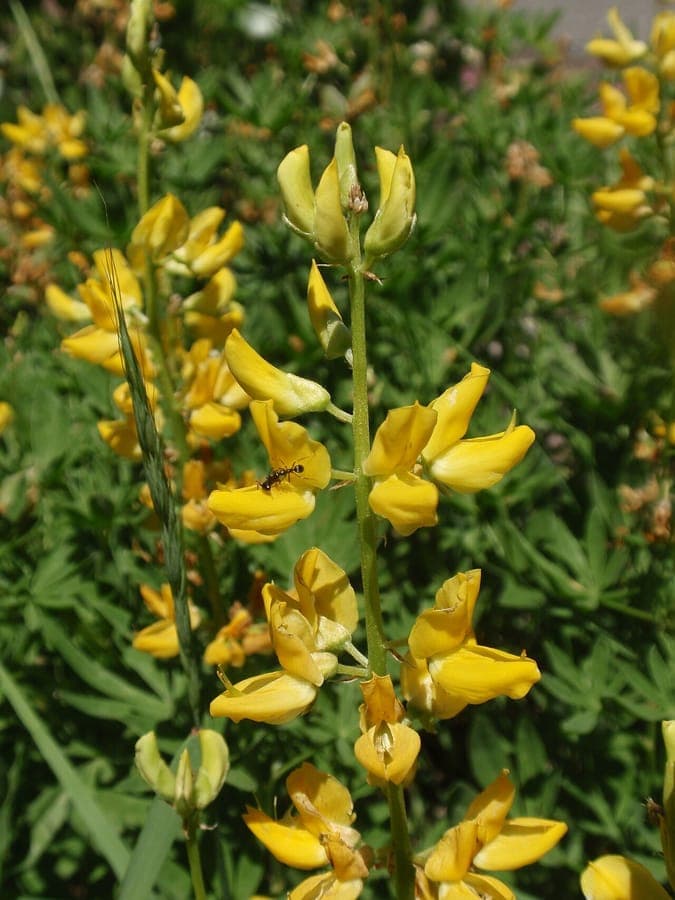
Tom Hilton / CC BY 2.0, via Wikimedia Commons
Lupinus croceus: complete guide to Saffron-flowered lupine
Lupinus croceus
Want to see Lupinus croceus: complete guide to Saffron-flowered lupine in your garden?
1 minute, no credit card
Overview
Lupinus croceus, commonly known as Saffron-flowered lupine, is an enchanting annual plant native to California. This lupine belongs to the legume family (Fabaceae) and distinguishes itself through its warm, golden-yellow flowers. Among the many Lupinus species, this one is certainly among the sunniest-looking.
As an annual plant, Lupinus croceus grows quickly and reaches maturity rapidly during the growing season. This makes it ideal for gardeners wanting immediate results. Moreover, the plant is relatively easy to grow from seed, allowing you to experiment with different sowing times.
Appearance & Bloom
The Saffron-flowered lupine reaches heights of 40-60 centimeters, small enough for many garden locations yet substantial enough to make an impact. The foliage is very characteristic of the Lupinus genus: feathery, soft to the touch, with numerous small leaflets.
Flowers grow in compact spikes rising above the foliage. Unlike many other lupines that display purple or blue hues, this species exhibits warm golden-yellow and sometimes orange-yellow tones. This makes it highly conspicuous in the garden. Individual flowers follow the papilionaceous pattern typical of legumes.
The blooming period extends over several weeks, usually from late spring through early summer. After flowering, small hairy pods develop containing abundant seeds. These seeds are easily harvested and can be resown year after year.
Ideal Location
This lupine grows optimally in full sun, meaning at least 6 hours of direct sunlight daily. In complete shade, the plant will become leggy with minimal flowering. It tolerates partial shade but will not flower as profusely.
Wind exposure poses no problem. The plant naturally grows under windy conditions in California.
Site selection is less critical than with perennials, since this is only an annual that can be resown the following season.
Soil Requirements
The Saffron-flowered lupine is extremely undemanding regarding soil. Actually, it thrives best in poorer soils. This is typical of lupines - they need little artificial fertilizer due to their nitrogen-fixing abilities.
Drainage is quite important. Soil retaining excessive water will lead to root rot. Heavy clay can be improved with sand and organic matter.
The plant thrives in both acidic and neutral conditions, so pH is not critical. A pH between 5.5 and 7.5 works well.
Free design
Want to see Lupinus croceus: complete guide to Saffron-flowered lupine in your garden? Make a free design now.
Watering
Once seedlings emerge, they require minimal water. After seed germination and initial establishment, water only occasionally when soil begins to dry. This plant dislikes waterlogging.
Many regions provide sufficient spring rainfall that supplementation is unnecessary. During dry spells, however, provide careful watering.
Once the plant is larger and approaching flowering, water when the soil surface feels dry.
Pruning
Pruning is unnecessary. However, removing spent flowers (deadheading) can extend the flowering period by preventing the plant from channeling all its energy into seed production.
If you wish to harvest seeds for next season, allow some pods to mature. This is actually one of the pleasures of annual lupines - they provide their own seed supply.
Maintenance Calendar
Spring: This is the season for sowing. Direct seed into the ground from April-May when soil has warmed. Lightly weed between seedlings.
Summer: The plant grows and flowers abundantly. Provide occasional water during dry spells. Removing spent flowers can extend blooming. From early July to August, seeds can be harvested.
Fall: The plant naturally dies back at season's end. Leave some pods standing to provide seeds.
Winter: No maintenance required.
Winter Hardiness
Winter hardiness is not relevant since this is an annual plant. The plant will die naturally at season's end. However, seeds can survive winter if stored dry. Resow the following spring.
Companion Plants
Other yellow lupines are less easily found, but Lupinus densiflorus can sometimes display yellow tones. For yellow in lupine form, Thermopsis is also worth considering.
If you want yellow annuals and like lupines, Centaurea cyanus (cornflower) or golden calendula are good alternatives.
For combinations in the same garden: pairing warm yellow with blue from other lupines creates beautiful contrast.
Conclusion
Lupinus croceus is an enchanting, easy-to-grow annual that brings abundant sunshine to the garden. The golden-yellow colors provide warm light in the front yard. For seeds and information, consult specialized retailers, and visit gardenworld.app for more inspiration and design ideas with lupines and other annual wildflowers.
Want to see Lupinus croceus: complete guide to Saffron-flowered lupine in your garden? Make a free design now.
Upload a photo, pick a style, and get a photorealistic design with plant list in under a minute.
No credit card required


Similar plants
Tall Silky Lupine: complete guide
Lupinus elatus
Tall silky lupine is a fast-growing Californian perennial with silvery foliage and blue-purple flower spikes, ideal for a prairie-style garden.
Garfield Lupine: complete guide
Lupinus garfieldensis
The Garfield lupine is a rare, fast-growing American perennial for alkaline, dry grassland gardens, with striking blue flower spikes.
Lupinus elegans: complete guide
Lupinus elegans
Lupinus elegans, the elegant lupine, is a spectacular blooming plant from Mexico with blue flower spikes. Care, cultivation and garden use.