
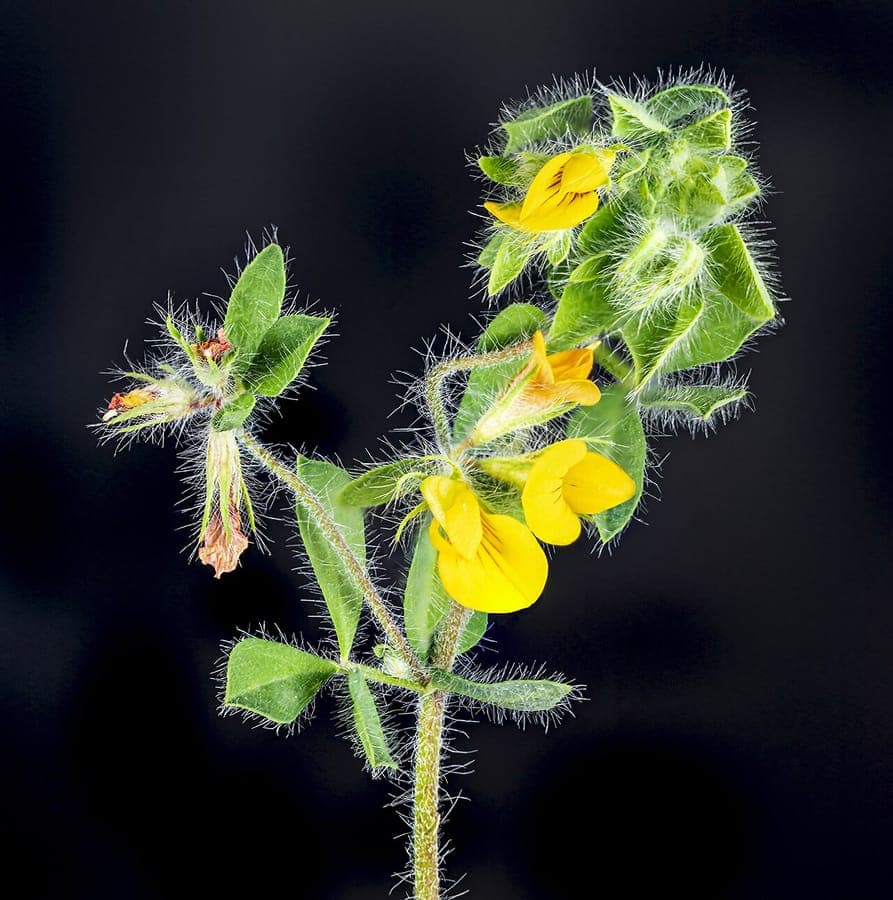
Didier Descouens / CC BY-SA 4.0, via Wikimedia Commons
Narrow birdsfoot trefoil: complete guide
Lotus angustissimus
Want to see Narrow birdsfoot trefoil: complete guide in your garden?
1 minute, no credit card
Overview
Lotus angustissimus, also called narrow birdsfoot trefoil or slender lotus, is a delicate, elegant Mediterranean plant from the Fabaceae family (legumes - the bean and clover family). A modest yet fascinating herb, it enters complete symbiosis with nitrogen-fixing bacteria in the soil, making it ecologically valuable.
Growing to 20-40 cm, it forms a slender, graceful shrubby shape with fine, grass-like foliage. The flowers are small but striking - bright red to orange-red - appearing in clusters from May through September. As a legume, it fixes nitrogen from the air, making it ideal for pollinator gardens and sustainable landscapes without artificial fertilizer.
Appearance and bloom
Lotus angustissimus grows as a slender, elegantly branched plant with extremely narrow, grass-like leaves - hence the name "angustissimus" (extremely narrow). The foliage is green, delicate, giving the plant an airy, botanical quality.
The flowers are the real attraction. They appear in small, densely packed flower clusters where each bloom is bright red to orange-red with subtle marking. Approximately 0.5-1 cm across, they are highly attractive to bees, butterflies, and other pollinators. Bloom continues almost throughout summer, May through September. After flowering, small, slender seed pods develop.
Ideal location
Lotus angustissimus demands full sun - at least 6 hours of direct daily sunlight. In partial shade it survives but becomes sparse and blooms minimally.
The plant tolerates wind well and is perfect for exposed locations. In fact, strong wind may even enhance pollination. Windy rooftops, balconies, and open gardens are ideal.
Soil
Lotus angustissimus is not demanding regarding soil. It grows in sand, loam, clay, and all variations. What it requires is good drainage - waterlogging is harmful. Ensure soil drains quickly after rain.
The plant tolerates poor soil better than over-fertilized soil. Indeed: artificial fertilizer can be harmful as it interferes with the plant's nitrogen-fixing process. Lean soil is better than rich.
pH between 6.5 and 8 is ideal, though it tolerates slightly acidic soils.
Free design
Want to see Narrow birdsfoot trefoil: complete guide in your garden? Make a free design now.
Watering
Once established, Lotus angustissimus is remarkably drought-tolerant. During the first growing season (first 6-8 weeks), water once weekly. After that, you can largely stop except in extreme drought.
The plant accesses moisture from deeper soil layers and has an extensive root system. Even in Mediterranean summers without rain, it thrives excellently. Waterlogging is fatal - ensure perfect drainage.
In very rainy winters, additional drainage may be needed (plant on mounds, add sand layer).
Pruning
Pruning is unnecessary and not recommended. The plant grows naturally in an attractive, compact form without intervention. Remove dead branches or leaves in spring (March).
Faded flowers need not be removed - the plant looks beautiful with both blooms and seed pods. Leave some pods to set seed for natural self-seeding.
Radical cutting back can damage the plant and should be avoided.
Maintenance calendar
March-April: New growth emerges; remove previous year's dead foliage.
May-June: Flowering begins; first red blooms open.
July-August: Peak bloom; plant bears numerous red flowers.
September-October: Flowering continues slower; pods ripen.
November-January: Winter dormancy; plant retains some foliage.
February: Season preparation; check drainage.
Winter hardiness
Lotus angustissimus is hardy to approximately 0 C (USDA zone 10-11). In cold regions (below 0 C in winter), the plant dies annually and is best treated as an annual. In regions where winter temperatures rarely drop below 5 C, it may overwinter.
In warm, Mediterranean climates, it survives without problem and grows nearly year-round. In colder areas, plant in May and enjoy through October, when it dies back.
Companion plants
Lotus angustissimus pairs beautifully with other Mediterranean, pollinator-friendly plants:
- Salvia (Sage): purple or red flowers, matching sunny preference
- Lavandula (Lavender): purple flowers, fragrant foliage, bee magnet
- Malva: pink flowers, coarse foliage, loose forms
- Matthiola: fragrant flowers, soft colors
This combination creates an authentic Mediterranean pollinator garden.
Closing
Lotus angustissimus is for gardeners who appreciate subtle, elegant plants with ecological benefits. It is a fine, grass-like plant with months of bright red blooming that bees adore. Low-maintenance, drought-tolerant, and nitrogen-fixing. Perfect for pollinator gardens, wild gardens, and sustainable design.
Difficult to find in regular nurseries, but seed is widely available online.
Design your pollinator garden with gardenworld.app.
Want to see Narrow birdsfoot trefoil: complete guide in your garden? Make a free design now.
Upload a photo, pick a style, and get a photorealistic design with plant list in under a minute.
No credit card required


Similar plants
Tall Silky Lupine: complete guide
Lupinus elatus
Tall silky lupine is a fast-growing Californian perennial with silvery foliage and blue-purple flower spikes, ideal for a prairie-style garden.
Garfield Lupine: complete guide
Lupinus garfieldensis
The Garfield lupine is a rare, fast-growing American perennial for alkaline, dry grassland gardens, with striking blue flower spikes.
Lupinus elegans: complete guide
Lupinus elegans
Lupinus elegans, the elegant lupine, is a spectacular blooming plant from Mexico with blue flower spikes. Care, cultivation and garden use.