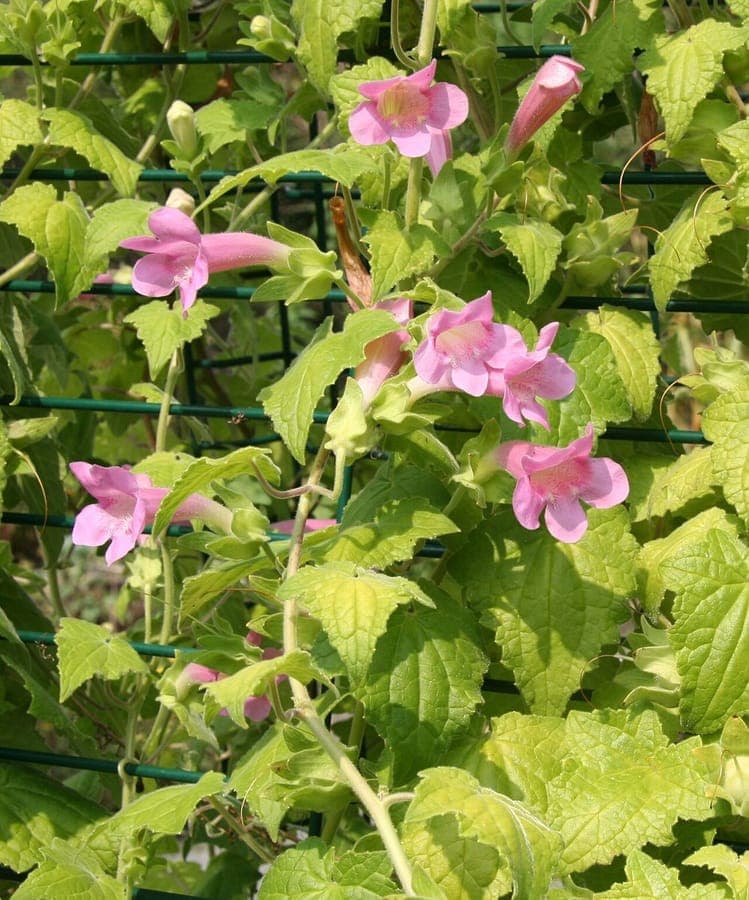
Michael Wolf / CC BY-SA 3.0, via Wikimedia Commons
Creeping gloxinia (Lophospermum erubescens): complete guide
Lophospermum erubescens
Want to see Creeping gloxinia (Lophospermum erubescens): complete guide in your garden?
Full design in HD: €7.99
Look after your Creeping gloxinia with the GardenWorld app
Identify plants with your camera and get a care calendar with reminders for this plant.


Overview
Creeping gloxinia (Lophospermum erubescens) is a climber from the mountains of eastern Mexico that is mostly seen on patios and balconies in Britain. It has soft, pale green leaves and large pink trumpet flowers that are reminiscent of foxgloves or gloxinias, hence the common name. Seed catalogues and garden centres often sell it under the older name Asarina erubescens, and occasionally as Maurandya. In the wild it is a perennial with a slightly woody base; in British gardens it is usually grown as an annual, although you can overwinter it indoors.
It belongs to the plantain family (Plantaginaceae) and is closely related to Rhodochiton. It grows quickly, reaching 1.5 to 3 metres in a single season, depending on the pot size and the summer. That makes it ideal for an obelisk in a large container, a balcony trellis, a wall-mounted support or a hanging basket from which the stems trail. If you are looking for a spot where a climber like this sits well with your other plants, you can have a garden design made on gardenworld.app that includes your patio and balcony as well.
Lophospermum erubescens is not known to be toxic to people or pets. It has naturalised in Hawaii, New Zealand and parts of Australia; in western Europe it does not survive the winter outdoors and causes no problems.
Appearance and bloom cycle
The leaves are triangular to heart-shaped, 5 to 8 cm long, coarsely toothed and velvety, so they feel soft and look slightly grey-green. The stems are hairy too. The plant climbs with its leaf stalks and flower stalks, which twine around thin supports.
The flowers are the highlight. They are tubular, 6 to 7 cm long, and open into five broad, rounded lobes. The colour is bright pink to rose red, with a paler, often whitish and finely speckled throat. They are borne singly in the leaf axils and open in succession, so the plant keeps flowering for a long time. In good weather bumblebees visit them.
Flowering starts in July and continues until the first frost in October. An overwintered plant often begins as early as June.
Ideal location and supports
Creeping gloxinia likes a warm, sheltered position in sun or partial shade. Morning sun with light shade in the afternoon is ideal, especially for a pot that would dry out quickly in fierce midday sun. Shelter from wind matters: the soft leaves tear easily and the long stems snap.
Because the plant grips with its leaf stalks, it needs thin supports:
- an obelisk or wigwam with slender rods or string;
- plastic mesh or wire mesh on a wall or fence;
- strings tied along a balcony railing;
- twiggy branches in a large pot.
Guide the young shoots onto the mesh for the first few weeks; after that the plant holds on by itself. In a hanging basket or at the top of a tall container it can also trail freely, forming a curtain of pink flowers.
Soil requirements
The plant wants a fertile, humus-rich and free-draining soil that stays evenly moist. In containers use a good multipurpose compost for patio plants, with some perlite added if you like. A pot at least 30 cm across holding 25 to 30 litres gives the roots enough room. Make sure there is a drainage hole, because the roots rot in waterlogged compost.
In open ground, mix compost into the planting hole and lighten heavy clay with grit. Choose a spot that warms up quickly in spring, such as a border at the foot of a south-facing wall.
Sowing and raising plants
Creeping gloxinia grows readily from seed but needs a long run-up. Sow from February to mid-March.
- Fill small pots or a seed tray with fine seed compost.
- Scatter the small seeds on the surface and press them in lightly. Do not cover them, or only barely: they need light to germinate.
- Keep them moist at 18 to 21 °C under a lid or plastic.
- Germination takes two to four weeks.
- Prick out the seedlings into 9 cm pots once they are large enough, and give each a small cane.
Keep young plants bright and not too warm. From early May, harden them off outdoors during the day, and move them out for good once the risk of frost has passed. Cuttings also root well: in summer or early autumn, take shoot tips 8 to 10 cm long and root them in moist cutting compost. That way you can overwinter small plants instead of a large one.
Free preview
Want to see Creeping gloxinia (Lophospermum erubescens): complete guide in your garden? Make a free preview of your design.
Watering
Creeping gloxinia has plenty of foliage and loses a lot of water in summer. Keep the compost evenly moist and water as soon as the top few centimetres are dry; in warm weather that often means every day. A plant that dries out lets its flowers droop and drops buds. Do not leave water standing in the saucer.
From June to September, feed every two weeks with a liquid fertiliser for flowering plants. A plant in a large pot with good compost will then keep flowering into autumn.
Pruning
Pinch out the tips of young plants at about 15 cm so that they branch and send several stems up at once. Beyond that, very little pruning is needed. You can shorten overlong or damaged stems in summer. Spent flowers usually drop on their own.
If you want to overwinter the plant, cut it back in October to about 20 to 30 cm above the pot.
Maintenance calendar
February to mid-March: sow indoors at 18 to 21 °C. Repot overwintered plants and move them into more light.
April: prick out the seedlings, pinch them and give them a cane.
Early May: harden off during the day, bring them in at night.
Mid to late May: once frosts are over, plant out in pots or containers and put the supports in place.
June to September: water evenly, feed every two weeks and tie in shoots. Flowering from July.
August to September: take cuttings for overwintering.
October: bring plants in before the first frost, or compost them. The planting calendar on gardenworld.app reminds you of the right moment to sow, plant out and bring plants indoors.
November to January: overwinter cool and bright, with little water.
Winter hardiness and overwintering
Lophospermum erubescens is not hardy. A light frost is enough to kill the leaves and stems, and a few degrees below zero kills the plant. In Britain it must come indoors before the first night frost, or be treated as an annual and sown afresh each year.
There are two ways to overwinter it. You can cut back the whole plant and keep it in its pot in a bright, frost-free place at 5 to 10 °C, such as a cool conservatory or an unheated room. Or you can overwinter just a few rooted cuttings on a cool windowsill, which takes up far less space. In both cases water sparingly and check regularly for aphids and whitefly. In March, repot the plants and move them somewhere warmer so they are ready for a new season.
Companion plants
The pink flowers and soft, pale green leaves go beautifully with silver-grey and purple tones. Around the rim of a large pot, combine creeping gloxinia with liquorice plant (Helichrysum petiolare) or an ivy-leaved geranium (Pelargonium peltatum) in white or deep red. For a touch of blue, add trailing lobelia (Lobelia erinus) or mealy sage (Salvia farinacea).
In a border against a sunny wall, a group of cosmos (Cosmos bipinnatus) in white or pink makes an airy foreground. Vigorous climbers such as morning glory or cup and saucer vine are best given their own support, as they quickly swamp creeping gloxinia.
Final thoughts
Lophospermum erubescens is a climber for anyone who wants something different from the usual summer bedding on a patio or balcony. It grows fast, has soft foliage and produces large pink trumpets for months. Sow early, give it a sheltered spot, thin supports and regular watering, and it asks very little of you. Overwinter a few cuttings indoors and you will have earlier flowers the following year.
This spring, try a packet of seed and a simple obelisk in a large pot. After one summer you will know whether this pink climber deserves a permanent place on your patio.
Frequently asked questions about Creeping gloxinia
Is Creeping gloxinia winter hardy?
Lophospermum erubescens is not hardy. A light frost is enough to kill the leaves and stems, and a few degrees below zero kills the plant.
When and how do you prune Creeping gloxinia?
Pinch out the tips of young plants at about 15 cm so that they branch and send several stems up at once. Beyond that, very little pruning is needed.
How much water does Creeping gloxinia need?
Creeping gloxinia has plenty of foliage and loses a lot of water in summer. Keep the compost evenly moist and water as soon as the top few centimetres are dry; in warm weather that often means every day.
Where does Creeping gloxinia grow best?
Creeping gloxinia likes a warm, sheltered position in sun or partial shade. Morning sun with light shade in the afternoon is ideal, especially for a pot that would dry out quickly in fierce midday sun.
What soil does Creeping gloxinia need?
The plant wants a fertile, humus-rich and free-draining soil that stays evenly moist. In containers use a good multipurpose compost for patio plants, with some perlite added if you like.

See it in your garden
See Creeping gloxinia in your garden
One photo of your garden and a few questions. You see the result in about a minute.
Try it with a photoIdentify this plant in your own garden. Identify a plant
Similar plants
Ivyleaf geranium: complete guide
Pelargonium peltatum
Discover ivyleaf geranium, a practical hanging plant with purple and pink flowers. Learn about cultivation, pruning and winter storage in this guide.
Helichrysum petiolare: complete guide
Helichrysum petiolare
Helichrysum petiolare, the licorice plant, is a graceful trailing plant with silvery-gray foliage perfect for containers and hanging baskets.
Lobelia erinus: complete guide
Lobelia erinus L.
Lobelia erinus is popular trailing plant with blue or red flowers, perfect for hanging baskets and containers. Flowers continuously all summer long.
