
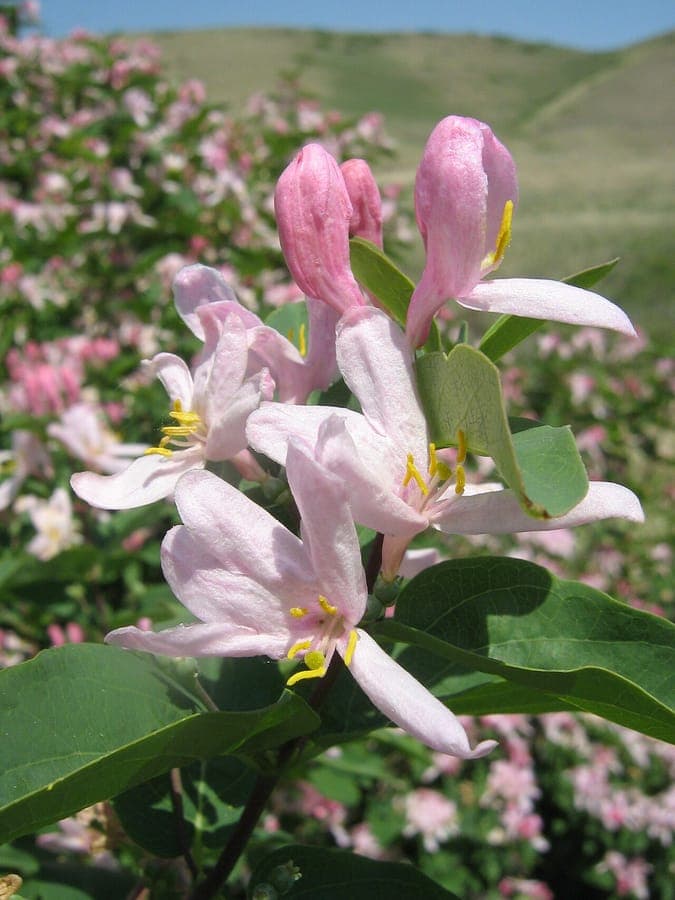
dave_7 from Lethbridge, Canada / CC BY 2.0, via Wikimedia Commons
Tatarian honeysuckle: complete guide
Lonicera tatarica
Want to see Tatarian honeysuckle: complete guide in your garden?
1 minute, no credit card
Overview
Tatarian honeysuckle (Lonicera tatarica) is a deciduous shrub native to central Asia, including regions like the Altai Mountains, Mongolia, and southern Russia. It's known for its long blooming period and dense growth, making it a popular choice for gardeners in temperate climates. While it's hardy and easy to grow, it's worth being cautious: in some areas, especially in North America, it's considered invasive due to its ability to spread quickly and outcompete native species.
In the UK and Western Europe, it's less aggressive but still benefits from regular pruning to keep it in check. When used thoughtfully, it adds charm and structure to mixed borders, informal hedges, or wildlife gardens.
On gardenworld.app, you can design a planting plan that integrates Tatarian honeysuckle with complementary species, ensuring visual harmony and proper spacing.
Appearance & bloom cycle
This shrub typically grows 1.5 to 2 meters tall and spreads up to 1.2 meters wide. It has a rounded, bushy habit with slender, arching stems. The leaves are oval, 3–8 cm long, and a deep green that turns yellowish-brown in autumn.
Flowers appear from May to June, depending on the region and weather. They're tubular, pink to deep red (sometimes white in early blooms), and grow in pairs along the stems. Though they attract bumblebees and hummingbirds, they're less appealing to honeybees due to their deep corolla.
After flowering, bright orange to red berries form. These are mildly toxic to humans but are eaten by birds, which helps spread the seeds-a key reason for its invasive potential in some areas.
Ideal location
Plant Tatarian honeysuckle in full sun to partial shade. For best flowering, aim for at least 6 hours of direct sunlight daily. In deep shade, the plant becomes leggy and produces fewer flowers.
It thrives in sheltered spots, especially when young, to protect new growth from late spring frosts. Use it as a background shrub, in a mixed hedge, or as a standalone feature. Allow 1.5 meters between plants when planting in rows to ensure good air circulation.
Soil requirements
This shrub is adaptable to most soil types-clay, loam, or sand-as long as drainage is adequate. It tolerates a pH range of 5.2 to 7.5, so it grows well in slightly acidic to neutral soils.
When planting, avoid adding fertilizer directly to the hole. Instead, apply a 5 cm layer of organic mulch, like compost or shredded bark, around the base to retain moisture and suppress weeds.
Free design
Want to see Tatarian honeysuckle: complete guide in your garden? Make a free design now.
Watering
During the first growing season, water weekly, especially in dry spells. Provide about 10 liters per plant to encourage deep root development. After the first year, it's fairly drought-tolerant but performs better with occasional deep watering during prolonged dry periods.
Use soaker hoses or drip irrigation rather than overhead sprinklers to prevent foliar diseases like powdery mildew.
Pruning
Prune after flowering, between July and August. Avoid pruning in spring, as this removes the current year's flower buds. Remove dead, damaged, or crossing branches. You can also cut back up to one-third of older stems to encourage new growth and maintain a compact shape.
For hedges, light shaping is fine in August, but avoid heavy pruning after September to allow new growth to harden before winter.
Maintenance calendar
- January: Check for winter damage. No pruning needed.
- February: Prepare tools. Apply compost if not done in autumn.
- March: Loosen soil around the base. No fertiliser yet.
- April: New shoots emerge. Begin light feeding if soil is poor.
- May: Flowering begins. Water during dry spells.
- June: Peak bloom. No pruning.
- July: Flowers fade. Start post-bloom pruning.
- August: Shape as needed. Watch for aphids.
- September: Stop pruning. Water if drought persists.
- October: Clear fallen leaves. Avoid fertilising.
- November: Mulch root zone to protect from frost.
- December: Dormant period. No action required.
Winter hardiness
Tatarian honeysuckle is extremely hardy, surviving temperatures down to -30°C. It's suitable for USDA zones 3 to 7. Established plants need no winter protection, but young shrubs benefit from a mulch layer to insulate roots.
The plant loses all its leaves in autumn, which can be left as natural mulch or cleared to reduce disease risk.
Companion plants
Pair Tatarian honeysuckle with early-summer perennials like Nepeta or Salvia. Their long bloom periods complement the shrub's short flowering window. It also works well with other shrubs such as Cornus alba or Viburnum opulus, which add textural contrast.
Avoid planting near aggressive groundcovers or plants with dense root systems, such as Anemone japonica or certain ornamental grasses.
Closing
Tatarian honeysuckle is a resilient, fast-growing shrub that rewards with vibrant blooms and structural presence. With minimal care and timely pruning, it can thrive for years. Just remember: keep children and pets away from the berries.
On gardenworld.app, you can visualise how this shrub fits into your garden layout, including growth projections and companion planting suggestions.
Want to see Tatarian honeysuckle: complete guide in your garden? Make a free design now.
Upload a photo, pick a style, and get a photorealistic design with plant list in under a minute.
No credit card required


Similar plants
Yellow honeysuckle (Lonicera tragophylla): complete guide
Lonicera tragophylla
Meet yellow honeysuckle (Lonicera tragophylla): a Chinese climber with large golden flowers that thrives in partial shade.
Lonicera korolkowii: complete guide
Lonicera korolkowii Stapf
Discover blueleaf honeysuckle, a vigorous shrub with beautiful flowers. Guide on growing, shaping and why this Asian climbing plant is perfect for gardens.
Lonicera oblongifolia: complete guide
Lonicera oblongifolia Hook.
Discover swamp fly honeysuckle, a North American woodland plant. Guide on growing, caring and why this native species is valuable for gardens.