
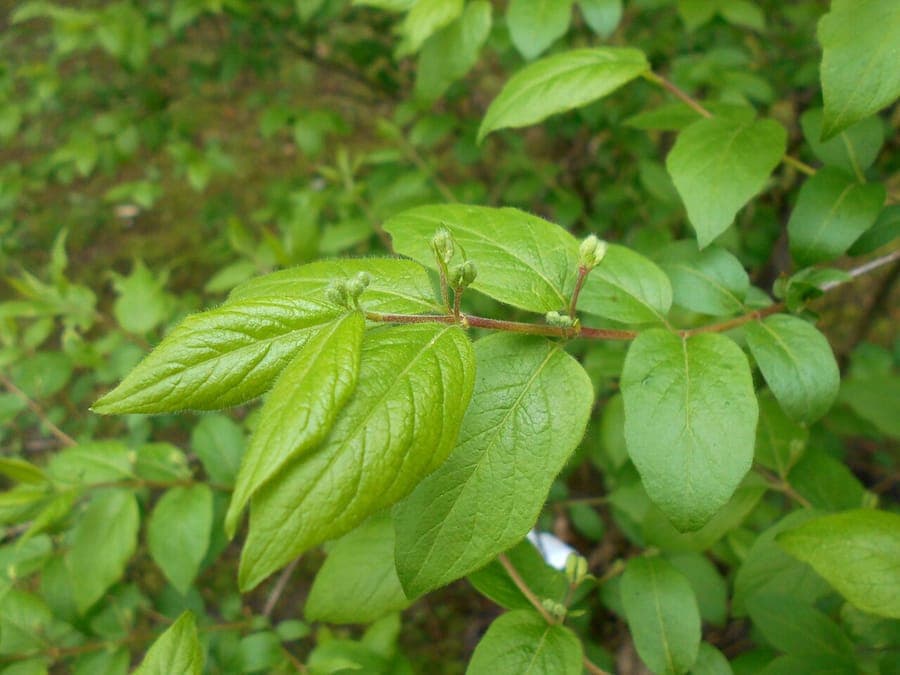
Salicyna / CC BY-SA 4.0, via Wikimedia Commons
Ruprecht honeysuckle: complete guide
Lonicera ruprechtiana
Want to see Ruprecht honeysuckle: complete guide in your garden?
1 minute, no credit card
Overview
The Lonicera ruprechtiana, commonly known as Ruprecht honeysuckle or Manchurian honeysuckle, is a decorative shrub from the Caprifoliaceae family. This plant originates from Russia, Korea, and Manchuria and is named after the botanist Johann Ruprecht. It is a robust, hardy shrub that grows for years with minimal maintenance.
The plant reaches a height of 2-3 meters and width of 1.5-2 meters. The shrub flowers from May to June with small, fragrant flowers in white to pink tones. After flowering, red to orange-yellow berries appear that attract birds. The plant is very suitable as a hedge plant or specimen shrub.
Appearance and bloom
Ruprecht honeysuckle is easily recognized by its compound leaves and characteristic flowers. The leaves are opposite and elliptical, approximately 3-5 cm long. The foliage grows dense, ensuring good shade and privacy in hedges.
The flowers appear in pairs along the stems and are approximately 1.5 cm long. They are funnel to tubular-shaped with five lobes. The color varies from white to pink, with yellow inward staminodes. Very fragrant, especially in evenings.
The fruits are red to orange-yellow berries, approximately 8 mm diameter, ripening from August to October and remaining visible throughout the year.
Ideal location
The Lonicera ruprechtiana prefers sunny to half-shaded locations. At least four hours of sun daily is ideal. In full shade, the plant grows slower and flowers less. Provide a sheltered spot without harsh winds.
The plant is suitable for hedge planting in rows 60-80 cm apart. Also good as a specimen shrub in borders or container cultivation against walls.
Soil
The Lonicera ruprechtiana is very flexible regarding soil requirements. The plant grows in nearly any soil as long as it does not remain waterlogged. Tolerates heavy clay soil and acidic soils as well as sandy or alkaline soils.
Add organic matter such as compost or composted leaves at planting. This helps especially in lean soils. In normal garden soil usually no enrichment needed.
Free design
Want to see Ruprecht honeysuckle: complete guide in your garden? Make a free design now.
Watering
Once established, this honeysuckle needs little water. During the first two years, water regularly, especially in dry periods. Mature plants are quite drought-tolerant.
In containers more water needed than in open ground. Ensure water can drain away, waterlogging must be avoided.
Pruning
The Lonicera ruprechtiana prunes well. Prune immediately after flowering (June-July) for a dense hedge. Remove approximately one third of annual growth. For maintenance pruning two to three times per year.
Old, thick branches can be cut hard back to near the base, the plant regrows well.
Maintenance calendar
February-March: Prune old frost-damaged branches. Reshape plant. April-May: New foliage emerges. Apply light fertilizer. May-June: Plant flowers. Water regularly. July-August: Maintenance pruning. Shape plant. September-October: Berries ripen. Birds visit plant. November-December: Prepare for winter. No more care needed. January: Rest and growth period.
Winter hardiness
This honeysuckle is very hardy to -25 degrees Celsius. The plant tolerates cold winters without problems. Usually damaged by severe frost, but the plant recovers quickly in spring.
In very wet winters extra drainage helps. Usually however no special preparation needed.
Companion plants
Ruprecht honeysuckle combines beautifully with:
- Myrica gale: fragrant foliage
- Boxwood: contrast in texture
- Forsythia: yellow spring flowers against green
- Spiraea: white spring flowers
- Euonymus: green or yellow-veined foliage
Conclusion
The Lonicera ruprechtiana is an ideal choice for those seeking a strong, low-maintenance hedge. With its fragrant flowers and bird-attracting berries, the plant offers something beautiful throughout the year. You can purchase this honeysuckle at Intratuin or Gamma. It is a reliable plant that lasts decades without special care.
Follow these guidelines and you will enjoy years of this Manchurian beauty. Visit gardenworld.app for more garden inspiration and designs.
Want to see Ruprecht honeysuckle: complete guide in your garden? Make a free design now.
Upload a photo, pick a style, and get a photorealistic design with plant list in under a minute.
No credit card required


Similar plants
Yellow honeysuckle (Lonicera tragophylla): complete guide
Lonicera tragophylla
Meet yellow honeysuckle (Lonicera tragophylla): a Chinese climber with large golden flowers that thrives in partial shade.
Lonicera korolkowii: complete guide
Lonicera korolkowii Stapf
Discover blueleaf honeysuckle, a vigorous shrub with beautiful flowers. Guide on growing, shaping and why this Asian climbing plant is perfect for gardens.
Lonicera oblongifolia: complete guide
Lonicera oblongifolia Hook.
Discover swamp fly honeysuckle, a North American woodland plant. Guide on growing, caring and why this native species is valuable for gardens.