
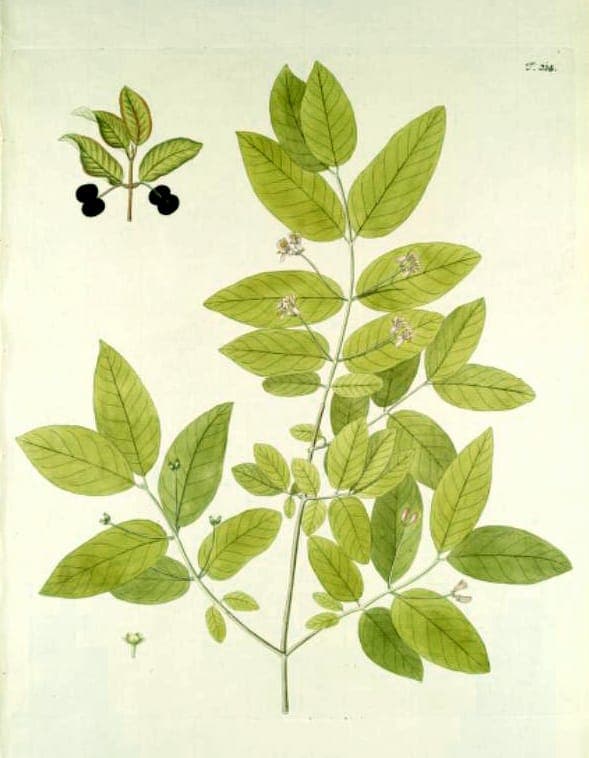
Nicolás Joseph Jacquin / Public domain, via Wikimedia Commons
Blackberried honeysuckle: complete guide
Lonicera nigra
Want to see Blackberried honeysuckle: complete guide in your garden?
1 minute, no credit card
Overview
Lonicera nigra, commonly known as blackberried honeysuckle, is a resilient climbing shrub native to central and southern Europe. While it's less common in UK and North American gardens, it's a hidden gem for wildlife-friendly landscapes. This honeysuckle climbs up to 3 meters using its twining stems, making it ideal for covering fences, arbors, or tree trunks. Unlike its fragrant relatives, Lonicera nigra doesn't produce scented flowers, but it more than makes up for it with its striking clusters of jet-black berries and year-round structure. It's non-invasive, hardy, and a great alternative to more aggressive honeysuckle species.
You can use gardenworld.app to design a planting scheme that integrates blackberried honeysuckle with other climbers and shrubs, ensuring balanced growth and visual harmony.
Appearance & bloom cycle
This plant has a bushy, vining habit with dark green, oval leaves measuring 4–7 cm long. The foliage emerges in early April with a soft bronze tint, maturing to deep green by late spring. From May to June, small, creamy-white flowers appear in pairs along the stems. These aren't showy or fragrant, but they attract hoverflies and bumblebees. By late August, green berries begin to form, ripening to a glossy black by mid-September. The berries are about 8 mm wide and persist into winter, providing food for birds. Note: the berries are toxic to humans and pets-keep them away from small children.
Ideal location
Blackberried honeysuckle thrives in partial shade to light shade. It tolerates full sun if the root zone stays cool and shaded. A north- or east-facing wall, fence, or trellis works best. Avoid hot, south-facing exposures unless the base is mulched and sheltered. Space plants 1.5 meters apart to allow air circulation and prevent overcrowding. It's hardy in USDA zones 5–8, making it suitable for most temperate climates. Provide a support structure-wooden stakes, wire mesh, or a pergola-so the plant can climb naturally.
Soil requirements
Lonicera nigra is adaptable to a range of soils but prefers moist, well-drained loam with a pH between 5.5 and 7.5. It tolerates clay if drainage is improved with grit or organic matter. In sandy soils, mix in compost to boost water retention. Before planting, dig a hole twice as wide as the root ball and amend the backfill with compost. A 5 cm layer of organic mulch in spring helps retain moisture and suppress weeds.
Free design
Want to see Blackberried honeysuckle: complete guide in your garden? Make a free design now.
Watering
During the first growing season, water weekly with 10–15 liters per plant, especially during dry spells. Once established, it's moderately drought-tolerant but performs best with consistent moisture in summer. Avoid overhead watering to prevent fungal issues. Use rainwater when possible, as tap water high in lime can affect long-term health. Check soil moisture by probing 10 cm deep-water only if dry.
Pruning
Pruning isn't required annually, but light shaping in late winter or early March keeps the plant tidy. Remove dead, damaged, or tangled growth, and trim back any stems that stray beyond the support. Limit cuts to one-third of the plant per year to avoid reducing berry production. Use clean, sharp secateurs and disinfect between cuts to prevent disease spread.
Maintenance calendar
- Jan: inspect for winter damage, check support ties
- Feb: prepare tools, plan light pruning
- Mar: prune old wood, apply compost layer
- Apr: monitor for aphids, begin feeding
- May: observe flowering, ensure even soil moisture
- Jun: allow flowers to fade naturally
- Jul: check berry development, avoid drought stress
- Aug: watch for ripening berries, protect from slugs
- Sep: enjoy full fruit display, attract thrushes and warblers
- Oct: leave fallen leaves for overwintering insects
- Nov: apply mulch to protect roots
- Dec: leave plant undisturbed for winter shelter
Winter hardiness
Hardy down to -20°C (USDA zone 5), Lonicera nigra handles most winter conditions with ease. Young plants benefit from a 5–10 cm mulch of straw or bark at the base. Mature plants need no protection. The persistent berries and dense stems offer shelter for birds and insects during cold months.
Companion plants
Pair blackberried honeysuckle with shade-tolerant perennials like barrenwort (Epimedium) or coral bells (Heuchera). For ground cover, use sweet woodruff (Galium odoratum) or ferns like Polystichum acrostichoides. Avoid planting near aggressive spreaders like English ivy. Combine with deciduous shrubs such as Viburnum or Cornus for seasonal contrast. You can explore compatible planting layouts on gardenworld.app to maximize space and biodiversity.
Closing
Lonicera nigra is a low-key powerhouse in the garden. It doesn't shout for attention, but it delivers year-round interest, supports wildlife, and asks for little in return. While not widely stocked in mainstream garden centres, it's increasingly available from specialist nurseries and online growers. Look for it at independent garden centres in late spring or order online. Plant it where you can appreciate its quiet beauty-near a window, along a quiet path, or beside a bench. With minimal care, it becomes a long-lived, graceful presence that blends seamlessly into naturalistic designs.
Want to see Blackberried honeysuckle: complete guide in your garden? Make a free design now.
Upload a photo, pick a style, and get a photorealistic design with plant list in under a minute.
No credit card required


Similar plants
Yellow honeysuckle (Lonicera tragophylla): complete guide
Lonicera tragophylla
Meet yellow honeysuckle (Lonicera tragophylla): a Chinese climber with large golden flowers that thrives in partial shade.
Lonicera korolkowii: complete guide
Lonicera korolkowii Stapf
Discover blueleaf honeysuckle, a vigorous shrub with beautiful flowers. Guide on growing, shaping and why this Asian climbing plant is perfect for gardens.
Lonicera oblongifolia: complete guide
Lonicera oblongifolia Hook.
Discover swamp fly honeysuckle, a North American woodland plant. Guide on growing, caring and why this native species is valuable for gardens.