
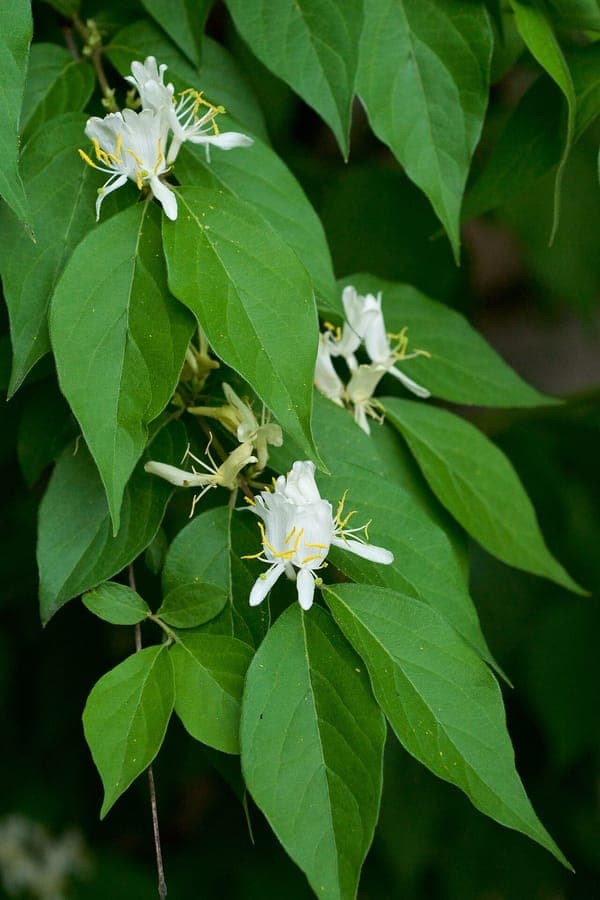
Eric Hunt / CC BY-SA 4.0, via Wikimedia Commons
Bush honeysuckle: complete guide
Lonicera maackii
Want to see Bush honeysuckle: complete guide in your garden?
1 minute, no credit card
Overview
Lonicera maackii, commonly known as bush honeysuckle, is a deciduous to semi-evergreen shrub that commands attention in the spring garden. Native to eastern Asia - including regions of China, Korea, Japan, and the Russian Far East - it's adapted to a wide range of conditions. In the UK and North America, it's often used as a privacy screen or informal hedge, reaching 2.5 to 4 meters in height and spreading 1.5 to 2 meters wide over 5 to 7 years. Growth averages 30–50 cm annually under good conditions.
While attractive, gardeners should be cautious: in parts of the US, this species is highly invasive and outcompetes native flora. In the UK and milder European zones, it's less aggressive but still capable of self-seeding via bird-dispersed berries. Plant it mindfully, preferably in controlled garden zones. Use gardenworld.app to simulate how this shrub fits into your garden layout, ensuring it doesn't dominate over time.
Appearance & bloom cycle
The real magic happens in late spring. From April to May, Lonicera maackii produces clusters of tubular, fragrant flowers at the leaf axils. They open creamy-white and fade to pale yellow, measuring about 2 cm long. The scent is subtle but sweet, especially noticeable in the evening, drawing in pollinators like moths, bees, and hoverflies.
After flowering, small red berries (5–8 mm) appear by late summer. These persist into autumn and are eaten by birds such as robins and thrushes - but they're toxic to humans, so keep children and pets away. The leaves are opposite, oval to lance-shaped, 6–10 cm long, with a smooth margin and a glossy upper surface. In mild winters, the shrub retains much of its foliage, providing year-round structure.
Ideal location
Full sun to partial shade is ideal. For the best flowering and densest growth, aim for at least 6 hours of direct sunlight per day. In deep shade, the plant becomes leggy and blooms sparsely. A sheltered spot near a fence, garden wall, or mixed border works well. Avoid planting near woodland edges if you're in a region where it's known to escape cultivation. You can explore different planting scenarios on gardenworld.app, helping you visualise long-term growth and interaction with nearby plants.
Soil requirements
Bush honeysuckle tolerates a broad range of soil types but thrives in moist, well-drained, humus-rich soil. The ideal pH is between 6.0 and 7.5. It handles clay soils as long as they don't remain waterlogged, and sandy soils if supplemented with organic matter. At planting, mix in compost or well-rotted manure to boost establishment. Avoid highly alkaline or compacted soils.
Free design
Want to see Bush honeysuckle: complete guide in your garden? Make a free design now.
Watering
Water deeply and regularly during the first growing season - about 10–15 liters per week per plant. Once established (after 2–3 years), it's moderately drought-tolerant but performs best with occasional deep watering during dry spells. Use soaker hoses or drip irrigation to deliver moisture directly to the root zone, reducing evaporation.
Pruning
Pruning helps maintain shape and encourages healthy new growth. The best time is late winter or early spring before bud break. Remove up to one-third of the oldest stems at ground level to rejuvenate the plant. Cut back any crossing or damaged branches. Avoid heavy pruning in autumn, as it may stimulate tender growth that won't survive winter. Use sharp, clean secateurs for clean cuts.
Maintenance calendar
- Jan: inspect for winter damage, clean tools
- Feb: plan pruning, check for pests
- Mar: prune, apply mulch around base
- Apr: flowering begins, monitor for aphids
- May: peak bloom, watch for powdery mildew
- Jun: light watering during dry periods
- Jul: remove any fallen berries to reduce self-seeding
- Aug: check for leaf discoloration or stress
- Sep: reduce watering as growth slows
- Oct: collect and compost fallen leaves
- Nov: protect young plants with mulch or fleece
- Dec: dormancy period - no action needed
Winter hardiness
Lonicera maackii is hardy in USDA zones 5 to 8. In zone 5, young plants may need winter protection with horticultural fleece. In zones 6–8, it generally survives unscathed. In colder areas, expect some leaf drop, but the plant will regrow from the base in spring.
Companion plants
Pair this shrub with shade-tolerant perennials like hostas, ferns (Dryopteris spp.), or carexes. For spring interest, plant beneath it Pulmonaria or Epimedium. Avoid overly aggressive spreaders like mint or ground ivy. In larger gardens, it complements birch trees or tall ornamental grasses like Calamagrostis.
Closing
Bush honeysuckle brings fragrance, structure, and wildlife appeal to the garden. While it's not the most low-risk plant in all regions, with careful placement and regular monitoring, it can be a rewarding addition. Buy young plants (40–60 cm) from reputable garden centres like those found at OBI or Hornbach, or local nurseries. With proper care, it can thrive for decades. Use gardenworld.app to design a planting scheme that balances beauty with ecological responsibility.
Want to see Bush honeysuckle: complete guide in your garden? Make a free design now.
Upload a photo, pick a style, and get a photorealistic design with plant list in under a minute.
No credit card required


Similar plants
Yellow honeysuckle (Lonicera tragophylla): complete guide
Lonicera tragophylla
Meet yellow honeysuckle (Lonicera tragophylla): a Chinese climber with large golden flowers that thrives in partial shade.
Lonicera korolkowii: complete guide
Lonicera korolkowii Stapf
Discover blueleaf honeysuckle, a vigorous shrub with beautiful flowers. Guide on growing, shaping and why this Asian climbing plant is perfect for gardens.
Lonicera oblongifolia: complete guide
Lonicera oblongifolia Hook.
Discover swamp fly honeysuckle, a North American woodland plant. Guide on growing, caring and why this native species is valuable for gardens.