
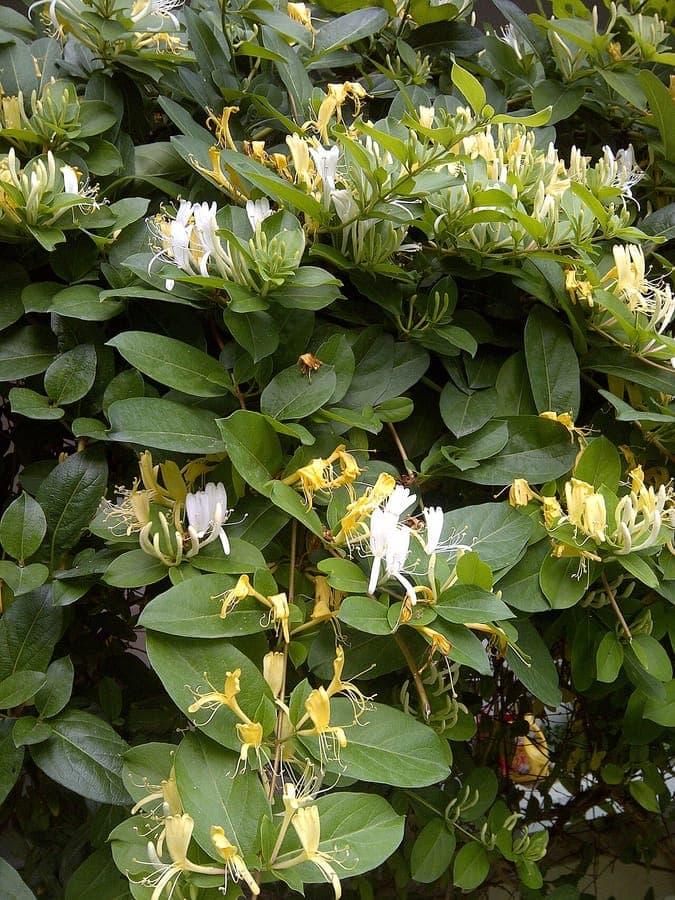
Aftabbanoori / CC BY-SA 3.0, via Wikimedia Commons
Japanese honeysuckle: complete guide
Lonicera japonica
Want to see Japanese honeysuckle: complete guide in your garden?
1 minute, no credit card
Overview
Japanese honeysuckle (Lonicera japonica) is a vigorous climber popular in gardens across temperate zones for its sweet-scented flowers and rapid coverage. Native to parts of East Asia-including Japan, Korea, and China-it has adapted well to UK and North American gardens. It's often used to cover fences, arches, or pergolas quickly, but its enthusiasm demands attention. Left unchecked, it can smother nearby plants and become invasive.
If you're planning where to place it in your layout, gardenworld.app lets you simulate its spread over time so you don't accidentally block light to other plants.
Appearance & bloom cycle
This vine grows 6 to 10 meters long with twining stems that latch onto supports or drape over structures. Its oval, dark green leaves are roughly 4–8 cm long and arranged oppositely. New growth may have a purplish tint, and some varieties are semi-evergreen, holding foliage through mild winters.
From late spring to midsummer-typically May through August-pendant, tubular flowers emerge. They open white and fade to golden yellow, creating a striking bicolor display. Their fragrance is strongest at dusk, attracting moths, bees, and hummingbirds. After flowering, small black berries form. While birds eat them without issue, they're toxic to humans and pets, so plant with caution in family gardens.
Ideal location
Japanese honeysuckle thrives in light shade to partial sun (light level 5 out of 10). Full sun increases flowering but also water needs, especially in sandy soils. A spot with morning sun and afternoon shade works well in most climates. South- or east-facing trellises, arbors, or chain-link fences make ideal supports.
Avoid planting near trees or delicate shrubs-this vine can climb and shade them out rapidly. Use sturdy structures; flimsy wire mesh may buckle under its weight over time. Check spacing and growth projections on gardenworld.app to avoid future conflicts with other plants.
Soil requirements
Lonicera japonica isn't fussy about soil type. It grows in clay, loam, or sandy soils as long as drainage is decent. The pH tolerance is wide: from 4.9 (slightly acidic) to 8.3 (slightly alkaline). That makes it adaptable to most garden soils without amendment.
For best results, enrich planting holes with compost or well-rotted manure. In heavy clay, mix in grit or coarse sand to improve permeability. Poor soils will slow growth but won't stop it-this plant is resilient.
Free design
Want to see Japanese honeysuckle: complete guide in your garden? Make a free design now.
Watering
During the first growing season, keep soil consistently moist. Water deeply once a week, more often during dry spells. Use a soaker hose or drip line to deliver moisture straight to roots and avoid wetting foliage, which can encourage mildew.
Mature plants are drought-tolerant and rarely need supplemental watering unless rainfall drops below 2.5 cm per week for several weeks. In extended dry periods, give a deep soak every 10–14 days.
Pruning
Pruning is essential. Without it, Japanese honeysuckle becomes a tangled, sprawling mess. The best time to prune is late winter or early spring before new growth starts. Cut back stems to 2–3 buds from the main framework to encourage bushy growth and more flowers.
For size control, do a light trim in midsummer after flowering. Avoid heavy pruning during active growth, as it can stress the plant. Use sharp bypass pruners and disinfect between cuts if disease is suspected.
Maintenance calendar
- Jan: Inspect for winter damage, remove dead stems
- Feb: Prepare for pruning, check support stability
- Mar: Main pruning window, shape plant
- Apr: Apply mulch, watch for new shoots
- May: Bloom begins, monitor for aphids
- Jun: Peak flowering, fragrance at night
- Jul: Watch for runners, trim if needed
- Aug: Light summer pruning possible
- Sep: Reduce watering if rainfall is adequate
- Oct: Berries ripen, foliage may yellow
- Nov: Semi-evergreen types may drop leaves
- Dec: Dormant period, minimal care needed
Winter hardiness
This plant is hardy in USDA zones 4–9. In zones 4 and 5, it may die back to the ground in harsh winters but regrows from the base. In milder zones (7–9), it often stays evergreen or semi-evergreen. No winter protection is needed, though young plants benefit from a mulch layer to insulate roots.
Companion plants
Pair with shrubs or perennials that tolerate root competition and light shade. Try hydrangeas, ferns, or hostas at the base. Climbing roses on the same structure can work if spaced well and pruned regularly.
Avoid slow-growing vines like clematis, which may get overwhelmed. Use gardenworld.app to preview plant combinations and avoid overcrowding.
Closing
Japanese honeysuckle delivers fast coverage and unforgettable fragrance, but it demands respect. Plant it where you can manage its reach, and commit to annual pruning. Buy from reputable garden centres-look for healthy, well-rooted stock at stores like OBI or Hornbach in Europe, or local nurseries in North America. With mindful placement and care, it can be a striking, long-term feature in your garden.
Want to see Japanese honeysuckle: complete guide in your garden? Make a free design now.
Upload a photo, pick a style, and get a photorealistic design with plant list in under a minute.
No credit card required


Similar plants
Yellow honeysuckle (Lonicera tragophylla): complete guide
Lonicera tragophylla
Meet yellow honeysuckle (Lonicera tragophylla): a Chinese climber with large golden flowers that thrives in partial shade.
Lonicera korolkowii: complete guide
Lonicera korolkowii Stapf
Discover blueleaf honeysuckle, a vigorous shrub with beautiful flowers. Guide on growing, shaping and why this Asian climbing plant is perfect for gardens.
Lonicera oblongifolia: complete guide
Lonicera oblongifolia Hook.
Discover swamp fly honeysuckle, a North American woodland plant. Guide on growing, caring and why this native species is valuable for gardens.