
Uwe Thobae / CC BY-SA 3.0, via Wikimedia Commons
Alpine honeysuckle: complete guide
Lonicera alpigena
Want to see Alpine honeysuckle: complete guide in your garden?
1 minute, no credit card
Overview
Lonicera alpigena, commonly known as Alpine honeysuckle, is a subtle yet resilient climber native to the mountainous regions of central and southern Europe. Unlike its more flamboyant relatives, this honeysuckle is compact, slow-growing, and perfectly adapted to rocky crevices, woodland edges, and alpine gardens. It's not commonly seen in mainstream UK or North American gardens, but it's a gem for those aiming for a naturalistic, low-maintenance design. On gardenworld.app, you can create a planting scheme that highlights the quiet elegance of Alpine honeysuckle, especially in woodland or rock garden settings.
Belonging to the Caprifoliaceae family, Lonicera alpigena is deciduous and typically grows as a trailing or weakly climbing shrub, reaching 50–100 cm in height with spread up to 1.5 m. It's not a vigorous vine, so it won't overwhelm neighbouring plants. Instead, it weaves gently through low shrubs or scrambles over small boulders. Its natural habitat includes subalpine forests and rocky slopes in countries like Austria, Switzerland, and northern Italy, where it thrives in cool, well-drained conditions.
Appearance & bloom cycle
The plant features narrow, lance-shaped leaves 2–4 cm long, dark green above and paler beneath, with a slight downy texture along the margins. In late spring-typically from April to early May-pairs of tubular flowers emerge in the leaf axils. These start creamy-white to pale pink, gradually turning yellow as they age. While not strongly scented, they attract early pollinators like bees and hoverflies.
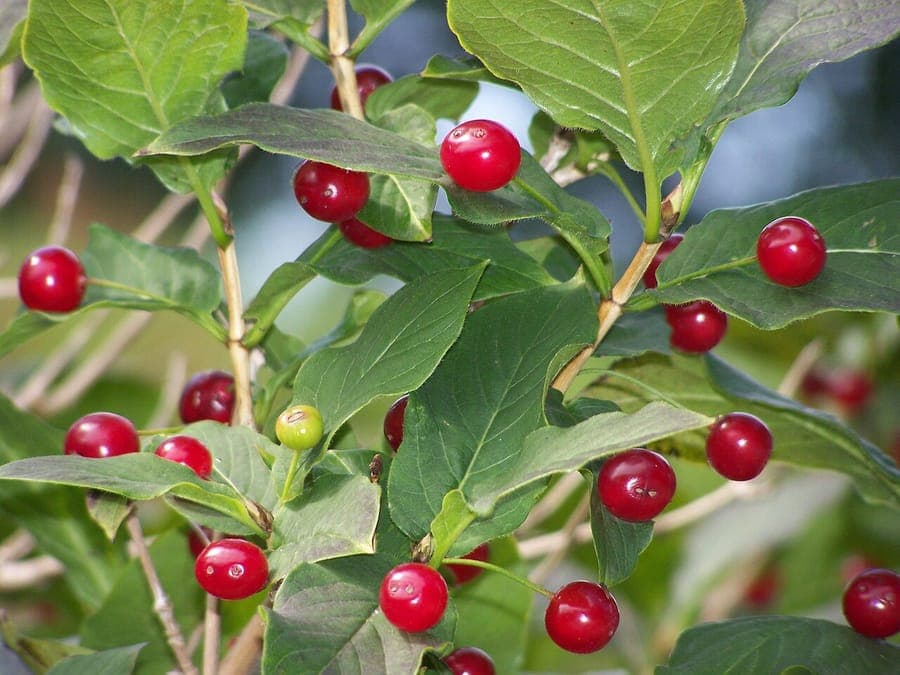
Following pollination, small, glossy berries develop by mid-summer. These are deep blue to black and about 6–8 mm in diameter. They are mildly toxic to humans but are readily eaten by birds such as thrushes and warblers, aiding in seed dispersal. The plant loses its leaves in autumn, revealing a network of slender, woody stems that persist through winter.
Ideal location
Alpine honeysuckle prefers partial to full shade, particularly dappled light under deciduous trees like birch or hazel. It can tolerate morning sun in cooler climates but struggles in hot, dry afternoon sun. This plant is ideal for north-facing slopes, shaded rockeries, or woodland borders. It doesn't need tall supports but benefits from low structures-such as logs, stone walls, or low shrubs-to climb over. Avoid exposed, windy sites, as the thin stems can dry out or snap in strong gusts.
Soil requirements
Well-drained, humus-rich loam is ideal. The soil should be slightly acidic to neutral (pH 5.5–7.0). Avoid heavy clay or waterlogged soils, which promote root rot. When planting, mix in leaf mould or composted bark to improve structure and moisture retention. Do not over-fertilise; this species evolved in nutrient-poor mountain soils and thrives with minimal feeding.
Free design
Want to see Alpine honeysuckle: complete guide in your garden? Make a free design now.
Watering
During the first growing season, keep the soil consistently moist but never soggy. Water deeply once a week during dry spells. Once established (after 12–18 months), the plant is moderately drought-tolerant, especially if mulched with organic material. However, prolonged dry periods in summer may require supplemental watering to prevent leaf scorch.
Pruning
Pruning is rarely needed. Alpine honeysuckle grows slowly and maintains a neat form naturally. If stems become leggy or extend beyond their intended space, trim them back in early spring (March–April) to a healthy bud. Avoid hard pruning, as recovery can be slow. Remove dead or damaged wood to improve air circulation and reduce disease risk.
Maintenance calendar
- Jan: Check for winter damage; no pruning.
- Feb: Inspect support structures; apply compost if needed.
- Mar: Light pruning; monitor for early growth.
- Apr: Flowers appear; watch for drying in sunny spots.
- May: End of bloom; berries begin forming.
- Jun: Minimal care; water during extended dry periods.
- Jul: Check for aphids or powdery mildew in humid weather.
- Aug: Remove weeds; avoid disturbing surface roots.
- Sep: Leaves may start yellowing; do not prune.
- Oct: Berries ripen; let birds clean them up naturally.
- Nov: Clear fallen leaves; leave as mulch if disease-free.
- Dec: Dormant period; protect young plants in pots.
Winter hardiness
Lonicera alpigena is fully hardy in USDA zones 4–7, tolerating temperatures down to -25°C. In zone 8, it may struggle in hot summers unless kept cool and shaded. No winter protection is needed for in-ground plants, though container-grown specimens benefit from being moved to a sheltered spot or wrapped with hessian.
Companion plants
Pair Alpine honeysuckle with shade-loving perennials such as ferns (Dryopteris filix-mas), wild ginger (Asarum europaeum), and wood anemones (Anemone nemorosa). It also works well with dwarf conifers, heathers, and small ornamental grasses. Avoid aggressive ground covers like ivy or periwinkle, which can smother its delicate stems.
Closing
Alpine honeysuckle is a quiet achiever in the garden-undramatic but invaluable for its ecological role and year-round structure. Its early blooms support pollinators, and its berries feed birds, all while asking for little in return. You can find Lonicera alpigena at independent garden centres or specialist alpine nurseries. While not always stocked at large chains, it's worth asking at local growers. For layout ideas and custom planting plans, visit gardenworld.app-where thoughtful design meets practical gardening.
Want to see Alpine honeysuckle: complete guide in your garden? Make a free design now.
Upload a photo, pick a style, and get a photorealistic design with plant list in under a minute.
No credit card required


Similar plants
Yellow honeysuckle (Lonicera tragophylla): complete guide
Lonicera tragophylla
Meet yellow honeysuckle (Lonicera tragophylla): a Chinese climber with large golden flowers that thrives in partial shade.
Lonicera korolkowii: complete guide
Lonicera korolkowii Stapf
Discover blueleaf honeysuckle, a vigorous shrub with beautiful flowers. Guide on growing, shaping and why this Asian climbing plant is perfect for gardens.
Lonicera oblongifolia: complete guide
Lonicera oblongifolia Hook.
Discover swamp fly honeysuckle, a North American woodland plant. Guide on growing, caring and why this native species is valuable for gardens.