
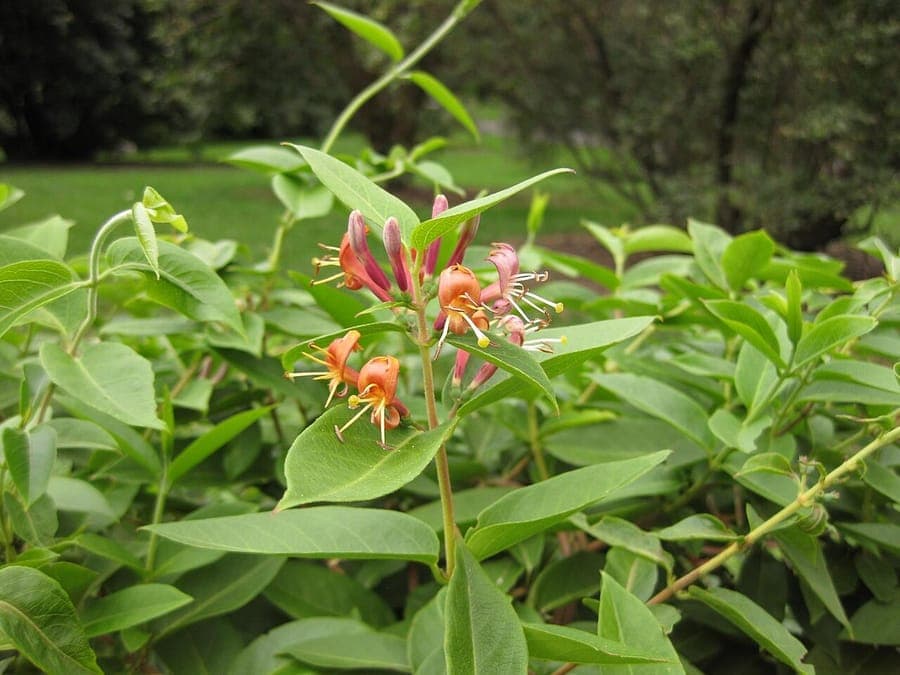
Raffi Kojian / CC BY-SA 3.0, via Wikimedia Commons
Fragrant grove honeysuckle: complete guide
Lonicera acuminata
Want to see Fragrant grove honeysuckle: complete guide in your garden?
1 minute, no credit card
Overview
Lonicera acuminata, commonly known as Fragrant grove honeysuckle, is a graceful evergreen climber that brings year-round structure and summer fragrance to temperate gardens. Native to regions like Assam, East Himalaya, and southern China, it's adapted to thrive in USDA zones 7–9, making it a solid choice for gardens across the UK and much of the US. Unlike some vigorous honeysuckles that take over, this species grows steadily at 30–50 cm per year, making it manageable for smaller spaces.
It belongs to the Caprifoliaceae family and climbs by twining stems, so it needs support like a trellis, fence, or pergola. It's a favourite among gardeners who want visual interest without constant pruning. With its glossy foliage and evening-scented blooms, it's ideal for patios, quiet corners, or shaded boundaries.
On gardenworld.app, you can design a layout that integrates Lonicera acuminata into mixed borders or vertical spaces, ensuring it has room to climb without crowding other plants.
Appearance & bloom cycle
The plant features narrow, lance-shaped leaves 5–10 cm long, deep green and slightly leathery, remaining on the vine all year. From June to August, clusters of slender, tubular flowers emerge in pale yellow, often flushed with pink or purple at the base. These blooms are richly fragrant, especially at dusk, attracting moths and evening pollinators.
Following flowering, small orange to red berries form. While not edible for humans, they provide food for birds. Left unpruned, the vine can reach 3–6 metres, forming a dense screen. Its growth habit is upright and twining, never invasive.
Ideal location
Choose a spot with partial shade to full sun. In full sun, flowering is more abundant, but soil moisture must be maintained. In dappled shade, such as under light tree canopies, it grows well and retains moisture longer. Avoid exposed, windy sites, especially in colder zones, as winter winds can desiccate the foliage.
Supports should be sturdy-wood, metal, or strong netting work well. Don't plant too close to walls with intense midday heat; a north- or east-facing wall is ideal. On gardenworld.app, visualise how this honeysuckle would look trained over an arch or along a fence line in your garden.
Soil requirements
Lonicera acuminata isn't fussy about soil, but it thrives in moist, well-drained loam rich in organic matter. A pH between 6.0 and 7.5 is optimal. Heavy clay soils are acceptable if they don't waterlog; amend sandy soils with compost to improve water retention.
At planting, dig a hole twice the width of the root ball and mix in garden compost. Avoid high-nitrogen fertilisers, which can promote leafy growth at the expense of flowers.
Free design
Want to see Fragrant grove honeysuckle: complete guide in your garden? Make a free design now.
Watering
During the first growing season, water weekly if rainfall is below 2.5 cm. Keep the root zone consistently moist but not soggy. After establishment, it tolerates short dry spells, but prolonged drought can reduce flowering and cause leaf drop.
In summer heatwaves, deep watering once a week helps. Water at the base to prevent fungal issues on leaves. Mulching with bark or compost helps retain moisture and suppress weeds.
Pruning
This honeysuckle rarely needs heavy pruning. Light shaping in March or April keeps it tidy. Cut back overlong stems to a healthy bud or side shoot. Remove any dead, damaged, or crossing growth to improve airflow.
Use sharp, clean secateurs to prevent disease spread. Avoid pruning after August, as flower buds for next year form in late summer.
Maintenance calendar
- January – February: Check for winter damage, protect young plants if frost is severe.
- March: Light pruning, inspect support structure.
- April – May: Monitor for aphids or mildew, apply organic mulch.
- June – August: Peak bloom, ensure consistent moisture.
- September – October: Reduce watering, let plant harden off.
- November – December: Apply mulch around base, avoid disturbing roots.
Winter hardiness
Hardy in USDA zones 7–9, it survives most UK and northern US winters. In zone 7, young plants benefit from a protective mulch of straw or bark. Foliage may bronze in cold weather but usually recovers in spring.
Sudden late frosts can damage new growth, but regrowth is typically quick. Avoid planting in frost pockets.
Companion plants
Pair with shade-tolerant perennials like Hosta, Tiarella, or Dryopteris. For layered effect, combine with Clematis 'Perle d'Azur' or climbing roses. Ferns and epimediums work well at the base.
Avoid fast-spreading groundcovers like ivy, which can compete for light and nutrients.
Closing
Lonicera acuminata is a reliable, elegant climber that adds fragrance and structure without dominating the garden. It's perfect for softening walls, covering fences, or enhancing a pergola. Its evergreen nature and low care needs make it a smart long-term investment. It's often available at garden centres in spring and autumn-look for healthy, bushy plants at retailers like OBI, Hornbach, Truffaut, or local garden centres in the US and UK.
Want to see Fragrant grove honeysuckle: complete guide in your garden? Make a free design now.
Upload a photo, pick a style, and get a photorealistic design with plant list in under a minute.
No credit card required


Similar plants
Yellow honeysuckle (Lonicera tragophylla): complete guide
Lonicera tragophylla
Meet yellow honeysuckle (Lonicera tragophylla): a Chinese climber with large golden flowers that thrives in partial shade.
Lonicera korolkowii: complete guide
Lonicera korolkowii Stapf
Discover blueleaf honeysuckle, a vigorous shrub with beautiful flowers. Guide on growing, shaping and why this Asian climbing plant is perfect for gardens.
Lonicera oblongifolia: complete guide
Lonicera oblongifolia Hook.
Discover swamp fly honeysuckle, a North American woodland plant. Guide on growing, caring and why this native species is valuable for gardens.