
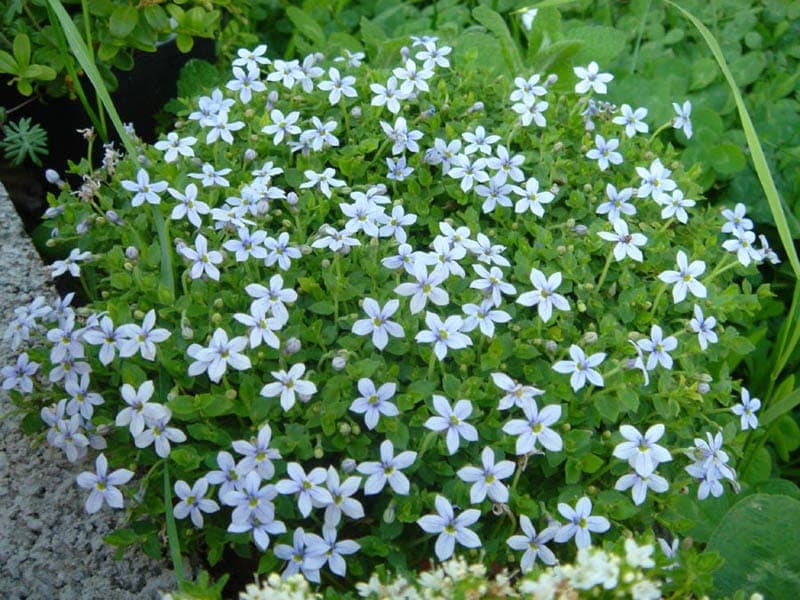
Ghislain118 https://www.fleurs-des-montagnes.net / CC BY-SA 3.0, via Wikimedia Commons
Lobelia pedunculata: complete guide
Lobelia pedunculata
Want to see Lobelia pedunculata: complete guide in your garden?
1 minute, no credit card
Lobelia pedunculata, commonly known as Matted Pratia or Gazon Lobelia, is an enchanting creeping perennial originating from Australia (New South Wales, Victoria, Queensland, and Tasmania). This member of the Campanulaceae family (the same as bellflowers) grows low, spreads extensively, and produces numerous small blue flowers over extended periods. The plant is ideal for borders, pathways, rock gardens, and alpine containers.
Appearance and Bloom
Lobelia pedunculata forms dense mats of fine foliage with many small, narrow, linear leaves pointing upward. The plant reaches only 5 to 15 centimetres in height but can spread 30 to 60 centimetres or more, depending on growing conditions. Leaves are small, dark green, smooth, and highly garden-like in appearance.
Flowers appear from May to October (in temperate climates) and, while small, are very numerous. Each bloom measures approximately 8 millimetres in diameter, blue to blue-violet in colour, and hangs on thin flower stalks (explaining the scientific name "pedunculata" - long-stalked). Flowers display a distinctive two-lipped form, characteristic of Campanulaceae. Blooms appear abundantly along stems, resulting in massive flowering displays.
After flowering concludes, small seed capsules form. In temperate climates, the plant retains foliage through much of the year, though winter growth is minimal.
Ideal Location
Lobelia pedunculata grows best in full sun to dappled shade, requiring 4 to 6 hours direct sunlight daily. In full sun, the plant produces massive blooms. In partial shade, growth remains good, though flowering may diminish slightly.
The plant is suitable for USDA zones 8 to 11 (winter temperatures -13°C to +4°C). In northern Europe, outdoor cultivation is impossible without winter protection; container cultivation with indoor winter protection is essential. It thrives better in southern France, Spain, Italy, Greece, and around the Mediterranean coast. In temperate regions, container cultivation with winter protection is necessary.
The plant grows naturally in eastern Australia in grasslands and rocky mountain slopes, so it thrives in well-drained, sunny garden locations.
Soil Requirements
Lobelia pedunculata is adaptable and grows in virtually all soils provided drainage is excellent. The plant detests waterlogging and will quickly rot in waterlogged soil. Use draining garden soil or seed compost mixed with sand or perlite in a 1:1 ratio if you have heavy clay.
The plant accepts both acidic and neutral soils and even grows in leaner soils. In containers, use general-purpose seed compost mixed with coarse sand for extra drainage.
Free design
Want to see Lobelia pedunculata: complete guide in your garden? Make a free design now.
Watering Practices
Once established, Lobelia pedunculata is quite drought-tolerant and even grows in drier soils. During growing periods (May to October), provide moderate watering when soil surface feels dry. Preventing excess moisture is crucial, as it quickly causes root rot.
In winter, when growth ceases, drastically reduce watering. In temperate climates, the plant may enter dormancy; minimal water suffices.
In containers, more frequent watering may be necessary due to faster drainage, but avoid waterlogging.
Pruning and Maintenance
Lobelia pedunculata requires minimal pruning. You can remove spent flowers for a neater appearance, though this is unnecessary. After extended flowering periods, light pruning maintains compact form, but aggressive cutting is not needed.
Remove dead or damaged stems in late autumn. For rejuvenating mature specimens, gentle pruning is possible but should be cautious.
Maintenance Calendar
May-October: Growth and flowering. Regular watering. Enjoy blue blooms.
November-April: Winter dormancy. Minimal watering. Plant may partially die back in frost zones.
Winter Hardiness
Lobelia pedunculata is frost-sensitive and grows outdoors only in USDA zones 8 to 11. In temperate climates (Netherlands, Belgium, Germany, France), outdoor cultivation will not survive without protection. The plant will die at temperatures below 0°C.
In temperate regions, it must be container-grown and moved indoors for winter (greenhouse, conservatory, cold frame). Minimal watering in winter is needed.
In warm climates (Southern Europe), it can grow outdoors without protection, though young plants may appreciate winter protection in extreme seasons.
Companion Plants
Lobelia pedunculata pairs beautifully in borders with other creeping and low-growing plants. Ideal companions include creeping thyme, stonecrop, silvery Artemisia, low-growing sedum, and other alpine creepers. Ensure companion plants are not invasive.
In rock gardens, it forms attractive layers and cascades beautifully over stones. In containers along pathways or terraces, it grows enchantingly. Ensure good visibility of the blooms.
It also pairs well with white or pink flowers for colour contrast. Dark green or grey foliage of companions creates beautiful backdrop for blue blooms.
Propagation
Lobelia pedunculata grows from seed, though seeds are extremely small and require careful handling. Division of creeping stems in spring or early summer produces new plants. Individual stems can be inserted into moist seed compost and will quickly develop roots.
Conclusion
Lobelia pedunculata is a beautiful creeping plant for gardens in warm to temperate climates. Its extended flowering period, massive blue blooms, and compact creeping growth make it ideal for borders, pathways, rock gardens, and containers. For temperate climates, container cultivation with winter protection offers possibility. Plant it where you can fully appreciate the blue flowers and where drainage is excellent.
Gardenworld.app helps you find the perfect location for Lobelia pedunculata. Questions about winter protection? Visit gardenworld.app for more guidance.
Want to see Lobelia pedunculata: complete guide in your garden? Make a free design now.
Upload a photo, pick a style, and get a photorealistic design with plant list in under a minute.
No credit card required


Similar plants
Campanula alaskana: complete guide
Campanula alaskana
Discover Campanula alaskana, the delicate alpine bellflower from Alaska. Growing tips, hardy requirements, and design ideas for rock gardens and alpine troughs.
Campanula scouleri: complete guide
Campanula scouleri
Discover Campanula scouleri, the refined Pacific bellflower. Growing tips, care requirements, and design ideas for woodland and mountain gardens.
Doublehorn calicoflower: complete guide
Downingia bicornuta
All about Downingia bicornuta - the doublehorn calicoflower: sowing, location, bloom and care for this rare annual in your garden.