
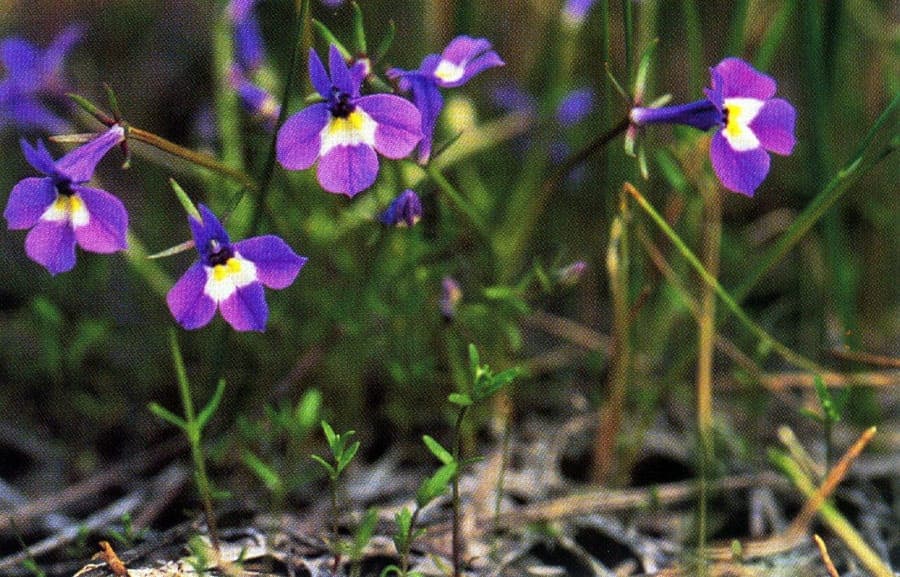
William & Wilma Follette. / Public domain, via Wikimedia Commons
Doublehorn calicoflower: complete guide
Downingia bicornuta
Want to see Doublehorn calicoflower: complete guide in your garden?
1 minute, no credit card
Overview
Downingia bicornuta, commonly known as the doublehorn calicoflower, is a charming annual herb in the family Campanulaceae. Native to the vernal pools, seasonal floodplains and moist grassy depressions of California, Oregon, Nevada and Idaho, this small plant thrives in habitats that flood in winter and early spring but dry out entirely by summer. In those exposed, often nutrient-poor situations, Downingia bicornuta rushes through its life cycle to produce a carpet of tiny purple flowers that few plants can match in a wet season.
Although the species does not appear in mainstream garden centres, it is increasingly available from specialist seed suppliers and native plant seed mixes. Its compact size and surprisingly rich bloom make it an interesting choice for anyone who wants to make use of a wet patch, dress a pond margin, or set up a botanical project with western North American wildflowers. On gardenworld.app you will find design ideas for wet gardens and rain gardens where this kind of unusual annual can play a starring role.
The name bicornuta refers to the two small horn-like protrusions on the lower lip of the flower, a feature that distinguishes this species from the closely related Downingia elegans and Downingia pulchella. The genus Downingia itself is named after Andrew Jackson Downing, a 19th-century American landscape designer. In Europe the plant remains largely unknown outside botanical gardens and enthusiast collections, which makes it all the more rewarding for those who discover it.
Appearance and bloom cycle
Downingia bicornuta is a small, upright annual that rarely exceeds 10 to 25 cm in height. The stems are slender and either unbranched or lightly branched, with small lance-shaped leaves alternately arranged along the stem. The plant is bright green and unassuming when not in flower, but the blooms more than compensate for any plainness in the vegetative phase.
The flowers are two-lipped, a characteristic feature of the Lobelioideae subfamily within Campanulaceae. The upper lip consists of two narrow purple lobes, while the lower lip has three broader lobes that form a flat landing platform for pollinators. The lower lip typically carries white and yellow markings or streaks, along with the two small protrusions or horns that give the species its name. Individual flowers are only 6 to 12 mm across, but they are produced in great numbers so that even a small sowing quickly creates a generously flowering patch.
The flowering period falls in the warm months, usually from May through August depending on when the seed was sown and the prevailing temperatures. As a true annual, Downingia bicornuta completes its entire life cycle within a single growing season: germination, vegetative growth, flowering, seed set and die-back.
Ideal location
The ideal location for Downingia bicornuta is sunny to lightly shaded, but above all wet or at least consistently moist. In its native habitat it grows on the drying margins of seasonal lakes, in seasonally flooded depressions and along the edges of wet meadows. It tolerates temporary waterlogging but also needs a drier phase to flower and set seed successfully.
In the garden it can be used along a pond or stream, in a rain garden (a shallow basin designed to capture run-off), or simply in a perpetually moist corner of a border that is problematic for more drought-tolerant plants. It also suits a large container or tub that is kept thoroughly wet at all times. At least a half day of direct sun encourages the richest bloom.
Soil
Downingia bicornuta is not demanding about soil type as long as it stays moist to wet. In the wild it grows on heavy clay soils with a pH of 6.0 to 8.2, showing that it tolerates mildly alkaline conditions as well as neutral ones. Sandy soil tends to drain too quickly; if you are working with sandy ground, incorporate plenty of clay or well-rotted compost to increase moisture retention.
A low to moderately fertile soil is best. In overly rich soil the plant grows lushly but tends to flower less freely, while in a lean but wet soil the flowering is at its most abundant. Mulching is not strictly necessary on wet sites, but a thin layer at the upper edge of a rain garden can help even out moisture levels.
Free design
Want to see Doublehorn calicoflower: complete guide in your garden? Make a free design now.
Watering
As a plant of wet habitats, Downingia bicornuta needs plenty of water, especially during germination and the early stages of growth. Keep the seed bed or seed tray continuously moist to wet. In open ground alongside a pond or in a rain garden, additional watering is usually unnecessary, but in a standard border the plant will need daily watering during dry spells.
In pots or containers, the bottom layer should stay permanently wet, or the pot can stand in a saucer of water. Once flowering is over and the plant begins to set seed, allowing the soil to become slightly drier stimulates seed ripening. Permanently waterlogged conditions without any drainage can cause root oxygen deficit and weaken the plant.
Pruning
As an annual, Downingia bicornuta requires virtually no pruning. Spent portions can optionally be removed to keep the plant looking tidy, but this is not at all essential. The plant continuously produces new flower buds until the first frost, so spent stems will naturally set seed if left in place.
If you want the plant to self-seed for the following season, allow the stems to ripen fully and let the seeds fall to the ground. In suitably moist conditions, Downingia bicornuta can persist by self-seeding from year to year. If you want to clear the site after the season, simply cut the plants back to ground level and compost the material.
Maintenance calendar
January to February: Plan your sowings. Order seed from a specialist supplier. Prepare the sowing site by loosening the soil and improving moisture retention if needed.
March to April: Sow directly outdoors once the ground is workable and hard frosts are mostly over, or start early indoors at 15 to 20 degrees Celsius. Keep the seed medium moist to wet at all times.
May to June: Seedlings emerge and grow rapidly. Thin to 10 to 15 cm spacing if needed. The first flowers appear.
July to August: Peak flowering period. Enjoy the purple flower carpets. Water as needed. Leave spent stems in place for seed set.
September to October: Seeds ripen. Collect seed for next year if you want to continue growing the species. Plants die off after the first frost.
November to December: Remove dead plant material. Store collected seed in a cool, dry place for the following season.
Winter hardiness
As a true annual, Downingia bicornuta does not survive winter as a mature plant. The entire above-ground plant dies after the first frost. The plant overwinters exclusively as seed in the ground. The seed is cold-tolerant and can overwinter outdoors without problems, germinating the following spring as temperatures rise.
In British or northern European gardens the plant must be resown each year unless it was allowed to set seed on the same spot the previous summer. On warm, moist sites spontaneous self-seeding is quite possible. Seed in pots also overwinters well if the container is left in a sheltered outdoor position. There is no USDA zone rating for true annuals, but the seed tolerates hard frost without difficulty.
Companion plants
Downingia bicornuta combines well with other plants of wet and semi-wet habitats. In a pond margin planting it looks attractive alongside small Carex species, Juncus rushes and low-growing wetland plants such as Veronica beccabunga (brooklime). As an annual ground cover for a temporarily wet summer spot, Mimulus species (monkey flowers) and small Lobelia species make good companions.
In more controlled garden settings it fits naturally into a wet prairie or wetland-themed design. Because it stays so small, it also works well mixed with other miniature plants in a large container of wet soil. For more inspiration on pond and wetland garden designs, visit gardenworld.app.
Closing
Downingia bicornuta is a little-known but botanically fascinating annual that can transform a wet, awkward corner of the garden into a sea of flowers. Its purple blooms with the tiny horn protrusions and white markings on the lower lip are genuinely charming when seen up close. For anyone who wants to clothe a seasonal wet bed, a pond margin or a rain garden with a botanical curiosity, this plant is an excellent choice. Sow early, provide plenty of moisture, and Downingia bicornuta will reward you with an unexpectedly generous flowering display through the heart of summer.
Want to see Doublehorn calicoflower: complete guide in your garden? Make a free design now.
Upload a photo, pick a style, and get a photorealistic design with plant list in under a minute.
10,000+ gardens designed already
No credit card required


Similar plants
Campanula alaskana: complete guide
Campanula alaskana
Discover Campanula alaskana, the delicate alpine bellflower from Alaska. Growing tips, hardy requirements, and design ideas for rock gardens and alpine troughs.
Campanula scouleri: complete guide
Campanula scouleri
Discover Campanula scouleri, the refined Pacific bellflower. Growing tips, care requirements, and design ideas for woodland and mountain gardens.
Phyteuma charmelii: complete guide
Phyteuma charmelii
Phyteuma charmelii is a rare alpine bellflower-family plant with vivid blue flower heads. Learn how to grow it in rock gardens and alpine beds.