
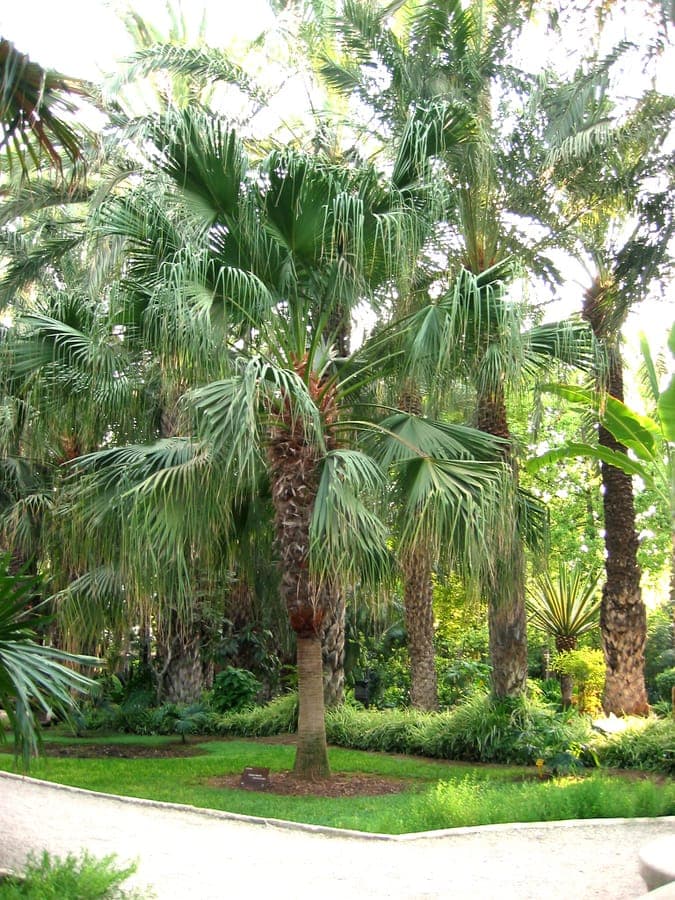
No machine-readable author provided. Cookie assumed (based on copyright claims). / CC BY-SA 3.0, via Wikimedia Commons
Livistona chinensis: complete guide
Livistona chinensis
Want to see Livistona chinensis: complete guide in your garden?
1 minute, no credit card
Overview
Livistona chinensis, better known as Chinese fan palm or fountain palm, is a beautiful plant that brings instant tropical character to your interior or garden. This elegant palm is highly sought after for its characteristic large, fan-shaped leaves that are almost like works of art. The plant originates from South China, Japan, and Taiwan and is now popular worldwide.
Livistona chinensis grows well both indoors and in milder climates outdoors. The plant is relatively low-maintenance and adaptable to various growing conditions. Whether you want an impressive statement piece for your living room or an exotic accent in your front yard, Livistona chinensis is certainly worth considering.
Appearance and Characteristics
Livistona chinensis is a formidable plant with a very characteristic form. The palm grows as a single trunk with large, fan-shaped leaves that can be almost 60-90 centimeters wide. Each leaf is deeply split into long, elegant segments, giving the plant a very decorative appearance.
The plant can eventually become quite large - in ideal conditions up to 10-15 meters tall, though much more slowly in container culture. Even young specimens already have an impressive tropical appearance.
The trunk is noticeably dark brown with attractive leaf scars. Mature plants produce small, yellow flowers followed by blue berries, although this rarely occurs in indoor-grown specimens.
Ideal Location
Livistona chinensis thrives optimally in bright, indirect light. A location near a bright window, but out of direct sunlight, is ideal. The plant can tolerate some direct sun, but too much can cause leaf scorch.
Indoors, the plant is perfect as a statement piece in a large living room or atrium. Outdoors (in mild climate), it grows well in partial shade to lightly dappled conditions, protected from strong winds.
The plant needs considerable space - it's not a compact plant. Don't plant it in small corners, but rather choose a spot where it has room to grow.
Soil and Potting
Livistona chinensis grows well in nutrient-rich, well-draining potting soil. For indoor use, combine standard potting soil with some extra perlite or sand for better drainage. Heavy clay-like soil is not suitable.
The plant prefers neutral to slightly acidic soil (pH 6.0 to 7.0). For outdoor cultivation in mild climates, ensure well-draining soil, possibly enriched with organic material.
Ensure good drainage in pots - use large containers with drainage holes at the bottom. Repot every 2-3 years as the plant grows.
Watering
Livistona chinensis prefers regular water, but not waterlogging. Ensure the soil dries out somewhat between waterings. During the growing period (spring and summer), water regularly, but less in winter.
Indoor plants: Check the soil regularly and water when the top centimeter feels dry. Regularly mist the leaves to remove dust and provide humidity.
Outdoor plants: Ensure regular watering during the growing season. In dry periods, daily watering may be needed. In winter when the plant is dormant, much less water.
The plant can suffer from very dry air - ensure adequate humidity.
Free design
Want to see Livistona chinensis: complete guide in your garden? Make a free design now.
Feeding
Livistona chinensis is a moderate feeder. During the growing period (May to September), you can feed monthly with balanced plant food. Always follow product instructions.
Avoid overfeeding - this can cause unpleasant salt buildup in potting soil. Light feeding is better than excessive.
Pruning and Maintenance
Livistona chinensis needs almost no pruning. You can gently remove brown or damaged leaves, but avoid pruning healthy green leaves.
Regularly remove dead or yellow leaves at the bottom. This is normal as the plant grows.
Regularly clean the leaves with a soft, damp cloth to remove dust. This helps the plant breathe better.
Maintenance Calendar
March-May: Growing season begins. Start regular feeding. Increase watering.
June-September: Peak growth period. Regular watering. Monthly feeding. Mist leaves.
October-November: End of growing period. Gradually reduce feeding and watering.
December-February: Resting period. Minimal watering. No feeding. Maintain good humidity.
Winter Hardiness
Livistona chinensis is not frost-hardy and cannot tolerate frost. In temperate regions, outdoor growing is only possible in very mild microclimates (for example, coastal areas).
The plant is much better suited for indoor growing. In warm greenhouses or winter gardens, it grows beautifully. Minimum temperature is about 10-13 degrees Celsius - below this temperature, the plant will experience stress.
If you grow it outdoors in a temperate climate, bring the plant indoors before the first frost.
Pests and Diseases
Livistona chinensis can suffer from spider mites, mealybugs, and fungal issues if humidity is too low. Mist regularly with water to prevent problems.
Overwatering can cause root problems. Ensure good drainage and don't let it sit in water.
Companion Plants (for indoor culture)
Livistona chinensis looks beautiful as a solo plant because it's already a statement. For multi-plant schemes, combine it with smaller foliage plants in complementary pots.
Examples: pothos, scindapsus, or philodendron as groundcover, or calathea as mid-ground plant.
Closing Thoughts
Livistona chinensis is undoubtedly one of the most spectacular foliage plants you can have in your home. With its enormous, fan-shaped leaves and tropical appearance, it will guaranteed attract attention. Although it needs some space and regular care, it's absolutely worth the effort. Whether you put it in your living room or grow it in a mild garden, Livistona chinensis will certainly be a unique addition. Available at gardenworld.app.
Want to see Livistona chinensis: complete guide in your garden? Make a free design now.
Upload a photo, pick a style, and get a photorealistic design with plant list in under a minute.
No credit card required


Similar plants
Needle palm: complete guide
Rhapidophyllum hystrix
Everything about the needle palm: the world's hardiest palm, suitable for gardens in temperate climates down to USDA zone 7b.
Saw palmetto: complete guide
Serenoa repens
A complete guide to saw palmetto (Serenoa repens), the iconic fan palm from Florida and the southeastern United States, prized for its toughness.
Puerto Rican hat palm: complete guide
Sabal causiarum
Grow Puerto Rican hat palm successfully. A majestic fan palm with tropical presence suited to sheltered Mediterranean-style gardens.