
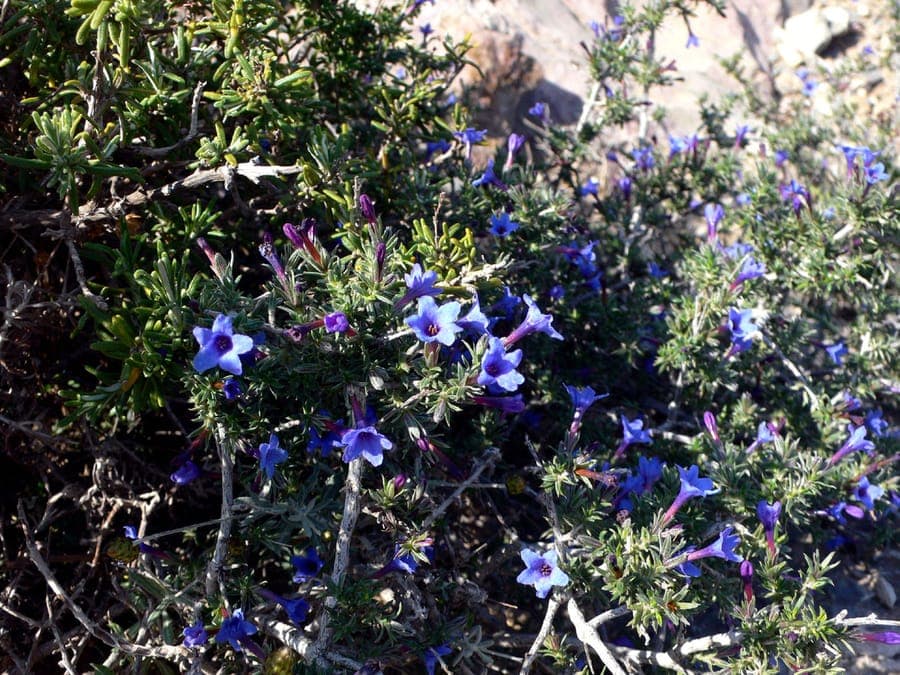
Nanosanchez / Public domain, via Wikimedia Commons
Shrubby gromwell: complete guide
Lithodora fruticosa
Want to see Shrubby gromwell: complete guide in your garden?
1 minute, no credit card
Lithodora fruticosa, also known as Shrubby gromwell, is an enchanting little shrub from the Boraginaceae family. This plant originates from southern France to northwestern Africa, with distribution throughout the western Mediterranean region. In temperate climates, this interesting little plant can be cultivated in warm, dry gardens and rock gardens in Mediterranean style.
The plant grows as a compact, low shrub typically reaching 30 to 60 centimeters in height. The leaves are small, narrow, and dark green in color. During spring (April through June), the plant produces numerous small, funnel-shaped flowers in shades ranging from blue to deep purple. These enchanting flowers are very striking and attract many nectar-seeking insects.
Lithodora fruticosa thrives best in full sun and in very warm, dry locations. The plant prefers well-draining, slightly poor soil and performs very poorly in wet feet conditions. In temperate climates, this little plant is best cultivated in very warm, protected garden corners, on south-facing borders, and in rock gardens with exceptionally good drainage.
When planting, it is essential to use a very well-draining growing medium. A mixture of alpine soil, sand, and fine gravel creates an ideal growing medium. This plant cannot tolerate water excess and does not tolerate waterlogging at all. This little plant requires perfectly drained soil.
Watering must be done very carefully, especially during the growing season. Allow the soil to dry slightly between waterings, but ensure it does not dry out completely. In summer, the plant requires regular watering, but in winter, water minimally, as the plant enters dormancy during this period. Excessive water inevitably leads to root rot in this sensitive little plant.
Feeding is not very important for this small plant. Minimal or no feeding is preferred. Excessive fertilizer can lead to luxuriant foliage growth without many flowers. If feeding is necessary, apply only very carefully a highly diluted solution in early spring.
Lithodora fruticosa thrives best in full sun. The plant requires at least 6 to 8 hours of direct sunlight daily. In areas with very hot summers, some light afternoon shade may be beneficial, but in most temperate climates, full sun is recommended.
Pruning should be done after the flowers fade. Gently cutting back the plant stimulates compact, fuller growth. Remove all dead or damaged branches, but be careful with pruning, as this plant is sensitive to heavy cutting.
This little plant is not very susceptible to pests and diseases. In very humid conditions, however, fungi and rot can occur. Ensure good air circulation and avoid wetting the foliage to prevent fungal diseases. In very dry conditions, spider mites can sometimes become a problem.
Lithodora fruticosa is not winter-hardy in northern temperate regions, but can overwinter outdoors with protection in southern temperate areas. In the rest of temperate climates, the plant must spend winter indoors or in a frost-free greenhouse. The plant can, however, be easily grown from seed or from soft cuttings taken in summer.
This little plant is for the enthusiast of Mediterranean and heat-loving plants. The plant is very suitable for rock gardens, alpine troughs, Mediterranean-style gardens, and for growing in containers that can be brought indoors for winter.
Reproduction can be done via seed or via soft cuttings. Soft cuttings can be taken in summer and must be rooted under humid, warm conditions in a frost-free greenhouse. Seeds can be sown in spring on very well-draining growing medium.
Lithodora fruticosa is a plant for the true plant enthusiast and for those who enjoy small, elegant Mediterranean shrubs. It is certainly worth the effort to integrate this interesting little plant into your warm garden or greenhouse. The enchanting blue flowers and compact growth form make it an attractive element for Mediterranean compositions. At specialty nurseries, you may find young plants when the season is favorable.
This little plant works excellently with other Mediterranean plants such as lavender, rosemary, and other heat-loving shrubs. It gives a true, authentic Mediterranean character to any garden.
Want to see Shrubby gromwell: complete guide in your garden? Make a free design now.
Upload a photo, pick a style, and get a photorealistic design with plant list in under a minute.
No credit card required


Similar plants
Western waterleaf: complete guide
Hydrophyllum occidentale
Full growing guide for western waterleaf (Hydrophyllum occidentale): shade tolerance, soil needs, watering, winter hardiness and naturalistic garden use.
Limestone phacelia (Phacelia affinis): complete guide
Phacelia affinis
Full guide to Phacelia affinis, the limestone phacelia: sowing tips, purple-blue bee flowers, drought tolerance and uses in dry or wildlife gardens.
Pyrenean viper's bugloss: complete guide
Echium asperrimum
Echium asperrimum is a striking biennial from the western Mediterranean with rough bristly stems and vivid blue flowers. A magnet for bees and a bold border plant.