
Dcrjsr / CC BY 3.0, via Wikimedia Commons
Prickly phlox: complete guide
Linanthus pungens
Want to see Prickly phlox: complete guide in your garden?
1 minute, no credit card
Overview
Linanthus pungens, commonly known as prickly phlox or granite prickly phlox, is a compact, somewhat woody perennial subshrub in the family Polemoniaceae. The species was formally described in 2000 by J.M. Porter and L.A. Johnson and is native to the western parts of North America, ranging from British Columbia in Canada south through the Sierra Nevada and Rocky Mountains to Arizona, Utah, New Mexico, and into northwestern Mexico (Baja California). In its natural habitat, it grows on rocky slopes, granite outcrops, and dry mountain passes, typically at elevations between 1,000 and over 3,000 metres.
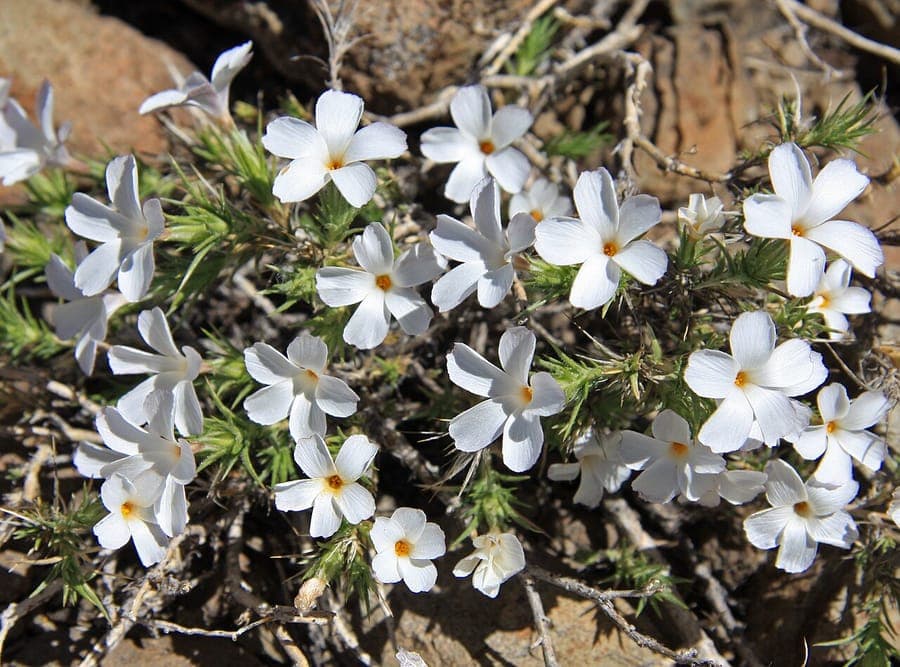
The species name 'pungens' is Latin for sharp or stinging, a direct reference to the needle-like leaf tips that deter browsing animals. This is an adaptation to the harsh, nutrient-poor environments where the plant must conserve as much material as possible. The flowers are deceptively beautiful for such a spiny, austere-looking plant: cream-white to light violet, funnel-shaped, and borne in profusion across the branch tips in spring and early summer.
In horticulture, Linanthus pungens has attracted attention as a choice plant for rock gardens, xeriscape plantings, and dry Mediterranean-style garden designs. It performs particularly well alongside other drought-tolerant North American natives and in gravel or scree beds where drainage is excellent. Its prickly texture provides interesting contrast with softer neighbouring plants. Visit gardenworld.app to see how plants like Linanthus pungens can be incorporated into contemporary garden designs.
The plant has a multi-stemmed growth form with moderate growth rate. Mature specimens in the wild may reach 30 to 60 cm across and 20 to 50 cm tall, though in cultivation size varies considerably with soil richness, light exposure, and moisture availability.
Appearance & bloom cycle
Linanthus pungens has a multi-stemmed, cushion-forming to somewhat upright habit. The stems are woody at the base, giving the plant the character of a low shrub or subshrub. The leaves are needle-like, described as fine in texture in botanical records, extremely sharp-tipped - the origin of both the common name 'prickly phlox' and the Latin epithet pungens. Leaves are green to grey-green, densely packed along the stems, producing a tight, spiny cushion appearance throughout the year.
The flowers are spectacular relative to the modest size of the plant. They are funnel-shaped to saucer-shaped, five-petalled, and range from bright white to cream with occasional light violet or pink tinges on the outer petals. Flowers appear densely at the stem tips, covering the plant almost entirely during peak bloom. This floriferousness surprises many gardeners encountering the species for the first time, given how understated and compact the plant is outside flowering season.
The bloom period is typically April to June at lower elevations, and June to August at higher mountain elevations. In European gardens, expect flowering from April through June in coastal and mild regions, and May through July in more continental settings. Flowers open during daylight hours and close at night or during overcast conditions.
After flowering, small seed capsules develop and split open to release the seeds. The plant self-seeds modestly in rock garden settings but is not aggressive. Even after flowering, the fine needle-like foliage provides interesting texture and structure throughout the remainder of the growing season and into winter.
Ideal location
As a mountain plant adapted to high-elevation, open environments, Linanthus pungens has a strong preference for full sun. The plant is adapted to intense solar radiation in rocky, treeless landscapes. In European gardens, a south-facing or south-west-facing position gives the best results. The plant tolerates light shade, but flowering decreases significantly and the cushion habit becomes looser and less attractive.
In rock gardens, the plant performs best when planted in crevices between rocks or on ledges where water drains away rapidly. Positioning the crown (the junction of roots and stems) above the surrounding soil level helps prevent moisture accumulation around the base, which is the single greatest threat to this plant in cultivation. A slope of 30 to 45 degrees in a rock bed is ideal.
The plant is well suited to container growing provided drainage is generous. A pot with large drainage holes and a 5 cm layer of coarse grit or broken crocks at the base gives excellent results. Position the container in a sunny, somewhat sheltered spot, protected from prolonged winter rain, as wet roots during cold weather are the main cause of failure in this species.
Soil requirements
The soil preferences of Linanthus pungens reflect its rocky, nutrient-poor native habitat. It performs best in lean, sharply draining, sandy to gravelly substrate. The ideal pH range is 6.0 to 8.0, making the plant adaptable to both slightly acidic and alkaline, lime-rich soils. This flexibility makes it particularly versatile for rock gardens where soil chemistry varies with the type of stone used.
Heavy, moisture-retentive clay soils are completely unsuitable. On such soils, root rot develops quickly, a problem exacerbated by the typically high moisture levels of average European climates. Improve heavy soils substantially: remove existing soil to a depth of 30 to 40 cm and replace with a mix of 60% coarse builder's sand, 30% stone chippings or pea gravel, and 10% lean loam or sandy garden soil.
Fertilisation is generally unnecessary and often counterproductive. Rich feeding leads to lush but weak growth that is more disease-prone and less compact. If the plant appears to slow down after the first two or three years, a small application of a low-nitrogen, high-potassium fertiliser in spring can stimulate flowering without promoting excessive vegetative growth.
Free design
Want to see Prickly phlox: complete guide in your garden? Make a free design now.
Watering
Linanthus pungens is a strongly drought-tolerant plant that in its natural range thrives on minimal precipitation, largely from snowmelt and infrequent rain showers. In the garden, this means that once established, the plant requires little to no supplemental watering except during extreme drought.
The first summer after planting is the only period where active watering attention is necessary. Plant in autumn if possible, allowing the winter months for root establishment before the first summer. Water weekly to every two weeks in the first year, depending on heat and dryness. Once established - typically after one full growing season - watering can be greatly reduced.
In the wetter parts of northern Europe, supplemental watering is rarely needed once the plant is established. The greater challenge is preventing excess moisture, not providing enough. Excessive winter rain can cause damage that summer drought never would. A protective overhang, a gravel mulch layer around the base, or placing the plant in a naturally sheltered niche can help manage winter moisture.
In dry summers: watering once a month deeply is sufficient for established plants. Avoid watering in the evening due to the risk of fungal disease. Drip irrigation directly to the root zone is preferable to overhead watering.
Pruning
Linanthus pungens needs little pruning but benefits from light trimming to stay compact and to rebloom well. Prune immediately after flowering - in June or July depending on the local blooming period - cutting back the spent flower-bearing stem tips by about one-third of their length. This stimulates the formation of new lateral shoots and results in a tighter, more attractive cushion habit.
Never prune hard in autumn or early winter, as fresh cut surfaces become entry points for frost damage. Cutting back deeply into old, woody stems is not recommended either: the plant regenerates poorly from old wood and may decline fatally. Always prune back to just above a visible growing bud or lateral shoot.
Dead or damaged branches can be removed at any time of year. Use clean, sharp secateurs to prevent ragged wounds that invite disease. In spring, before new growth commences, assess the overall structure of the plant and remove any winter casualties.
Maintenance calendar
January to February: Plant is relatively inactive. Check that drainage around the crown is functioning well, especially during freeze-thaw cycles when large volumes of water are released. Protect the plant during prolonged frosts below -10 °C with a layer of pine branches or burlap.
March: Check for winter damage. Remove demonstrably dead branches. At the first signs of new growth, a small dose of low-nitrogen fertiliser can be applied.
April: First flowers appear in early regions and mild climates. Enjoy the bloom. No special garden tasks required.
May: Full bloom. Maximum ornamental value. No watering required unless exceptionally dry.
June to July: Bloom ends. Immediately after the last flowers fade: prune back flowering tips by one-third. This is the most important maintenance task of the year.
August to September: New growth following pruning. Plant recovers and builds energy reserves for the next season.
October: New plants can be planted this month. Ensure good rooting before winter.
November to December: Do not remove green foliage. The plant needs it for photosynthesis during mild winter spells. Protect only during hard frost.
Winter hardiness
Linanthus pungens is surprisingly winter-hardy for a plant from the high mountains of western North America. In its natural range, it withstands heavy snowfall and temperatures of -20 °C and below, but always under dry conditions - snow covers and insulates the plant while keeping it dry and protected from wet frost.
In European climates, the picture is more nuanced: the combination of moderate cold and high humidity, particularly wet winters, is the greatest threat to this plant in cultivation. The plant is rated for USDA zones 5 to 7, covering virtually all of the Netherlands, Belgium, and much of Germany, but actual survival in the garden depends heavily on drainage conditions. A well-draining, deep rock bed or raised bed is essential for successful overwintering in average European gardens.
For container-grown plants: protect the container during sustained frost below -8 °C by moving it to a cold but frost-free shed or unheated greenhouse. The plant needs some light in winter, making an unheated conservatory or greenhouse ideal. Avoid keeping it too warm in winter: forced early growth produces soft, vulnerable shoots that can be destroyed by the late frosts that commonly occur in March and April.
Companion plants
Linanthus pungens associates best with other drought-tolerant, sun-loving rock garden plants. Excellent combinations include:
-
Phlox subulata (moss phlox): a close relative with comparable growing requirements. The cushion habit and prolific flowering make a beautiful pairing. Available in pink, white, or lilac, complementing the cream-white blooms of Linanthus.
-
Artemisia schmidtiana 'Silver Mound': silver-white, cushion-forming foliage that provides elegant contrast to the green, spiny mass of Linanthus pungens. Both plants are compact and drought-tolerant.
-
Dianthus deltoides (maiden pink): small, delicate carnation-like flowers in pink or red, excellent in lean rock gardens. Comparable soil and light requirements.
-
Sedum acre (biting stonecrop): a low-growing succulent for the driest, poorest positions. Fills spaces between rocks and provides a living undercarpet.
-
Achillea tomentosa (woolly yarrow): yellow flower heads on 15 to 20 cm stems, excellent for dry rock gardens. Shares the preference for lean, sharply draining substrate.
Space Linanthus pungens at least 30 cm from neighbouring plants to ensure adequate air circulation and room for the spiny cushion to develop.
Conclusion
Linanthus pungens is a botanical treasure for the dedicated gardener who appreciates unusual, specialist plants. The combination of spiny texture, spectacular flowering, and extreme drought tolerance makes it unique in the horticultural palette. In the right environment - a sunny, well-drained rock bed or calcareous slope - it delivers a beautiful floral display year after year with minimal care.
For a complete garden design incorporating rock plants and drought-tolerant species, visit gardenworld.app and discover how even the driest and least fertile spot in your garden can be transformed into a flowering focal point.
Want to see Prickly phlox: complete guide in your garden? Make a free design now.
Upload a photo, pick a style, and get a photorealistic design with plant list in under a minute.
10,000+ gardens designed already
No credit card required


Similar plants
Phlox alyssifolia: complete guide to Alyssum-leaf Phlox
Phlox alyssifolia
Alyssum-leaf phlox is a compact alpine pink bloomer from North America. Discover care, location and all growing requirements.
Phlox richardsonii: complete guide to Richardson's Phlox
Phlox richardsonii
Richardson's phlox is an arctic bloomer exceptionally robust. Learn cultivation in extreme conditions and complete care guide.
Polemonium foliosissimum: complete guide
Polemonium foliosissimum
Polemonium foliosissimum is a vigorous Rocky Mountain perennial with blue-purple summer flowers that attract pollinators and thrive in borders.