
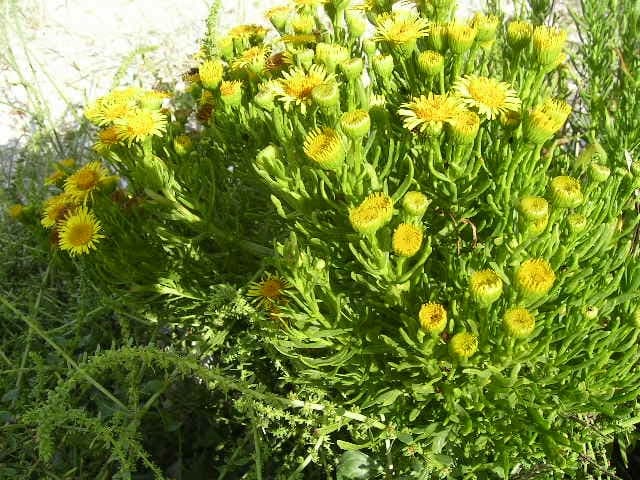
Chilepine / Public domain, via Wikimedia Commons
Golden samphire: complete guide
Limbarda crithmoides
Want to see Golden samphire: complete guide in your garden?
1 minute, no credit card
Limbarda crithmoides, known as Golden samphire or Salz-Alant in German, is a fascinating coastal plant from the Asteraceae family. This plant originates from northwestern and southwestern Europe, naturally occurring along coastlines from France to Spain. In temperate climates, this plant is excellent for seaside and coastal gardens, as well as for dry, nutrient-rich growing locations.
The plant forms a compact, shrubby growth pattern reaching approximately 30 to 60 centimeters in height. The leaves are narrow, linear, and grey-green in color, giving the plant fine textural qualities. In August and September, the plant produces numerous tiny yellow flowers arranged in clustered, umbrella-like formations. These flowers attract many nectar-seeking insects.
Golden samphire thrives best in full sun and in warm, dry locations. The plant has remarkable salt tolerance and can grow in salty, windy coastal conditions where other plants would fail. This makes it an ideal plant for seaside gardens and coastal landscapes. The plant is also very drought-tolerant once established.
When planting, it is important to position the plant in a very well-draining location. Limbarda crithmoides tolerates very nutrient-rich, often lime-rich soils. The pH value can range from 7.5 to 8, which is slightly alkaline. This is actually beneficial for this plant which naturally grows in salty, lime-rich coastal conditions.
Watering should be limited, especially once the plant is well-established. For young plants, water regularly until they are well-established, then watering can be drastically reduced. Established plants need virtually no water and can thrive entirely on rainfall.
Feeding is not essential for this plant. Excess fertilizer can cause lush growth without many flowers. Light feeding in early spring can, however, be welcome to start the growing season well.
Limbarda crithmoides is winter-hardy in temperate climates and can remain outdoors year-round. The plant can tolerate heavy winters and frost, although it prefers a dry winter location. In very wet winters, prolonged water excess can cause problems.
Pruning should be done in early spring or after the flowers fade. Lightly pruning the plant stimulates compact, fuller growth. Remove all dead or damaged branches.
Pests are rarely a problem for this salt-resistant plant. In very humid conditions, however, fungi can occur. Ensure good air circulation and avoid wetting the foliage to prevent fungal diseases. In very dry conditions, spider mites can sometimes become a problem.
Limbarda crithmoides is an excellent plant for seaside gardens, coastal landscapes, dry rock gardens, and for filling difficult dry corners in the garden. The plant looks beautiful when planted in groups and can be used to create fine structural effects in garden design.
This plant works excellently with other coastal plants such as lavender, rosemary, and other dry-soil plants. It gives a natural, relaxed character to coastal-style gardens.
In temperate regions, you can find this plant at some specialist garden centers specializing in coastal or Mediterranean plants. At larger garden centers, you may find it occasionally, especially during the growing season.
Limbarda crithmoides is a valuable addition to any garden where you need a salt-tolerant, dry-ground plant. The yellow flowers appear precisely when many other plants are fading, making it a useful addition to the autumn garden. With minimal care, this plant will provide golden flowers for many years.
Want to see Golden samphire: complete guide in your garden? Make a free design now.
Upload a photo, pick a style, and get a photorealistic design with plant list in under a minute.
No credit card required


Similar plants
Calendula stellata: complete guide
Calendula stellata
Complete guide to Calendula stellata, the star-flowered marigold from Sicily: location, soil, watering and companion planting tips.
Korean chrysanthemum: complete guide
Chrysanthemum x rubellum
Chrysanthemum x rubellum is a hardy autumn perennial with single pink to copper flowers from August to November. Care and combinations.
Helianthus divaricatus: complete guide
Helianthus divaricatus
Helianthus divaricatus is a North American woodland sunflower with yellow summer blooms, ideal for naturalistic borders and shady edges.