
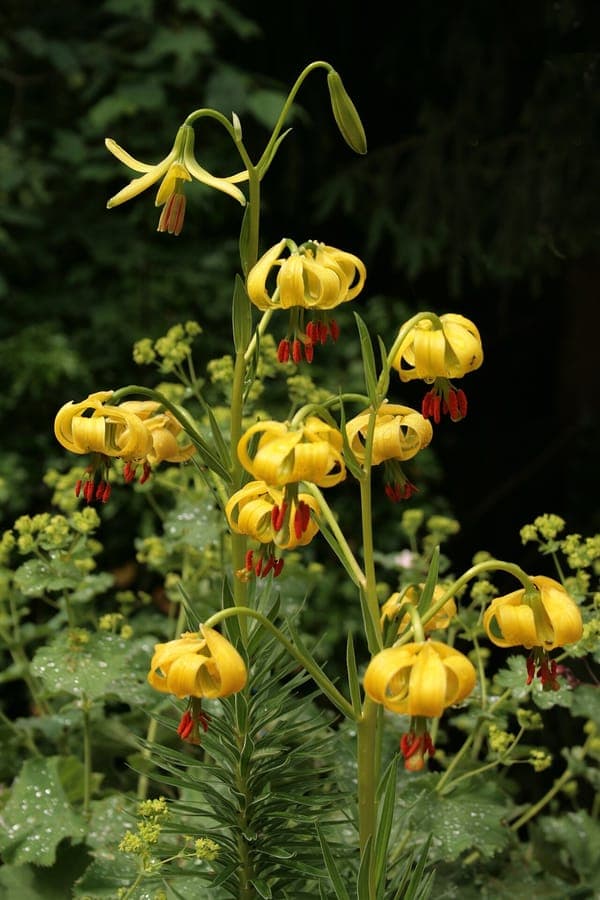
Jean-Pol GRANDMONT / CC BY-SA 3.0, via Wikimedia Commons
Pyrenean lily: complete guide
Lilium pyrenaicum
Want to see Pyrenean lily: complete guide in your garden?
1 minute, no credit card
Overview
Lilium pyrenaicum, commonly known as the Pyrenean lily, is a graceful perennial bulb native to mountainous regions of southern France and northern Spain. Unlike its flamboyant Asiatic cousins, this lily thrives on subtlety-offering delicate, nodding yellow blooms atop slender stems that sway gently in the breeze. It's a reliable performer in temperate gardens, blooming in early summer and returning year after year with minimal fuss. For gardeners seeking a naturalistic, low-maintenance bulb with charm rather than flash, this species fits the bill.
On gardenworld.app, you can visualise how Lilium pyrenaicum fits into your garden layout alongside companion plants and seasonal bloomers.
Appearance & bloom cycle
This lily grows between 60 and 90 cm tall, with upright, slightly hairy stems and narrow, lance-shaped green leaves arranged in a spiral pattern. From May through July, it produces 3 to 7 downward-facing, trumpet-shaped flowers per stem. The petals are a rich, buttery yellow, occasionally marked with fine green or orange streaks near the base. The blooms are lightly fragrant, attracting bees and hoverflies without overwhelming the senses.
In cooler climates, flowering starts in late May; in warmer zones, it may begin in early May. Peak bloom usually occurs in June. The plant dies back completely by late autumn, with the bulb entering dormancy until the following spring.
Ideal location
Lilium pyrenaicum prefers a spot with at least 6 hours of direct sunlight per day (light level 6 on a scale of 10). Full sun is acceptable if the soil stays consistently moist but well-drained. A partially shaded site in the afternoon-especially in hot summer regions-helps prevent stress. Ideal locations include the middle of a mixed border, the edge of a woodland garden, or a rock garden with good air circulation.
Avoid deep shade or areas under dense tree canopies, as this will reduce flowering. Use gardenworld.app to map sun exposure in your garden and pinpoint the best microclimate for your lilies.
Soil requirements
Well-drained soil is non-negotiable. This lily hates wet feet and will rot in heavy clay or compacted soil. Aim for a loamy or sandy loam mix with a pH between 6.5 and 7.0. If your soil is clay-heavy, amend planting holes with grit, perlite, or coarse sand, and incorporate organic matter like leaf mould or compost.
Do not add lime unless a soil test shows acidity below pH 6.0. Excess alkalinity can cause chlorosis and poor root development.
Free design
Want to see Pyrenean lily: complete guide in your garden? Make a free design now.
Watering
Water regularly during the growing season (April to July), especially in dry springs. Keep the soil evenly moist but never soggy. Once blooming ends, reduce watering gradually to allow the bulb to harden off for dormancy.
Avoid overhead watering to prevent fungal diseases like botrytis. A soaker hose or watering at soil level is ideal. In containers, ensure pots have drainage holes and use a gritty compost mix.
Pruning
No pruning is needed. Allow the foliage to die back naturally-do not cut it down while still green. The leaves feed the bulb for next year's growth. Only remove stems when they are fully brown and dry, usually by late September or October.
Cutting too early weakens the bulb and may result in smaller flowers or no bloom the following year.
Maintenance calendar
- March–April: Watch for emerging shoots. Protect from slugs with organic pellets or copper tape.
- May–July: Peak growth and bloom. Water during dry spells. Stake if needed in windy areas.
- August: Reduce watering. Keep soil slightly drier as foliage begins to yellow.
- September: Cut back dead stems. Leave bulb in ground.
- October–February: Dormant period. No care required. In wet areas, consider light mulch to protect from rot.
Winter hardiness
Hardy in USDA zones 5 to 8 (-23°C to -12°C). The bulbs can remain in the ground year-round in most temperate climates as long as drainage is excellent. In areas with prolonged wet winters, lift and store bulbs in dry sand or perlite, or apply a light mulch of pine bark to improve drainage.
Potted plants should be moved to a sheltered spot or wrapped to prevent freeze-thaw cycles that damage bulbs.
Companion plants
Pair with Allium karataviense for structural contrast, or Nepeta racemosa for soft purple accents. It works well with Eryngium, Sedum, and Festuca ovina in gravel gardens. Avoid aggressive spreaders like Bergenia or Mint, which can crowd out the lily.
In mixed borders, plant behind early perennials like Polemonium or Campanula to hide bare lower stems.
Closing
The Pyrenean lily is not the loudest voice in the garden, but it's one of the most authentic. Its quiet beauty fits perfectly in naturalistic designs, cottage gardens, or alpine rockeries. Plant bulbs in autumn (September to October) at a depth of 15–20 cm, spaced 15 cm apart. Purchase healthy, firm bulbs from trusted garden centres or online retailers. With proper siting and care, Lilium pyrenaicum will reward you with reliable blooms for years. It's a plant that earns its place not through spectacle, but through quiet persistence. For design inspiration, check gardenworld.app to simulate seasonal changes and plan long-term bulb displays.
Want to see Pyrenean lily: complete guide in your garden? Make a free design now.
Upload a photo, pick a style, and get a photorealistic design with plant list in under a minute.
No credit card required


Similar plants
Reverchon's gagea: complete guide
Gagea reverchonii
Full guide to Gagea reverchonii, Reverchon's gagea: rare Pyrenean bulb with bright yellow spring flowers, soil needs and companion planting.
Leafy gagea: complete guide
Gagea foliosa
Gagea foliosa is a rare Mediterranean bulb with bright yellow star-shaped flowers blooming February to March in well-drained rocky settings.
Tubular gagea: complete guide
Gagea fragifera
Gagea fragifera is a mountain bulb with golden-yellow star flowers blooming May to July on subalpine slopes from Europe to the Himalaya.