
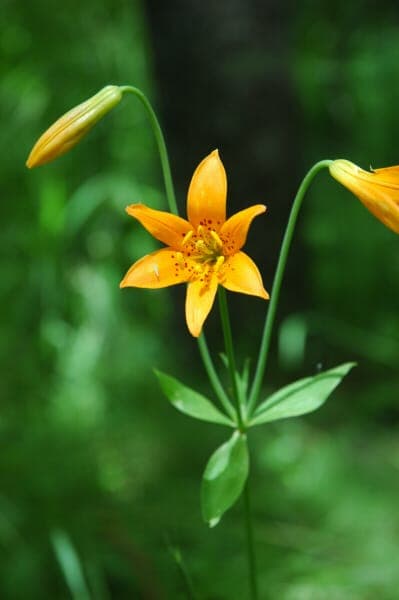
John Loganecker / Public domain, via Wikimedia Commons
Lilium parvum: complete guide
Lilium parvum
Want to see Lilium parvum: complete guide in your garden?
1 minute, no credit card
Overview
Lilium parvum, known as Alpine lily or Sierra lily (sometimes also called sierra tiger lily), is a beautiful native lily species of the Sierra Nevada mountain range in northern California and western Nevada. In the wild, this lily grows in moister mountain meadows at elevations of 1,200-3,000 meters, where soil is often acidic, moister, and humus-rich. The Alpine lily is highly attractive to collectors, not so much to general gardeners, because of its striking small flowers and demanding growth requirements. Once established in the right moister, acidic soil, this lily can grow and bloom for many years.
Appearance and Bloom
The Alpine lily grows as a small to medium-sized lily species, usually 30-90 centimeters tall, much shorter than many other lilies. The leaves are narrow, line-like, and scattered along the thin stem. What makes this lily special are its small yet brilliant flowers. The flowers are trumpet- or bell-shaped, usually bright yellow, orange-yellow, or red-orange in color. Each flower hangs slightly downward, allowing their undersides to be clearly visible. Flowers typically appear in June-July, sometimes later at higher elevations. Each stem usually bears 2-10 flowers in a loose cluster. The fragrance of Alpine lilies is virtually absent, so flowers must rely on color for appeal. This lily produces small seeds in capsules after flowering.
Ideal Location
Alpine lilies grow best in partial shade to bright shade - they prefer 2-3 hours of direct sunlight daily combined with bright, filtered light for the rest of the day. In warmer climates, they must absolutely be protected from afternoon heat and intense sun. This plant grows in its natural habitat in open mountain meadows where conditions are moister and cooler. Plant in a location with good air circulation but protected from strong wind. Ensure the plant is not positioned at the base of a warm wall.
Soil
Soil is critical for Alpine lilies. This plant is very demanding and grows best in acidic, moister, humus-rich soil that mimics mountain meadow conditions in the wild. Create a mix consisting of:
- 50% acidic, moister humus (e.g., acidic leaf mold, peat soil)
- 20% coarse sand
- 15% garden soil
- 15% extra sand and charcoal
PH must be distinctly acidic (pH 5.5-6.0). This is not a plant for neutral or alkaline soil. Adding decomposed leaves, sphagnum moss, or birch bark helps. Good drainage is essential - stagnant water will cause root rot despite preference for moisture.
Free design
Want to see Lilium parvum: complete guide in your garden? Make a free design now.
Watering
Alpine lilies need moister soil, but it's a difficult balance. Water regularly so the soil never completely dries out but also doesn't become boggy. Deep watering once weekly is usually appropriate, more during very warm periods. In mountain conditions in nature, these lilies receive moister soil from snowmelt and frequent mountain rains. In a dry garden, you must imitate this. Water at the base, not over foliage. In autumn, gradually reduce watering as the plant dies back. In winter, water minimally - just enough to keep bulbs dry but not dehydrated.
Pruning
Alpine lilies require no real pruning. Remove spent flowers (deadheading) to prevent seed development. Leave foliage untouched until it naturally yellows and dies back in autumn - then cut dead stems to ground level. Remove diseased leaves immediately.
Maintenance Calendar
April: Gradually increase watering, check drainage. May-July: Regular watering, remove spent flowers. August-September: Gradual reduction of watering. October-March: Minimal watering, plant dormant. Year-round: Check for slugs, monitor acidic soil pH.
Winter Hardiness
Alpine lilies are hardy to approximately -20 degrees Celsius in most parts of Northern Europe. They can overwinter outdoors in well-drained, acidic soil. Ensure excellent drainage in winter - stagnant water around bulbs will cause rotting. Mulch around the plant in October with a layer (5-8 cm) of acidic material such as decomposed leaves or pine needles. Remove this mulch carefully in April when new growth begins.
Companion Plants
Alpine lilies combine well with other mountain plants that prefer acidic, moister soil:
- Rhododendron
- Azalea
- Skimmia
- Pieris
- Gaultheria
- Digitalis (Foxglove)
- Polemonium (Jacob's ladder)
Plant them together in groups in the acidic garden.
Conclusion
The Alpine lily is absolutely for enthusiasts, not beginners. It requires patience, attention to detail, and lots of love. But for those willing to create an acidic, moister mountain environment, this striking small lily offers incredible rewards. Once established, the Alpine lily will last for decades. Consult specialized lily collectors or gardenworld.app for cultivated specimens and expert advice.
Want to see Lilium parvum: complete guide in your garden? Make a free design now.
Upload a photo, pick a style, and get a photorealistic design with plant list in under a minute.
No credit card required


Similar plants
Reverchon's gagea: complete guide
Gagea reverchonii
Full guide to Gagea reverchonii, Reverchon's gagea: rare Pyrenean bulb with bright yellow spring flowers, soil needs and companion planting.
Leafy gagea: complete guide
Gagea foliosa
Gagea foliosa is a rare Mediterranean bulb with bright yellow star-shaped flowers blooming February to March in well-drained rocky settings.
Tubular gagea: complete guide
Gagea fragifera
Gagea fragifera is a mountain bulb with golden-yellow star flowers blooming May to July on subalpine slopes from Europe to the Himalaya.