
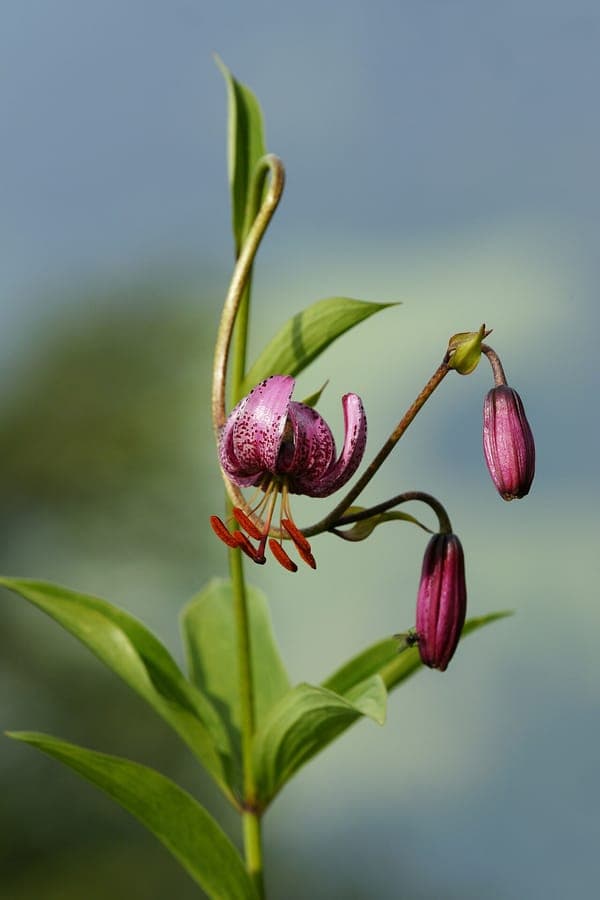
böhringer friedrich / CC BY-SA 2.5, via Wikimedia Commons
Turk's-cap: complete guide
Lilium martagon
Want to see Turk's-cap: complete guide in your garden?
1 minute, no credit card
Overview
Lilium martagon, commonly known as Turk's-cap lily, is a graceful perennial bulb that thrives in cool, partially shaded gardens across Europe. Unlike many lilies that demand full sun, this species prefers dappled light and well-drained soil, making it a standout choice for woodland edges, shaded borders, or naturalised plantings. Native to forested slopes from the Baltics to the Balkans, it brings a wild, romantic charm to the garden with its drooping, turban-like blooms and tall, slender stems.
On gardenworld.app, you can design a garden layout that highlights Turk's-cap lily's preference for shade and companionship with other shade-tolerant perennials.
Appearance & bloom cycle
Turk's-cap lily grows 3 to 5 feet (90–150 cm) tall, producing multiple flowers - often 5 to 20 per stem - that bloom in early summer. The flowers are unmistakable: deeply recurved petals form a turban or fez-like shape, facing downward. Each bloom measures 2 to 3 inches across, in shades of deep purple, maroon, or soft pink, often heavily speckled with dark spots. The foliage is narrow, lance-shaped, and arranged in whorls up the stem, creating a lush, vertical texture.
Flowering occurs in June and July, lasting about three weeks. After blooming, the plant remains upright and visually present through late summer, gradually yellowing in autumn.
Ideal location
This lily performs best in partial shade (light level 6), meaning 4 to 6 hours of filtered sunlight daily. A spot beneath light tree canopy or at the edge of a shrub border works perfectly. Full sun, especially in hot afternoon conditions, can scorch leaves and reduce flowering. Deep shade, on the other hand, leads to leggy growth and poor bloom production.
In garden design, Turk's-cap lily adds height and elegance to the mid-to-back of a border. It's especially effective in cottage-style or naturalistic plantings. Use gardenworld.app to visualise how it fits into your overall garden plan alongside ferns, hostas, and astilbes.
Soil requirements
Lilium martagon grows best in well-drained, humus-rich soil with a neutral to slightly alkaline pH of 7.0 to 7.5. Avoid acidic soils - if your pH drops below 6.5, consider amending with garden lime. Heavy clay soils should be improved with compost, leaf mould, or coarse sand to prevent waterlogging, which leads to bulb rot.
A top-dressing of compost or well-rotted manure in early spring boosts fertility and helps retain moisture without saturating the roots.
Free design
Want to see Turk's-cap: complete guide in your garden? Make a free design now.
Watering
Water moderately during active growth (April to August). The soil should stay evenly moist but never soggy. During dry spells in June and July, give a deep soak once a week. Use rainwater if possible, as tap water high in lime can affect sensitive bulbs over time. Water at the base to keep foliage dry and reduce fungal risks.
In winter, the dormant bulb requires no supplemental watering - natural rainfall is sufficient.
Pruning
No pruning is needed. Allow the stem and leaves to die back naturally, as they feed energy back into the bulb for next year's bloom. Only cut down the stem in late autumn, once it has turned completely brown and dried. Remove any diseased or damaged foliage during the growing season, but avoid cutting green leaves.
Maintenance calendar
- February–March: Check soil structure. Add compost if needed. Protect emerging shoots from slugs.
- April–May: Keep soil moist. Watch for aphids and slugs. Do not plant bulbs now - autumn is ideal.
- June–July: Peak bloom. Water during dry periods. Avoid fertilising while blooming.
- August–September: Let foliage fade naturally. No feeding required.
- October–November: Cut back dead stems. Mulch lightly with leaf mould in colder zones.
- December–January: Dormant period. No care needed.
Winter hardiness
Lilium martagon is fully winter hardy in USDA zones 3 to 8. It tolerates temperatures down to -25°C (-13°F). The bulb survives freezing winters as long as the soil drains well. In wet, heavy soils, add grit or plant on a slope to prevent rot. Mulching is optional but helpful in zone 3 or areas with fluctuating winter temperatures.
Companion plants
Pair Turk's-cap lily with shade-loving perennials like Hosta, Ferns, Alchemilla mollis, Astilbe, and Epimedium. These plants cover bare lower stems and create a layered, woodland effect. Avoid invasive ground covers that compete for space and moisture.
Good bulb companions include Allium and Camassia, which bloom earlier and fill gaps before the lily emerges.
Closing
Turk's-cap lily isn't flashy, but it's deeply satisfying for gardeners who appreciate subtlety and structure. It asks for little and gives back for years. Plant bulbs in autumn at garden centres across the UK and US, or order online for best selection. Choose the right spot, and you'll enjoy its elegant blooms every summer. And remember: on gardenworld.app, you can create a custom planting plan that ensures your Turk's-cap lilies thrive in harmony with your garden's conditions.
Want to see Turk's-cap: complete guide in your garden? Make a free design now.
Upload a photo, pick a style, and get a photorealistic design with plant list in under a minute.
No credit card required


Similar plants
Reverchon's gagea: complete guide
Gagea reverchonii
Full guide to Gagea reverchonii, Reverchon's gagea: rare Pyrenean bulb with bright yellow spring flowers, soil needs and companion planting.
Leafy gagea: complete guide
Gagea foliosa
Gagea foliosa is a rare Mediterranean bulb with bright yellow star-shaped flowers blooming February to March in well-drained rocky settings.
Tubular gagea: complete guide
Gagea fragifera
Gagea fragifera is a mountain bulb with golden-yellow star flowers blooming May to July on subalpine slopes from Europe to the Himalaya.