
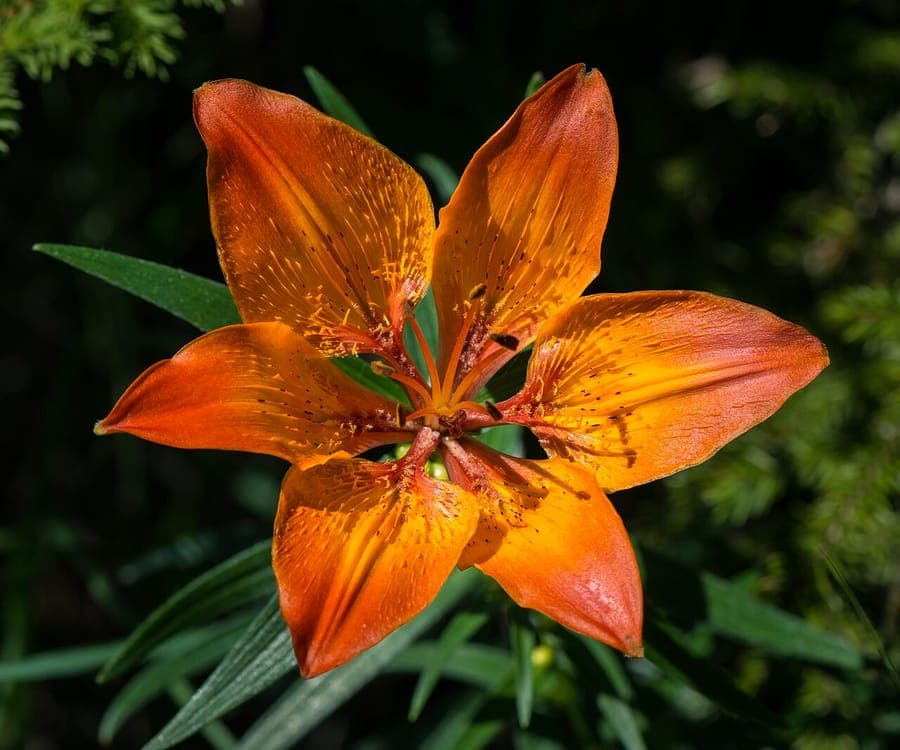
Uoaei1 / CC BY-SA 3.0, via Wikimedia Commons
Orange lily: complete guide
Lilium bulbiferum
Want to see Orange lily: complete guide in your garden?
1 minute, no credit card
Overview
Lilium bulbiferum, commonly known as the Orange lily, is a bold, upright-growing forb from the Liliaceae family that brings a fiery punch to summer borders. Native to central and southern Europe – including Austria, France, Italy, and Spain – it's naturally adapted to sunny slopes, open woodlands, and rocky soils. Standing tall at 80–120 cm, it's not a shy plant. It demands attention with its radiant orange to yellow-orange flowers, each curling dramatically backward like flames caught in motion. This is a lily that thrives on simplicity, not pampering.
One of its defining quirks is the production of bulbils – tiny aerial bulbs that form in the leaf axils during summer. These fall to the ground and sprout the next season, giving the plant a self-sustaining, almost wild character. If you're designing a naturalistic planting scheme, this trait is a bonus. On gardenworld.app, you can map out where these bulbils might land and how they'll integrate into your garden over time, avoiding overcrowding.
Appearance & bloom cycle
The Orange lily blooms from early June through mid-July, depending on your zone. Each stem carries 3–6 large, trumpet-shaped flowers, roughly 8–10 cm across, with a faint, spicy fragrance. The petals reflex sharply backward, exposing prominent stamens dusted with bright orange pollen. While technically listed as yellow-flowered in databases, in full sun the blooms often appear deep orange, especially in southern exposures.
Foliage is narrow, dark green, and arranged in whorls up the stem. After flowering, the plant continues to photosynthesize through late summer, so don't rush to cut it down. The bulbils mature in late July and August – collect them if you want to propagate, or let them drop for natural spread.
Ideal location
Give this lily a spot with at least 6 hours of direct sun (light level 6–8). It tolerates light afternoon shade, especially in hotter zones (7–8), but full sun brings the best blooms. Plant it in the middle to back of a sunny border, on a dry slope, or near a south-facing wall. Avoid damp, shaded corners – it'll sulk and rot. In exposed gardens, consider staking tall stems in early June to prevent wind rock.
If you're sketching a new garden layout, gardenworld.app lets you preview how these lilies will look in height and colour contrast against other summer perennials, helping you avoid visual clashes.
Free design
Want to see Orange lily: complete guide in your garden? Make a free design now.
Soil requirements
Well-drained, alkaline soil is non-negotiable. Aim for a pH of 7.5–8.0. Heavy clay or waterlogged soil will kill the bulb within a season. If your soil is dense, amend it with horticultural grit, coarse sand, or crushed oyster shell. Plant bulbs 15 cm deep and space them 20–25 cm apart. Avoid using fresh manure or acidic compost – it encourages rot.
Watering
Water deeply but infrequently during active growth (April–August). Once established, the Orange lily is fairly drought-tolerant, but prolonged dry spells will reduce bloom size. Never let the soil stay soggy. In September, taper off watering to help the plant enter dormancy.
Pruning
Only cut the stem after the foliage has completely yellowed, usually by late September. Cutting too early starves the bulb. Remove spent flowers if you want to prevent seed formation, but leave the stem and leaves intact. The bulbils can be harvested when brown and stored in dry sand over winter.
Maintenance calendar
- Jan: Check for heaving from frost
- Feb: Inspect bulbs for rot if dug up
- Mar: Plant new bulbs if missed last autumn
- Apr: Begin light feeding with balanced granular fertiliser
- May: Watch for aphids and lily beetles
- Jun: Enjoy blooms, water during dry spells
- Jul: Collect mature bulbils, avoid overwatering
- Aug: Reduce watering, let foliage photosynthesize
- Sep: Cut back only after yellowing
- Oct: Divide or transplant if needed
- Nov: Mulch lightly in wet areas
- Dec: Dormant period
Winter hardiness
Hardy in USDA zones 5–8. The bulb survives down to -20°C when well-drained. In colder zones or heavy soils, a thin mulch of leaf mould or straw helps prevent freeze-thaw cycles from pushing bulbs to the surface.
Companion plants
Pair with drought-tolerant, sun-loving perennials: Salvia nemorosa, Nepeta, Echinacea purpurea, or Sedum 'Matrona'. These share similar soil and light needs and provide contrasting texture. Avoid aggressive spreaders like mint or ground-hugging ivy that might smother the base.
Closing
The Orange lily isn't flashy in a polished way – it's bold, a bit wild, and utterly reliable. It asks for little and gives back with weeks of vibrant colour. Buy bulbs in autumn from garden centres like those found at major retailers or independent nurseries. With proper planting and patience, it'll return for years. For a tailored planting plan that includes height, spread, and seasonal interest, try gardenworld.app and design your summer border with confidence.
Want to see Orange lily: complete guide in your garden? Make a free design now.
Upload a photo, pick a style, and get a photorealistic design with plant list in under a minute.
No credit card required


Similar plants
Reverchon's gagea: complete guide
Gagea reverchonii
Full guide to Gagea reverchonii, Reverchon's gagea: rare Pyrenean bulb with bright yellow spring flowers, soil needs and companion planting.
Leafy gagea: complete guide
Gagea foliosa
Gagea foliosa is a rare Mediterranean bulb with bright yellow star-shaped flowers blooming February to March in well-drained rocky settings.
Tubular gagea: complete guide
Gagea fragifera
Gagea fragifera is a mountain bulb with golden-yellow star flowers blooming May to July on subalpine slopes from Europe to the Himalaya.