
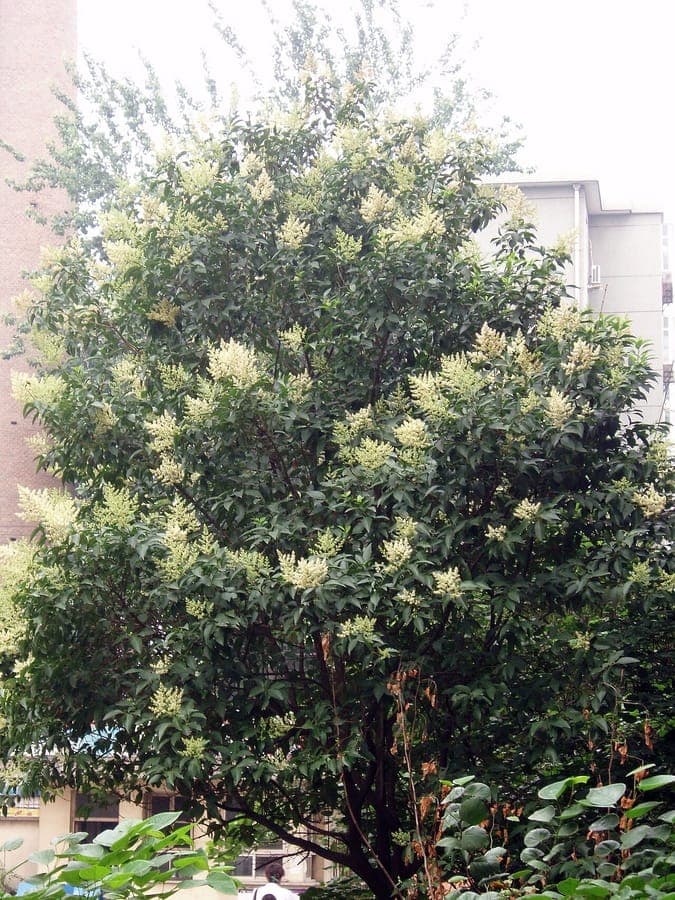
Taken by Fanghong / CC BY 2.5, via Wikimedia Commons
Chinese privet: complete guide
Ligustrum lucidum
Want to see Chinese privet: complete guide in your garden?
1 minute, no credit card
Overview
Ligustrum lucidum, commonly known as Chinese privet, is a tough, evergreen shrub or small tree that's a go-to for hedges, screens, and structural backbone planting. Native to central and southeastern China, Korea, and Tibet, it thrives in temperate to subtropical climates. In the UK and northern Europe, it performs best in sheltered, sunny spots but tolerates light shade. Mature height ranges from 4 to 6 meters, occasionally reaching 8 meters when trained as a tree. It's not fussy, but it does need a little attention in its first year and during harsh winters. If you're looking for a dense, year-round green barrier, this plant delivers.
Appearance & bloom cycle
Chinese privet has long, glossy, dark green leaves-10 to 20 cm in length-arranged in opposite pairs. The foliage stays on the plant all year in mild winters, making it excellent for permanent screening. From July to August, it produces showy, fragrant panicles of small white flowers, up to 20 cm long. These attract bees and other pollinators. After flowering, it sets clusters of purple to black berries, which are poisonous to humans but eaten by birds. These berries can self-seed in ideal conditions, so if you want to prevent spread, prune right after flowering. The plant has a bushy, upright habit and responds well to shaping.
Ideal location
Give Ligustrum lucidum a spot with full sun to light shade-aim for a light rating of at least 8 out of 10. It grows denser and flowers better in full sun. In deep shade, it becomes leggy and sparse inside. It handles urban pollution well and works great against walls or fences that radiate heat. Young plants benefit from shelter from cold winds, especially in exposed gardens. In colder parts of zone 8, consider planting near a south-facing wall. On gardenworld.app, you can design a garden layout that positions Chinese privet for maximum privacy and sun exposure, with room to grow.
Soil requirements
It tolerates a wide range of soils but prefers moist, well-drained loam with a pH between 6.5 and 7.0. It copes with clay if drainage is adequate and with sandy soil if you add organic matter. Avoid waterlogged conditions-roots will rot. Before planting, amend the hole with compost or well-rotted manure. It's moderately salt-tolerant, so okay near roads, but don't plant too close to areas where de-icing salts accumulate.
Free design
Want to see Chinese privet: complete guide in your garden? Make a free design now.
Watering
Water regularly in the first growing season-once a week during dry spells, more in containers or full sun. After establishment, it's fairly drought-tolerant but performs best with consistent moisture in summer. Deep, infrequent watering encourages strong roots. Apply a 5–8 cm layer of mulch around the base to retain moisture and suppress weeds. On gardenworld.app, you can set up a seasonal watering reminder tailored to your local weather and soil type.
Pruning
This is where Chinese privet shines. It tolerates hard pruning and can be shaped into tight hedges, pleached forms, or left as a loose, tree-like specimen. The best time to prune is late winter to early spring (February–March), before new growth starts. Avoid pruning after August to protect next year's flower buds. For formal hedges, trim twice a year-once in spring and a light tidy-up in late summer. Use sharp, clean tools to prevent disease. Remove dead or crossing branches annually to improve airflow.
Maintenance calendar
- Jan: Check for frost damage, remove dead wood
- Feb: Start pruning, focus on shape and density
- Mar: Complete pruning, apply compost around the base
- Apr: Monitor new growth, water if dry
- May: Watch for aphids or scale insects
- Jun: Prepare for flowering, avoid pruning
- Jul-Aug: Peak bloom, enjoy the fragrance
- Sep: Light trim if needed, no heavy cuts
- Oct: Mulch to protect roots over winter
- Nov: Clear fallen leaves, inspect for pests
- Dec: Final check, protect container plants from freezing
Winter hardiness
Ligustrum lucidum is hardy in USDA zones 8–11. In zone 8, established plants usually survive, but young ones may suffer dieback below -8°C. Protect the trunk with hessian or fleece in the first 2–3 winters, especially in exposed sites. Ensure good drainage-wet soil plus frost is deadly. In pots, wrap the container in bubble wrap and move to a sheltered spot. Avoid winter wet.
Companion plants
Pair Chinese privet with other evergreens like bay (Laurus nobilis), yew, or pittosporum for texture contrast. Underplant with hellebores, ferns, or heucheras in light shade. For formal hedges, plant lavender or rosemary at the base for a clean edge. In naturalistic schemes, combine with ornamental grasses like Stipa or Carex. Avoid plants with aggressive root systems that compete for water.
Closing
Chinese privet is a reliable, fast-growing plant that earns its place in any garden needing screening or structure. It's not flashy, but it's dependable. Buy healthy stock from reputable garden centres, plant in spring, and give it space to develop. With basic care, it'll thrive for decades. And don't forget-on gardenworld.app, you can simulate how your Ligustrum lucidum hedge will grow over time and adjust your design accordingly.
Want to see Chinese privet: complete guide in your garden? Make a free design now.
Upload a photo, pick a style, and get a photorealistic design with plant list in under a minute.
No credit card required


Similar plants
Rough menodora: complete guide
Menodora scabra
Full guide to Menodora scabra: a drought-tolerant desert subshrub with bright yellow flowers, ideal for rock gardens and xeriscapes.
Fraxinus dipetala: complete guide
Fraxinus dipetala
California ash or two-petal ash from southwestern USA. Beautiful spring flowers, drought-tolerant. Experimental choice for warm Mediterranean front gardens.
Syringa komarowii: complete guide
Syringa komarowii
Syringa komarowii is a striking lilac from central China with elegant flower spikes and lovely foliage. Discover the complete care guide here.