
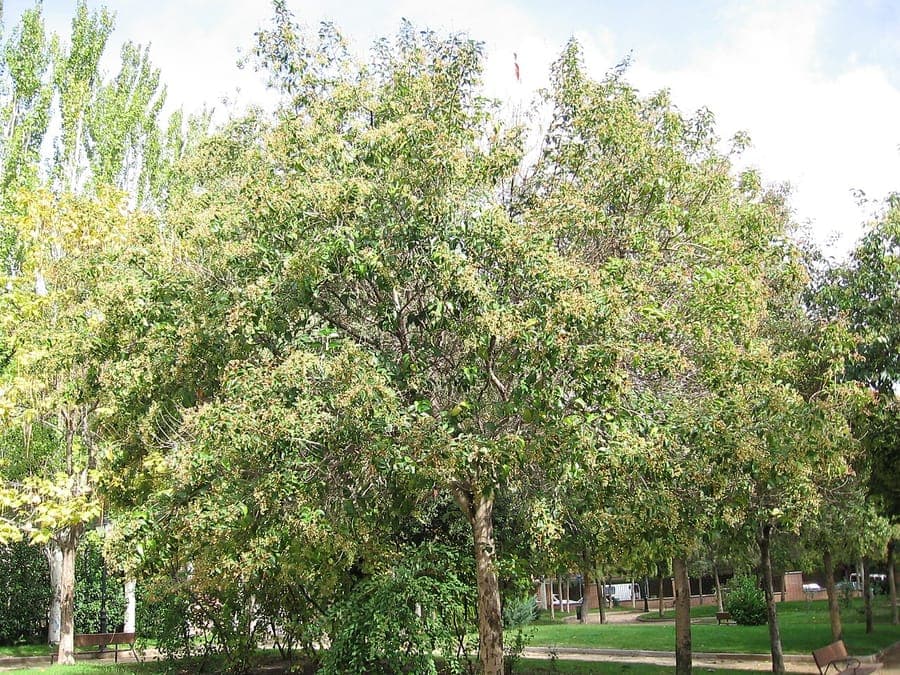
José Luis Gálvez / CC BY-SA 2.5, via Wikimedia Commons
Japanese privet: complete guide
Ligustrum japonicum
Want to see Japanese privet: complete guide in your garden?
1 minute, no credit card
Overview
Ligustrum japonicum, commonly known as Japanese privet, is a resilient evergreen shrub widely used in gardens across temperate zones. Native to Japan, Korea, and parts of southeastern China, it adapts well to urban environments and suburban landscapes. Its popularity stems from its dense foliage, tolerance for pruning, and ability to thrive in partial shade. Whether you're building a sound-dampening hedge along a busy street or shaping a sculptural focal point, this plant delivers reliability. On gardenworld.app you can design a garden layout that accounts for its mature spread and height, ensuring enough space for healthy growth.
Appearance & bloom cycle
Japanese privet typically grows as a multi-stemmed shrub, reaching 4–6 m tall if unpruned, but usually maintained at 2–3 m in cultivated settings. The leaves are oval, glossy dark green, 5–10 cm long, and leathery to the touch. In mid-summer, from June to August, clusters of small, tubular white flowers appear. They emit a faint, somewhat unpleasant scent that attracts bees and flies. After flowering, dark purple to black berries form - these are toxic to humans and pets but are consumed by birds. The plant remains evergreen year-round in USDA zones 8–10, though hard freezes may cause minor leaf scorch.
Ideal location
This shrub thrives in full sun to partial shade. While it tolerates full sun, it often performs better in light shade, especially in areas with hot afternoon exposure. It handles urban pollution well, making it ideal for city gardens. Avoid exposed, windy sites, particularly for young plants, as winter winds can desiccate foliage. A sheltered spot near a fence or wall helps maintain humidity and reduces wind stress. When planning your layout, use gardenworld.app to map sun patterns and ensure your privet gets optimal light without overexposure.
Soil requirements
Japanese privet is adaptable to various soil types but prefers well-drained loam with a pH between 5.5 and 6.9. It tolerates clay if drainage is improved with compost, and sandy soils with added organic matter. Avoid waterlogged conditions, as prolonged saturation leads to root rot. Before planting, amend the soil with 5–10 cm of compost to boost fertility and moisture retention. A slow-release granular fertilizer in early spring supports steady growth.
Watering
Newly planted privets need consistent watering - aim for 2.5 cm per week during the first growing season. Once established, they're moderately drought-tolerant but benefit from deep watering during extended dry periods, especially when grown as hedges. Water at the base to prevent foliar diseases like powdery mildew. Use drip irrigation or soaker hoses for efficiency, particularly in large plantings.
Free design
Want to see Japanese privet: complete guide in your garden? Make a free design now.
Pruning
One of the biggest strengths of Ligustrum japonicum is its response to pruning. It can be shaped into tight formal hedges or left more natural for informal screens. Prune twice a year: once in late spring (May) after the first flush of growth, and again in mid-summer (August) for a tidy finish. Avoid heavy pruning in autumn, as new growth won't harden before winter. Use sharp bypass pruners or electric hedge trimmers for clean cuts. Never remove more than one-third of the foliage at once to prevent shock.
Maintenance calendar
- Jan: Inspect for winter damage, remove dead wood
- Feb: Minimal activity, skip pruning unless mild
- Mar: Prepare soil, add compost if needed
- Apr: Begin regular watering as temperatures rise
- May: First pruning after spring growth
- Jun: Monitor for pests like aphids or scale
- Jul: Flowering period, avoid pruning now
- Aug: Second pruning, check soil moisture
- Sep: Reduce watering, allow plant to harden
- Oct: Final cleanup, remove fallen berries
- Nov: Protect young plants from frost
- Dec: Mulch around base to insulate roots
Winter hardiness
Japanese privet is winter-hardy in USDA zones 7 to 10. In zone 7, expect some leaf browning during harsh winters, but plants usually recover in spring. Mulching with 5–8 cm of bark or leaf compost helps protect shallow roots. Young plants benefit from burlap wrapping in exposed areas. Mature shrubs require little protection but may show tip damage below -12°C.
Companion plants
Pair Japanese privet with shade-tolerant perennials like Helleborus, Heuchera, or Lamium. Use variegated forms of hostas or ferns to contrast its solid green foliage. For spring interest, plant Eranthis or Scilla in front. Avoid invasive groundcovers like ivy, which can climb and smother the shrub. Other Oleaceae, such as Osmanthus or lilacs, create a thematic planting scheme. Keep spacing in mind - allow at least 90 cm between privet and nearby plants to prevent competition.
Closing
Japanese privet is a workhorse in the garden - dependable, adaptable, and easy to maintain. With proper site selection and a solid pruning routine, it forms a dense, attractive hedge that lasts for decades. Just remember: the berries are poisonous, so keep them away from children and pets. Buy healthy stock from reputable garden centres, and avoid plants with yellowing leaves or broken stems. With thoughtful planning, this shrub integrates seamlessly into both modern and traditional landscapes. On gardenworld.app you can simulate different hedge heights and spacing to match your garden's scale and aesthetic.
Want to see Japanese privet: complete guide in your garden? Make a free design now.
Upload a photo, pick a style, and get a photorealistic design with plant list in under a minute.
No credit card required


Similar plants
Rough menodora: complete guide
Menodora scabra
Full guide to Menodora scabra: a drought-tolerant desert subshrub with bright yellow flowers, ideal for rock gardens and xeriscapes.
Fraxinus dipetala: complete guide
Fraxinus dipetala
California ash or two-petal ash from southwestern USA. Beautiful spring flowers, drought-tolerant. Experimental choice for warm Mediterranean front gardens.
Syringa komarowii: complete guide
Syringa komarowii
Syringa komarowii is a striking lilac from central China with elegant flower spikes and lovely foliage. Discover the complete care guide here.