
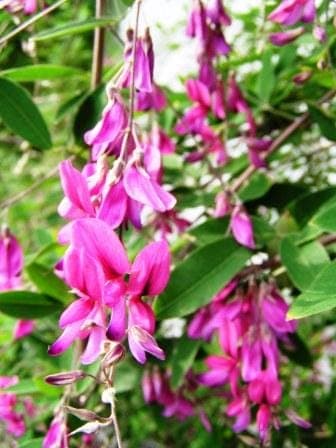
VoDeTan2 / CC BY-SA 3.0, via Wikimedia Commons
Lespedeza thunbergii: complete guide
Lespedeza thunbergii
Want to see Lespedeza thunbergii: complete guide in your garden?
1 minute, no credit card
Overview
Lespedeza thunbergii, also known as Thunberg's lespedeza or summer beauty, is a beautiful flowering shrub originating from Asia. This fast-growing woody plant produces dense, pendulous clusters of vibrant purple flowers during summer months that create a spectacular effect. Not only is the plant aesthetically striking, but it is also incredibly winter-hardy and adaptable.
If you're looking for a flowering shrub with minimal maintenance requirements, Lespedeza thunbergii is absolutely worth considering. In this guide, you'll learn how to cultivate this Asian beauty and enjoy years of gorgeous blooms.
Appearance and Bloom
Lespedeza thunbergii is a shrub with a distinctive form - the branches initially grow upright, but as they mature and produce heavier flowers, they elegantly arch downward. This creates a beautiful fountain-like silhouette that is particularly attractive in the garden.
The flowers are undoubtedly the highlight of this plant. They appear in summer and autumn in rich purple-red tones that stand out against the light green foliage. The flowers are small pea-like pods that grow in dense, pendulous clusters. A single flowering branch is already spectacular; a plant covered in flowering branches is truly breathtaking.
The foliage is bright green and fine in texture, creating a lovely contrast with the purple-red flowers. In autumn, the leaves turn to yellow and brown tones before falling, providing additional seasonal interest.
Ideal Location
Lespedeza thunbergii thrives optimally in full sun conditions. The plant needs at least 6 hours of direct sunlight daily for optimal blooming. In partial shade, it will grow, but you'll see fewer flowers.
The plant is ideal for the middle of borders, against walls, or as a specimen plant where its tall form can be displayed. Since the plant can grow quite large, make sure you have enough space or be prepared to do occasional pruning.
Lespedeza thunbergii is also suitable for large containers on terraces or balconies, though you'll need to pay extra attention to watering in such situations.
Soil
Lespedeza thunbergii is very adaptable regarding soil conditions. The plant thrives in average, well-draining soil and can even survive in poor soils. This makes it particularly suitable for less favorable growing conditions where other plants would struggle.
Ideal are neutral to slightly acidic soils (pH 5.7 to 7.2), which are fairly standard values for gardens. However, the plant doesn't need much nutrition and actually grows better in less-enriched soils.
The main requirement is good drainage. Although the plant is reasonably tolerant of moist conditions, permanent waterlogging can lead to root problems. Improve heavy clay soils with sand or gravel.
Free design
Want to see Lespedeza thunbergii: complete guide in your garden? Make a free design now.
Watering
Once Lespedeza thunbergii is established, it's a relatively drought-tolerant plant. You don't need to water excessively. With normal rainfall, the plant usually has sufficient water.
In the first growing season, ensure regular watering until the plant is firmly established. After that, you only need to water extra during prolonged dry periods. In such periods, watering once a week will be sufficient.
During the growing and blooming period (May to October), it can be helpful to occasionally provide extra moisture, especially in years with significant drought. This will stimulate blooming.
Avoid waterlogging in winter, when the plant needs less water. Just make sure the root zone doesn't dry out completely.
Pruning
Lespedeza thunbergii is a plant that benefits from regular pruning, especially since it can otherwise become much taller and less compact. The best time to prune is at the end of winter or very early spring before new growth begins.
Prune the entire plant back to approximately 30-50 centimeters in height to maintain a dense, compact silhouette. This will encourage the plant to develop more branches and thus produce more flowers.
If you want a larger plant, apply only light pruning - remove only dead wood and a third of the longest growth. Avoid pruning after May, as this may result in removing flowering branches.
Maintenance Calendar
January-March: Pruning. This is the ideal time for pruning when the plant is still dormant.
April-May: Growing season begins. Ensure regular watering as growth accelerates.
June-September: Blooming period. Ensure regular watering. Enjoy the gorgeous purple flowers.
October-November: Continued blooming. Winter preparation. Gradually reduce watering.
December: Resting period. Minimal care needed.
Winter Hardiness
Lespedeza thunbergii is exceptionally winter-hardy and can withstand temperatures down to minus 15 degrees Celsius without problems. In the Netherlands, the plant will almost always survive.
Note: in very cold winters with heavy frost and little snow cover, this plant may suffer. In the worst case, the plant may die back completely to ground level. However, normally it will regrow from the roots in spring.
Mulching around the plant in late autumn can provide some extra protection in very harsh winters, especially in northern regions.
Companion Plants
Lespedeza thunbergii combines beautifully with other summer bloomers. Plant it next to white flowers like japonica or clematis for a lovely contrast. Blue flowers like delphiniums or salvias also make an attractive combination.
The plant works well alongside yellow-leaved plants like coleus or lonicera - the purple of Lespedeza really stands out. Also excellent as a backdrop for lower summer bloomers.
In large planting schemes, Lespedeza can serve as a focal element due to its spectacular blooming.
Closing Thoughts
Lespedeza thunbergii is an underrated jewel in many gardens. With its fast growth, spectacular blooming, and minimal maintenance requirements, it's a plant that will guarantee you enjoyment. Whether you have a large perennial border or just want some summer color, Lespedeza thunbergii is an excellent choice. Available at gardenworld.app.
Want to see Lespedeza thunbergii: complete guide in your garden? Make a free design now.
Upload a photo, pick a style, and get a photorealistic design with plant list in under a minute.
No credit card required


Similar plants
Tall Silky Lupine: complete guide
Lupinus elatus
Tall silky lupine is a fast-growing Californian perennial with silvery foliage and blue-purple flower spikes, ideal for a prairie-style garden.
Garfield Lupine: complete guide
Lupinus garfieldensis
The Garfield lupine is a rare, fast-growing American perennial for alkaline, dry grassland gardens, with striking blue flower spikes.
Lupinus elegans: complete guide
Lupinus elegans
Lupinus elegans, the elegant lupine, is a spectacular blooming plant from Mexico with blue flower spikes. Care, cultivation and garden use.