
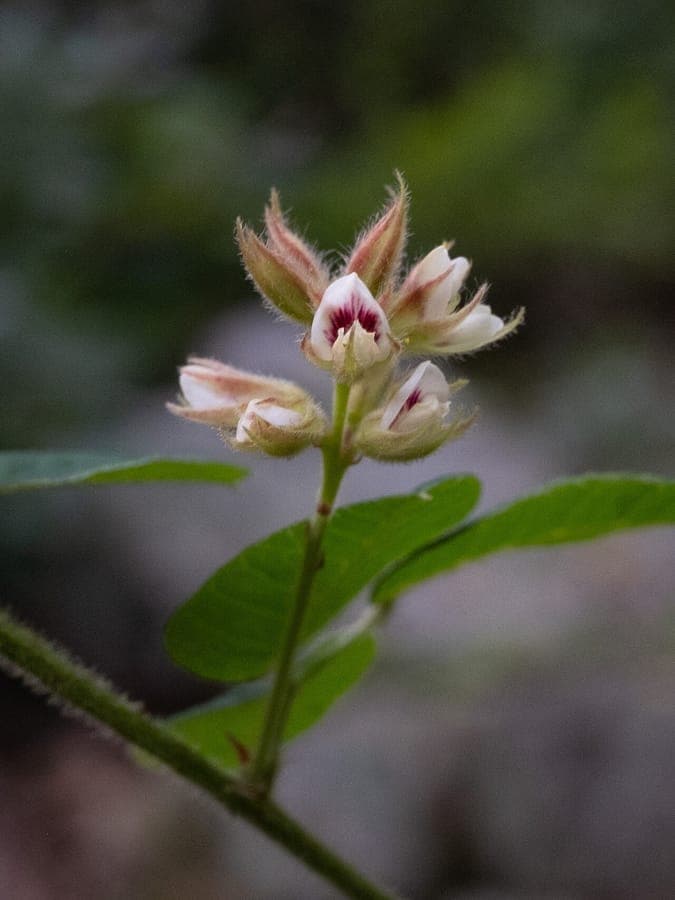
Alex Abair / CC BY 4.0, via Wikimedia Commons
Hairy bush-clover: complete guide
Lespedeza hirta
Want to see Hairy bush-clover: complete guide in your garden?
1 minute, no credit card
Overview
Lespedeza hirta, commonly called hairy bush-clover or hairy lespedeza, is a native perennial forb belonging to the legume family (Fabaceae). It grows across a wide swath of the central and eastern United States - from Maine and Vermont south to Florida and Texas, and west to Missouri and Illinois. The species name hirta is Latin for 'hairy', describing the dense, spreading white hairs that cover stems, petioles, and leaf surfaces, giving the whole plant a soft, greyish appearance.
In the wild, hairy bush-clover occupies dry, open habitats: pine barrens, rocky woodland edges, dry prairies, roadside banks, and old fields. It is one of the last-blooming native perennials in eastern North American flora, with flowers appearing from August through October, providing crucial late-season nectar for bumblebees, solitary bees, and various butterfly species - including the rare frosted elfin butterfly, which depends on Lespedeza hirta as a larval host plant.
As a garden plant it offers several distinct advantages: summer-long decorative foliage with a distinctive hairy texture, an extended late bloom season that bridges the gap when many summer perennials have finished, and strong drought and lean-soil tolerance. It fixes atmospheric nitrogen through root nodule symbiosis with Rhizobium bacteria, gradually improving soil quality on poor sites. For garden design ideas that incorporate native late-bloomers like this one, gardenworld.app provides a helpful planning tool.
Several varieties and synonyms exist: Lespedeza polystachya (Michx.) and Despeleza hirta are historical synonyms encountered in older literature. Within the species, var. curtissii and var. sparsiflora differ subtly in flower density and calyx shape but are culturally identical.
Appearance & bloom cycle
Hairy bush-clover is a multi-stemmed upright perennial reaching 60 to 90 cm in height and 40 to 60 cm in spread. Every part above ground - stems, leaf stalks, and leaf surfaces - is covered with dense white or greyish hairs that give the plant its characteristic velvety, greyish-green appearance throughout the growing season. This texture is ornamentally valuable even before the plant comes into bloom.
The leaves are trifoliate (three leaflets per leaf), with each leaflet elliptic to oblong, 2 to 4 cm long. The leaflet surface has a somewhat rough, matte texture, in contrast to the smoother foliage of the closely related Lespedeza capitata. Leaves emerge bright green in spring and gradually deepen to grey-green as the season progresses.
Flowering begins in August and reaches its peak in September through October - remarkably late for a temperate perennial. The small individual blossoms (6 to 8 mm) are typical pea-family flowers in off-white to pale yellow, occasionally flushed pink, grouped in dense, short racemes along the upper portions of the stems. The entire upper half of each stem becomes studded with these small flower clusters, creating a soft, hazy display.
After flowering, small elongated seed pods develop and ripen to dark brown-black by late autumn. These persist through winter and provide food for small songbirds. The dried stems and flower stalks remain standing through winter, creating structural interest in the dormant garden.
Ideal location
Full sun is the critical requirement. Hairy bush-clover tolerates light afternoon shade but performs best in open, sunny positions with at least six hours of direct sunlight daily. In too much shade, stems become weak and floppy and flowering is sparse. A south-facing or west-facing position in a mixed border, a sunny bank, or an open meadow-style planting are all ideal situations.
This species is particularly well suited to difficult sites that defeat other perennials: dry, gravelly banks, roadside strips with poor soil, thin patches in a lawn that won't support grass, or rocky outcrops. In European gardens (UK, Belgium, Netherlands, northern France), it performs as a reliably perennial plant in USDA zones 5-7, provided the soil drains freely. It combines beautifully with native European species and naturalised North American prairie plants.
Soil requirements
Lespedeza hirta has evolved on lean, freely draining acidic to near-neutral soils, with a pH range of 5.8 to 6.9. Rich, moist garden soils produce overly lush growth that tends to flop, and the flowering quality decreases markedly. This plant thrives on the neglected patches of the garden - thin sandy loam, gravelly ground, or old construction rubble sites that have been left to settle.
No fertiliser is needed beyond an annual light top-dressing of mature compost at 4 to 5 litres per square metre in early spring. On genuinely poor sandy soils, even this is optional. As a legume, the plant produces its own nitrogen via Rhizobium root nodules; nitrogen fertiliser actively inhibits bloom. On heavy clay soils, incorporate coarse grit (30 percent by volume) before planting to improve drainage - waterlogged roots cause root rot, which is the main cultural problem with this species.
Free design
Want to see Hairy bush-clover: complete guide in your garden? Make a free design now.
Watering
Established hairy bush-clover is one of the more drought-tolerant perennials available for temperate European gardens. Once the root system has developed - which takes one full growing season - the plant will survive three to four weeks without rainfall without visible damage. This makes it ideal for low-maintenance gardens, gravel gardens, and dry prairie-inspired plantings.
During the first year after planting, water weekly in dry spells to support root establishment. Use drip irrigation or a watering can directed at the base of the plant; overhead irrigation keeps the hairy foliage wet for extended periods and can encourage powdery mildew. After the first year, supplemental watering is only occasionally needed during exceptional summer droughts.
In winter, no supplemental water is required on well-drained ground. In containers, water just enough once every two weeks to prevent the root zone from completely drying out.
Pruning
Hairy bush-clover is a die-to-ground perennial: the stems die back in late autumn or early winter, and the plant regrows from the woody crown each spring. The main pruning task is cutting all dead stems back to 10-15 cm above ground in late February or early March, just before new growth emerges. This single annual cut is all the routine maintenance the plant requires.
Leave the stems standing through winter: the dried flower stalks and seed pods provide food for birds and winter garden structure. If you want a more compact plant, cut the main stems by half in late June; this delays flowering by two to three weeks but produces a bushier, more self-supporting form. No hard renovation pruning or division is typically needed, as the plant maintains itself reliably.
Maintenance calendar
March: Cut all previous year's stems to 10-15 cm; apply a light layer of compost; watch for new shoots emerging.
April: New stems grow rapidly; water weekly if dry; prepare supports for plants on windy sites.
May: Full leaf development; established plants need minimal water; inspect for aphids on shoot tips.
June: Optional mid-season cutback by half for compact form; no watering needed for established plants in typical seasons.
July: Flower buds begin to form in leaf axils; avoid over-watering.
August–September: Peak flowering; rich nectar attracts bumblebees, solitary bees, and butterflies; no pruning.
October: Bloom fades; seed pods ripen; birds visit for seed; leave stems standing.
November–February: Winter dormancy; apply 8-10 cm straw mulch over roots in zone 5-6 if severe cold (-15 °C or lower) is expected.
Winter hardiness
Lespedeza hirta is reliably hardy across USDA zones 4 to 8 - an unusually wide hardiness range that encompasses nearly all of temperate Europe. In its native eastern North America, it endures winters well below -20 °C without mulch. For UK, Belgian, Dutch, and northern French gardens (zones 6-7), the plant is reliably perennial without any protection. In the coldest parts of zone 5 (northern Germany, upland central Europe), a winter mulch of 8-10 cm of leaf mould or straw provides effective insurance.
First-year plants are more frost-sensitive than established ones; give young plants extra protection during their first winter. By the second year, the woody crown is well established and extremely cold-tolerant. The late-season flowering habit also helps: by the time the first hard frosts arrive in October-November, the plant has already completed its bloom cycle.
Companion plants
Hairy bush-clover thrives alongside other sun-loving, drought-tolerant prairie and meadow plants:
- Echinacea purpurea (purple coneflower): blooms July–September, extending the ornamental season before and into Lespedeza hirta's bloom; 50 cm spacing recommended.
- Schizachyrium scoparium (little bluestem grass): a warm-season grass with spectacular red-bronze autumn colour that complements the hairy texture of lespedeza stems; 40 cm spacing.
- Helenium autumnale (common sneezeweed): yellow-orange autumn flowers bloom simultaneously with lespedeza for a warm late-season colour combination.
- Asclepias tuberosa (butterfly weed): vivid orange flowers in August on equally dry, lean soils; an essential companion in prairie-inspired plantings.
- Rudbeckia hirta (black-eyed Susan): golden summer flowers bridge the gap between early summer interest and lespedeza's autumn bloom.
- Solidago rigida (stiff goldenrod): yellow autumn plumes harmonise with the soft white lespedeza flowers in late season borders.
Avoid lush, competing neighbours that will shade out or outcompete this lean-soil specialist.
Closing
Lespedeza hirta earns its place in any garden through a combination of unusual bloom timing, ecological value, and sheer toughness. Its late-season flowers support pollinators when most other perennials have finished, its hairy foliage adds textural interest throughout summer, and its tolerance of lean, dry conditions makes it ideal for the spots in the garden where other plants simply give up.
Discover how hairy bush-clover and other drought-tolerant native perennials can be incorporated into a cohesive garden design at gardenworld.app. The platform makes it easy to plan plant combinations and visualise your planting scheme before a single plant goes in the ground.
Want to see Hairy bush-clover: complete guide in your garden? Make a free design now.
Upload a photo, pick a style, and get a photorealistic design with plant list in under a minute.
10,000+ gardens designed already
No credit card required


Similar plants
Tall Silky Lupine: complete guide
Lupinus elatus
Tall silky lupine is a fast-growing Californian perennial with silvery foliage and blue-purple flower spikes, ideal for a prairie-style garden.
Garfield Lupine: complete guide
Lupinus garfieldensis
The Garfield lupine is a rare, fast-growing American perennial for alkaline, dry grassland gardens, with striking blue flower spikes.
Lupinus elegans: complete guide
Lupinus elegans
Lupinus elegans, the elegant lupine, is a spectacular blooming plant from Mexico with blue flower spikes. Care, cultivation and garden use.