
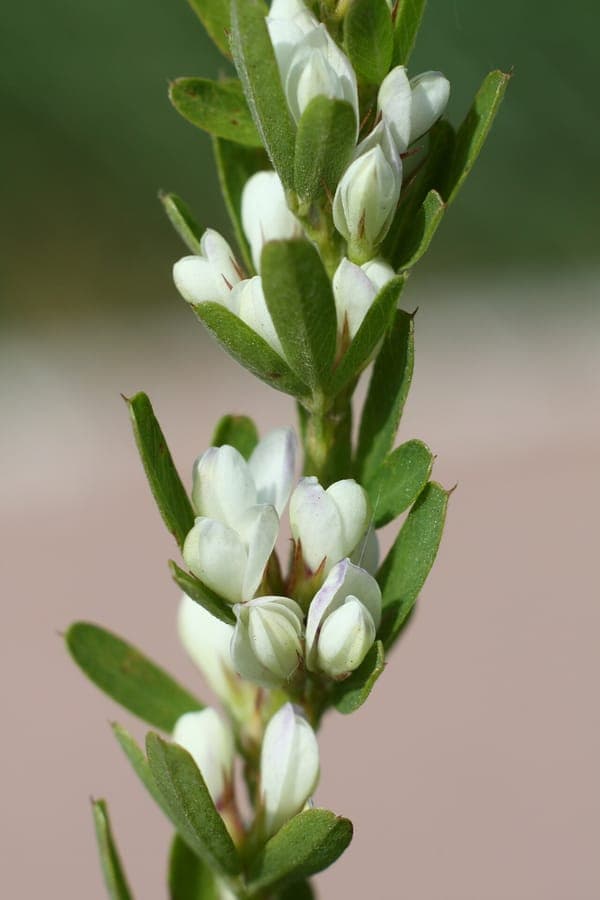
Dalgial / CC BY-SA 4.0, via Wikimedia Commons
Sericea lespedeza: complete guide
Lespedeza cuneata
Want to see Sericea lespedeza: complete guide in your garden?
1 minute, no credit card
Overview
Lespedeza cuneata, known in English as sericea lespedeza, Chinese bush-clover, silky bush-clover, or perennial lespedeza, is a remarkable perennial or semi-shrub in the Fabaceae family - the legume family, which also includes peas, beans, and clovers. The species was described in 1832 by botanist George Don, building on earlier work by Dumont de Courset. Its native range extends from Afghanistan and Pakistan through the Himalayas, China, Korea, Japan, and Southeast Asia to parts of Australia.
The genus name 'Lespedeza' honours Vicente Manuel de Zespedes (1720-1796), the Spanish governor of Florida, whose name was misspelled 'Lespedez' in the original botanical work - a typographical error that became immortalised in botanical nomenclature. The species name 'cuneata' refers to the wedge-shaped (Latin: cuneatus) base of the three-part leaves.
In Europe, Lespedeza cuneata remains relatively little known but is a surprisingly versatile ornamental for the sunny dry border and naturalistic planting schemes. In its native Asian range it is used as a forage crop, soil stabiliser, and medicinal plant in traditional Chinese medicine. In the United States, where it was introduced in the twentieth century as an erosion control plant and wildlife food source, it has become naturalised and is considered invasive in several southeastern states - testimony to its extraordinary adaptability and vigour.
For European gardens, Chinese bush-clover is an excellent choice for dry, sunny borders, erosion control on slopes, butterfly and bee gardens, and naturalistic late-summer planting compositions. At gardenworld.app you can explore how perennials like Lespedeza cuneata can be incorporated into an elegant, low-maintenance garden design that supports biodiversity and provides year-round seasonal interest.
The plant forms a tall, plume-like perennial or sub-shrub that reaches 90 to 150 cm in height in European climates. The stems are upright to arching and carry dense, finely leaved branches that give the plant a light, feathery silhouette. In August and September it flowers generously with small white to pale purple pea-like blooms that are highly attractive to butterflies and bees.
Appearance & bloom cycle
The most striking feature of Lespedeza cuneata is its fine, grey-green foliage. Each leaf consists of three small, oblong to wedge-shaped leaflets of 1 to 2 cm in length and 3 to 5 mm in width, densely packed along the stems. The leaflets are mat grey-green on the upper surface and lightly hairy beneath, giving them a silky sheen - hence the name 'sericea' (silky). The texture is delicate and feathery, comparable to Artemisia or some fine-leaved grasses. This foliage gives the plant ornamental value even out of flower, as a textural contrast in the border.
The stems grow upright and become long and gently arching at their tips under the weight of the branches and flower heads. The plant reaches 90 to 150 cm in height, sometimes more in warm, fertile positions. The base becomes slightly woody with age but the plant is not truly ligneous - botanically it is a sub-shrub or herbaceous perennial whose above-ground parts partially or fully die back in winter.
Flowering begins in August and continues into October. The flowers are small (5 to 8 mm), pea-like, white with a purple or pink centre, and are borne in the leaf axils along the full length of the branches. Flowering is prolific: on a mature plant thousands of small blooms can be open simultaneously, creating an ethereal white haze over the plant. The flowers are intensively visited by bees, bumblebees, and various butterfly species.
After flowering, small single-seeded pods develop that remain on the stems throughout winter, adding some interest as a structural plant in the border. The seeds are small and can self-sow near the parent plant.
Ideal location
Lespedeza cuneata is an emphatically sun-loving plant that in its native range grows on open, dry to moderately moist grassland slopes, roadsides, and rocky or sandy soils in full sunlight. For the European garden: choose the sunniest available position. The plant thrives in full sun (at least 6 hours of direct sun per day) and flowers considerably less generously in partial shade.
The position may be warm - even hot in summer: Chinese bush-clover is excellently adapted to high summer temperatures and drought. A sheltered spot at the base of a wall or on a sun-catching slope is ideal. The plant roots deeply and is well able to withstand wind loading once established.
Lespedeza cuneata is well suited to: dry summer borders in a sunny position, gravel gardens and stony gardens, slopes and erosion-prone banks, butterfly and bee gardens, or as an accent plant in naturalistically styled planting. As a specimen plant in a warm position it has an elegant, pluming silhouette that works well as a background plant in the border.
Soil requirements
One of the greatest advantages of Lespedeza cuneata is its tolerance for poor and dry soils. In nature it grows on lean, well-draining substrates - from sandy soils to rocky ground - with a slight preference for an acidic to neutral pH (5.0 to 7.0). As a member of the legume family it fixes nitrogen via root nodules and is therefore well adapted to nutrient-poor conditions.
On overly rich, wet, or heavy clay soils Lespedeza cuneata grows vigorously but becomes floppy, prone to lodging, and less floriferous. The ideal soil is a moderately lean, well-draining sandy loam or gravelly soil. Lime is tolerated but not required.
On heavy soil: incorporate 15 to 20 cm of coarse sand and gravel into the top layer to improve drainage. In a gravel garden or xero-garden, no soil improvement is necessary - the plant thrives on precisely the kind of lean, mineral-rich substrate that characterises these garden styles.
Fertilising: generally unnecessary and even counterproductive. If the plant looks somewhat thin after two years, a light autumn dressing of well-rotted compost (2 to 3 cm around the plant) is sufficient. Artificial fertilisers or nitrogen-rich feeds are inadvisable as they make the plant rank and floppy.
The roots are deep and drought tolerant once established - generally from the second growing year onward. In the first two years after planting, supplemental watering during dry periods is still beneficial.
Free design
Want to see Sericea lespedeza: complete guide in your garden? Make a free design now.
Watering
Lespedeza cuneata is exceptionally drought tolerant once established. In its native range it survives long dry periods without assistance. In European gardens: once established (after two years), supplemental watering during normal northwest European summer rainfall is barely necessary.
During the first and second years after planting: water during dry periods of more than two weeks, to allow the plant to develop a deep root system. A deep watering of 10 to 15 litres per square metre per week during prolonged dry spells is sufficient. Deep, infrequent watering is more effective than shallow, frequent applications.
On light, sandy, or gravelly soils, even established plants may benefit from watering during extreme drought periods (more than three to four weeks without rain in summer) to keep flowering and foliage in good condition. On heavier, moisture-retaining soils this is not necessary.
Avoid overwatering, especially on heavy soils: root rot is the primary cause of poor growth and plant death in Lespedeza cuneata. A dry position is always preferable to a wet one.
In winter: no supplemental watering. The plant is dormant and soil moisture levels in most European winters are adequate without assistance.
Pruning
Pruning of Lespedeza cuneata is limited but important for maintaining a compact, free-flowering plant. Without pruning, the stems become progressively longer and the plant lodges easily - particularly on richer soils. The correct timing and method of pruning are crucial.
Main prune in early spring (March-April): cut all above-ground stems back to 20 to 30 cm above ground level, or just above the frost-hardy base. This is the only intervention needed annually. After cutting back, the plant regrows vigorously and flowers on new wood in late summer and autumn.
Important: do not prune in autumn. The dead stems provide some protection for the root crown in winter and add winter interest to the border. Leave them in place until early spring.
During the growing season: no pruning needed, unless outward-spreading stems or overly tall growth needs correcting. If the plant tends to lodge, stems can be supported with a bamboo cane or a ring support.
The plant self-sows readily from seed. If the spread of seedlings is unwanted, remove the seed heads after flowering before the seeds are fully ripe.
Maintenance calendar
January-February: Plant is in winter dormancy. Stems remain upright as winter decoration. No maintenance needed.
March-April: Cut back to 20 to 30 cm above ground. Light soil improvement around the plant if last year's growth was poor.
May-June: Strong new stems shoot up. Little to no watering needed (unless extremely dry). No feeding.
July: Stems reach full height. Foliage fully developed. A deep watering if drought conditions prevail.
August-September: Flowering begins and reaches its peak. Bees and butterflies visit the flowers intensively.
October: Flowering finishes. Pods ripen on the stems. Last butterfly visits.
November-December: Above-ground parts die back. Leave stems in place as winter silhouette and crown protection.
Winter hardiness
Lespedeza cuneata is reliably cold hardy for northwest European climates. The plant is native to regions with cold winters - Korea, northern China, the Himalayas - and tolerates temperatures to around -20 degrees Celsius without problems in most cases. This corresponds to USDA hardiness zones 4 to 8, amply covering the Netherlands, Belgium, Germany, and northern France.
The above-ground stems die back fully or partially in winter. In mild winters the basal stems may remain slightly woody; in severe winters they die back completely to ground level. In both cases the plant regrows vigorously the following spring, provided the root crown has survived the winter in good condition.
For good overwintering: ensure well-draining soil (wet winter soil is the main risk), leave the dead stems in place until early spring to protect the root crown, and mulch the crown in severe winters with a 5 to 10 cm layer of dry leaves or straw for extra frost protection. In normal northwest European winters this is rarely necessary for established plants.
Young newly planted specimens (first and second year) are more vulnerable than established plants: mulch their root crowns in the first two winters as a precaution. Once established, the plant is robust and returns reliably after the harshest winters northwest Europe can offer.
In USDA zones 9 and warmer (Mediterranean climate and above), the plant may become semi-persistent if the stems do not fully die back in winter.
Companion plants
Lespedeza cuneata has fine, airy foliage and an elegant, feathery habit that combines well with plants of more substance or broader leaf form. Recommended companions for the sunny, dry border:
- Perovskia atriplicifolia (Russian sage): the blue-purple flower spikes and silver-grey foliage of perovskia complement perfectly the fine grey-green leaves and white flowers of Chinese bush-clover. Together they form an elegant, drought-tolerant duo for the late-summer border.
- Echinacea purpurea (purple coneflower): the broad, rounded flower heads of echinacea create a strong form contrast with the pluming branches of lespedeza. The late-summer flowering of both species overlaps beautifully.
- Agastache foeniculum (anise hyssop): the vertical flower spikes in blue-purple or pink and the aromatic foliage make an attractive addition in a butterfly and bee garden.
- Salvia nemorosa (ornamental sage): the purple-blue flower spikes and rough-textured foliage of sage give structure and contrast alongside the airy silhouette of Chinese bush-clover.
- Sporobolus heterolepis (prairie dropseed): this grass has a comparable fine texture and airy habit to lespedeza and combines excellently in naturalistically styled plantings.
Perovskia, Echinacea, and Salvia are readily available at specialist garden centres. For Lespedeza cuneata itself, specialist perennial nurseries and online plant suppliers are the best source. At gardenworld.app you can request a bespoke garden design that incorporates butterfly- and bee-friendly perennials, drought tolerant and ornamental at once, in a professionally planned planting scheme.
Closing
Lespedeza cuneata, sericea lespedeza or Chinese bush-clover, is an undiscovered gem for the dry, sunny border. Its fine grey-green foliage, its feathery habit, and its generous white flowering in late summer combine with exceptional drought tolerance and solid cold hardiness. The plant demands little after establishment and rewards its owner with an annually returning, elegant flower display that attracts bees and butterflies in large numbers.
Looking for drought-tolerant, ornamental perennials for a biodiversity-friendly garden? Visit gardenworld.app for professionally tailored garden designs, including advice on the best perennials for sunny, dry positions and a sustainable, low-maintenance planting plan.
Want to see Sericea lespedeza: complete guide in your garden? Make a free design now.
Upload a photo, pick a style, and get a photorealistic design with plant list in under a minute.
10,000+ gardens designed already
No credit card required


Similar plants
Tall Silky Lupine: complete guide
Lupinus elatus
Tall silky lupine is a fast-growing Californian perennial with silvery foliage and blue-purple flower spikes, ideal for a prairie-style garden.
Garfield Lupine: complete guide
Lupinus garfieldensis
The Garfield lupine is a rare, fast-growing American perennial for alkaline, dry grassland gardens, with striking blue flower spikes.
Lupinus elegans: complete guide
Lupinus elegans
Lupinus elegans, the elegant lupine, is a spectacular blooming plant from Mexico with blue flower spikes. Care, cultivation and garden use.