
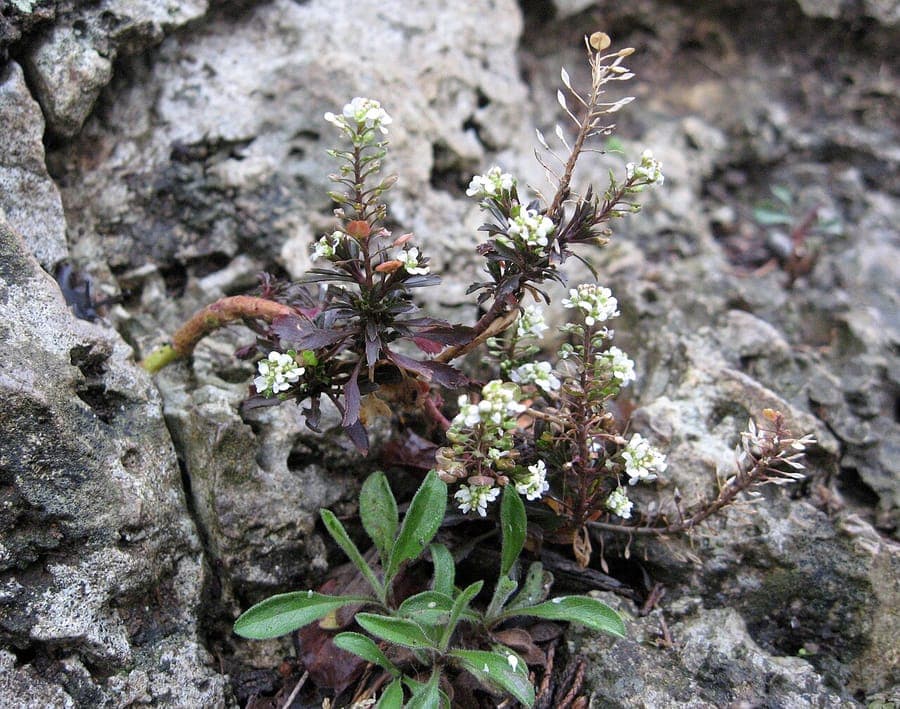
Mason Brock (Masebrock) / Public domain, via Wikimedia Commons
Virginia cress: complete guide
Lepidium virginicum
Want to see Virginia cress: complete guide in your garden?
1 minute, no credit card
Overview
Virginia cress (Lepidium virginicum) is a compact annual to biennial plant from the Brassicaceae family, native to North America. Now naturalized in Europe, it grows rapidly as a pioneer on disturbed sites, birdseed locations, and compacted roads. It reaches 15-45 cm and is known for its frost hardiness and aggressive seed production.
The plant self-seeds naturally via numerous tiny seeds, making it useful for ecological bird gardens but requiring vigilance in container cultivation.
Appearance & Bloom
Virginia cress forms a compact, aggressively branched rosette. The leaves are linear to lanceolate, green, coarsely hairy, and aromatic. The plant grows initially in a low pattern (first year), then upright (second year).
From May to September, tiny white to pale-pink flowers appear in thin-thread-like spires, followed by characteristic thin, oval seedpods of 4-5 mm with very numerous seeds (100+).
Ideal Location
Virginia cress thrives in full sun. Especially suitable for warm, dry spots.
- Light requirement: Full sun (minimum 6 hours direct sunlight)
- Drainage: Very well-draining
- Temperature: Hardy to -10°C (USDA zone 7)
- Height: 15-45 cm
Free design
Want to see Virginia cress: complete guide in your garden? Make a free design now.
Soil Requirements
Grows on virtually all soils, including very poor, compacted, rocky, and saline soils. This is advantageous for erosion control on difficult sites.
- pH: 5.0-8.0 (highly tolerant)
- Moisture: Dry to moderately moist
- Nutrition: No fertilizer needed
Watering
Minimal watering needed. Once established, rainwater is usually sufficient. During extreme drought (>30 days), light misting helps prevent desiccation.
- Frequency: Weekly only during very dry weather
- Method: Bottom watering
Pruning & Maintenance
No pruning needed. Remove seedpods before ripening to prevent self-seeding (unless naturalization desired). Remove entire plant by fall.
Maintenance Calendar
- March-April: Direct sow in ground
- May-September: Bloom & seed production
- October-November: Plant senescence
- Winter: Dormant; regrows in spring
Winter Hardiness
Hardy to -10°C (USDA zone 7). In milder winters possibly persistent.
Companion Planting
Combine in ecological plantings with:
- Purple coneflower (Echinacea purpurea)
- Larkspur (Delphinium)
- Daisy (Chrysanthemum)
Final Thoughts
Virginia cress is ideal for dry, difficult sites with minimal care. At gardenworld.app, discover more on ecological, low-maintenance gardens. Warning: can become invasive; monitor seed production!
Want more ideas for tough, drought-tolerant plants? Visit gardenworld.app and download our xeriscaping guide.
Want to see Virginia cress: complete guide in your garden? Make a free design now.
Upload a photo, pick a style, and get a photorealistic design with plant list in under a minute.
No credit card required


Similar plants
Garden cress: complete guide
Lepidium sativum
Garden cress is a fast, nutritious leafy vegetable with a peppery kick. Learn how to grow this noble Brassicaceae at home in just 2-3 weeks.
Narrow-leaf pepperwort: complete guide
Lepidium ruderale
Narrow-leaf pepperwort is a cold-hardy, volunteer plant colonizing disturbed soils. Learn how to cultivate this robust Brassicaceae on poor ground without fertilizer.