
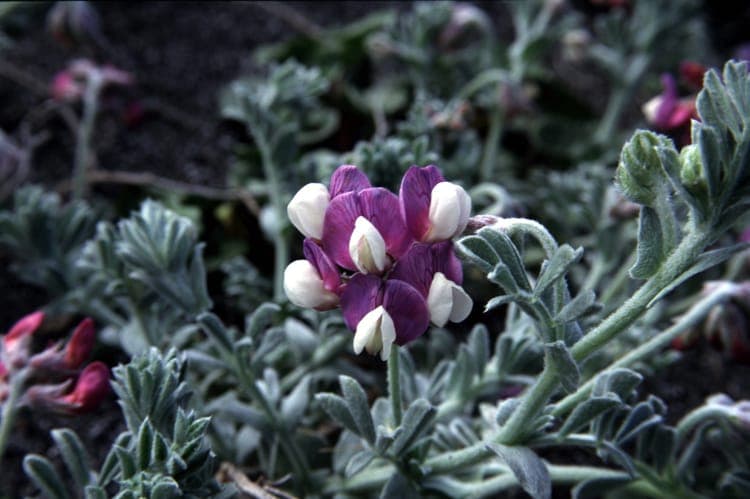
Gordon Leppig & Andrea J. Pickart / Public domain, via Wikimedia Commons
Gray beach pea: complete guide
Lathyrus littoralis
Want to see Gray beach pea: complete guide in your garden?
1 minute, no credit card
Overview
Lathyrus littoralis, commonly known as the gray beach pea, silky beach pea, or dune sweet pea, is a rhizomatous herbaceous vine native to the Pacific coastal dunes of British Columbia, Washington, Oregon, and California. It belongs to the family Fabaceae - the legume family - and shares that family's remarkable ability to fix atmospheric nitrogen through root symbiosis with Rhizobium bacteria. Older botanical literature may list this plant under the synonyms Orobus littoralis or Astrophia littoralis.
In its native habitat, Lathyrus littoralis colonizes open sandy ground near the shoreline, often growing alongside beach grasses and low coastal shrublets. The rhizomatous root system allows the plant to spread vegetatively and anchor shifting sands - a trait that makes it ecologically valuable for dune stabilisation and, in garden settings, useful for holding together loose sandy banks or rocky slopes. The silvery, finely hairy foliage is one of its most distinctive features: a soft, silk-like texture catches the light and gives the plant an attractive sheen even when not in bloom.
For gardeners, the gray beach pea offers purple-pink flowers attractive to bumblebees and solitary bees, a reasonably self-sufficient growth habit once established, and a tolerance for exposed, windy positions that many ornamental plants cannot manage. At gardenworld.app you can explore how this coastal specialist integrates into a dune garden, a gravel border, or a sunny front garden design.
Appearance & bloom cycle
The stems of Lathyrus littoralis are slender, semi-climbing to sprawling, and reach 30 to 60 cm in length. They are covered with the same soft, silky hairs as the leaves, giving young shoots a silver-grey appearance. Each leaf consists of two to four pairs of leaflets - oval to oblong, grey-green with a distinct silky sheen - terminating in a tendril that the plant uses to cling to grasses and low structures.
Flowering begins in late April and continues through June, with individual flower clusters carrying two to six blooms per stem. Each flower is a typical pea-family blossom with a broad standard petal (flag) and lateral wings in deep purple-pink to lilac. Up close, the flowers have a faint sweet fragrance. As flowering ends, seed pods develop that mature to near-black by late summer - these provide ornamental interest even after the main bloom is over.
Planted 40 cm apart, multiple specimens quickly form a continuous mat 50 to 100 cm across. The rhizomatous growth habit means that established clumps slowly expand each season, creating an increasingly dense ground cover without any need for division or replanting.
Ideal location
Lathyrus littoralis demands full sun. In its wild coastal habitat it is fully exposed to sunlight all day, and shade reduces both stem vigour and flower production. A south-facing or south-west-facing position is ideal. The plant handles wind exposure extremely well - better than most ornamentals - making it suitable for open front gardens, roadside verges, and seaside locations where salt spray and persistent wind would damage less adapted plants.
In UK, Belgian, Dutch, or northern French coastal gardens, this species performs reliably year round in USDA zones 7-8. In more continental positions - central Belgium, northern Germany - it thrives through summer but may need winter mulch or treatment as a half-hardy perennial. Avoid positions with standing water or heavy shade from buildings; a freely draining aspect is non-negotiable.
Soil requirements
This plant evolved on lean, freely draining coastal sands with pH ranging from 5.8 to 7.8 - slightly acidic to mildly alkaline. It thrives on nutrient-poor ground and does not need rich soils. In fact, excessive soil fertility promotes leafy growth at the expense of flowers.
On heavy clay soil, improve drainage thoroughly before planting: incorporate 10 litres of coarse horticultural grit and 3 litres of perlite per square metre into the top 30 cm. On chalky or sandy soils, no amendment is needed. As a legume, Lathyrus littoralis fixes its own nitrogen, so fertilisation is minimal: a light dressing of well-rotted garden compost at 5 litres per square metre in early spring is ample. Avoid high-nitrogen feeds such as lawn fertiliser.
Free design
Want to see Gray beach pea: complete guide in your garden? Make a free design now.
Watering
Once established, gray beach pea is drought-tolerant and rarely needs supplemental watering in temperate European climates. During the first growing season after planting, water weekly during dry spells to help roots establish deeply. After that, fortnightly watering during extended droughts is sufficient.
Water at the base of the plant in the morning to allow foliage to dry quickly. Overhead watering in the evening invites fungal spotting on the leaves. In winter, no supplemental water is required on well-drained ground; plants in containers should be watered just enough to prevent the root zone from desiccating completely - roughly once every two weeks.
Pruning
Minimal pruning is required. After the main flowering peak in June, remove spent flower stems to encourage a potential second flush in August. In early spring, cut all dead stems back to ground level; the rhizomes will regenerate new shoots from March onwards. Trim any runners that stray beyond the intended planting area - the rhizomatous spread can be quite vigorous on loose sandy soils and should be contained if the plant is used in a mixed border.
For specimens grown against a low fence or wire frame, remove dead material in spring and re-tie new growth as needed. There is no need for hard renovation pruning.
Maintenance calendar
March: Remove dead stems to ground level; top-dress with 5 litres compost per square metre; check for overwintered rhizomes showing signs of rot.
April: New shoots emerge; put supports in place for climbing specimens; water if dry weather persists.
May: Full leaf growth; flower buds begin to form; inspect for aphids on growing tips.
June: Peak flowering; remove spent flowers after bloom; water weekly on sandy soils during prolonged dry spells.
July–August: Possible second flush; pods ripen to black; reduce watering.
September: Collect ripe seeds if propagation is intended; cut back any rhizome runners that have spread too far.
October–November: Stems begin to die back; apply 8 cm mulch of leaf mould or straw over roots in USDA zone 6 areas.
December–February: Dormancy; minimal care; protect from severe frost below -15 °C.
Winter hardiness
Lathyrus littoralis is reliably perennial in USDA zones 7-8 (mild coastal climates). In zone 6 - most of inland Belgium, the Netherlands, and northern Germany - the rhizomes survive with an 8-10 cm mulch layer. In zones 4-5, lift rhizomes in November, store dry and cool at 5-8 °C, and replant in April after the last frost. The plant tolerates salt spray and strong winds far better than most perennials, making it a natural choice for exposed seaside positions.
Companion plants
Pair gray beach pea with other coastal or dry-soil specialists:
- Armeria maritima (sea thrift): compact, pink-flowered rosette; 25 cm spacing with Lathyrus littoralis creates a natural-looking coastal tapestry.
- Eryngium maritimum (sea holly): blue-tinged spiky texture contrasts dramatically with the soft, silky lathyrus foliage.
- Glaucium flavum (yellow horned poppy): thrives on the same lean, alkaline sandy soils; yellow flowers complement the purple blooms.
- Sedum acre (biting stonecrop): low mat-former for the front edge; equally tolerant of dry, poor conditions.
- Centranthus ruber (red valerian): drought-tolerant, showy, and flowers concurrently in May-June.
- Ammophila arenaria (marram grass): the classic companion in coastal dune plantings; both species stabilise sand effectively.
Closing
Lathyrus littoralis is a specialist coastal plant that brings soft silver-grey foliage and rich purple flowers to positions where many ornamentals simply refuse to grow. Its ability to fix nitrogen, tolerate salt and wind, and spread by rhizomes to stabilise loose soils makes it as functional as it is beautiful.
Plan a garden that makes the most of this coastal gem by designing your planting scheme at gardenworld.app. Browse the full plant collection for more coastal and dry-soil companion combinations that work beautifully alongside Lathyrus littoralis.
Want to see Gray beach pea: complete guide in your garden? Make a free design now.
Upload a photo, pick a style, and get a photorealistic design with plant list in under a minute.
10,000+ gardens designed already
No credit card required


Similar plants
Tall Silky Lupine: complete guide
Lupinus elatus
Tall silky lupine is a fast-growing Californian perennial with silvery foliage and blue-purple flower spikes, ideal for a prairie-style garden.
Garfield Lupine: complete guide
Lupinus garfieldensis
The Garfield lupine is a rare, fast-growing American perennial for alkaline, dry grassland gardens, with striking blue flower spikes.
Lupinus elegans: complete guide
Lupinus elegans
Lupinus elegans, the elegant lupine, is a spectacular blooming plant from Mexico with blue flower spikes. Care, cultivation and garden use.