
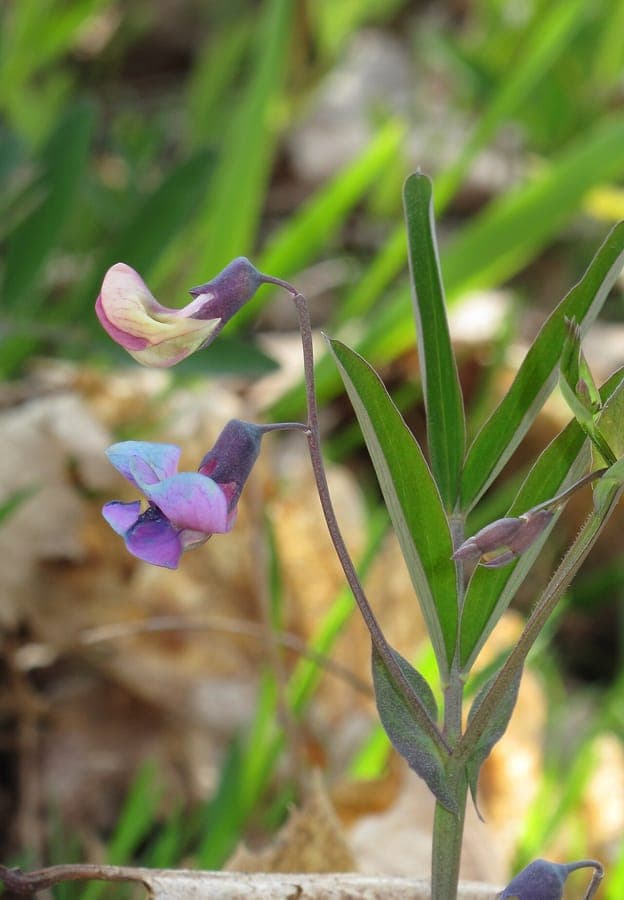
Robert Flogaus-Faust / CC BY 4.0, via Wikimedia Commons
Bitter vetch (Lathyrus linifolius): complete guide
Lathyrus linifolius
Want to see Bitter vetch (Lathyrus linifolius): complete guide in your garden?
1 minute, no credit card
Overview
Bitter vetch (Lathyrus linifolius), also known as narrow-leafed singletary or heath pea, is a fascinating woodland plant that distinguishes itself from other Lathyrus species through its preference for shade and narrow foliage. This robust, perennial herbaceous climber owes its name to its remarkably narrow leaf segments - quite different from the broad wings of Lathyrus latifolius. With its deep red to purple flowers, bitter vetch brings an intense colour accent to dark garden corners.
On gardenworld.app you can have a garden design created where this plant integrates ideally as ground cover in woodland situations, beneath shrubs, along tree roots and in other difficult shaded spots. The plant reaches 20-40 cm in height and spreads slowly to approximately 50-70 cm in width. Thanks to its preference for moister soils, it is excellently suited to damp woodland edges.
Appearance and bloom period
Bitter vetch flowers from May to July with deep red to dark purple flower clusters containing only a few flowers per truss - usually two to four florets. The foliage is highly characteristic: narrow, linear to lance-shaped, no wider than 2-3 mm - much narrower than other Lathyrus species. This gives the plant a fine, delicate appearance despite its robustness.
After flowering, small, flat seed pods appear with dark brown seeds. The plant grows more in height than in breadth and eventually forms a light, prominently visible grouping of flower clusters. The scent of the flowers is soft but pleasant.
Ideal location
Bitter vetch is one of the few Lathyrus species that tolerates and even prefers shade. Place it in half-shade to full shade - at least two to four hours of sun suffice. This makes it ideal for beneath deciduous trees, along stream edges and other moist shaded corners of the garden.
The plant thrives better in moist conditions than dry ones. Avoid very warm, dry spots; there it will quickly wilt. Plant approximately 25-30 cm apart for dense coverage. In woodland edges among feathery grasses and smaller shrubs it feels at home.
Soil requirements
Bitter vetch demands moisture-retentive soil - not waterlogged, but not continuously dry either. In sandy soils, add plenty of humus and leaf compost (30-40%) to improve moisture retention. In heavy clay, add sand and gravel for better drainage.
The preferred pH ranges from 5.5 to 7.0 - it thrives better in weakly acidic to neutral soils. Feeding is not essential, but an annual top dressing of compost (3-5 cm) supports growth. On gardenworld.app you can integrate this soil preparation into your garden plan.
Free design
Want to see Bitter vetch (Lathyrus linifolius): complete guide in your garden? Make a free design now.
Watering
During the first growing season, water regularly - two to three times weekly during dry periods - so the soil does not dry out. Water at the base of the plant. Once the plant is well established, supplementary water is only necessary during very extended drought.
The plant performs much better in moist conditions than dry ones. A mulch of 5 cm of leaf or needle litter helps moisture retention enormously. In winter, you prevent stagnant wet feet - ensure well-draining soil.
Pruning
Bitter vetch grows relatively slowly and moderately aggressively. Prune in early spring (March-April) to remove dead stems and frost damage. After flowering, you can remove spent flower stems to limit self-seeding (unless you want seed). The plant does not require heavy pruning.
Maintenance calendar
March-April: Remove dead and frost-damaged stems. Plant new specimens; ensure moisture-retentive soil with plenty of humus.
May-June: Peak flowering period. Monitor for drought; water in dry periods.
June-July: Peak flowering, seed ripens. Harvest seed if you want to limit self-seeding.
August-October: Growth slows. Add a layer of compost around plants. Plant for autumn.
November-February: Quiet period. Do not specifically protect young plants - they are completely winter-hardy.
Winter hardiness
Lathyrus linifolius is very winter-hardy, to -25°C (USDA zones 3-9). This is one of the hardiest Lathyrus species and can readily overwinter outdoors throughout the UK and temperate Europe.
Companion plants
Bitter vetch forms beautiful combinations with other woodland plants. Group with wood anemone, evergreen sedge (Carex), yellow starflower and Christmas fern. For flowering contrast, plant woodland violets or shade-loving broom nearby.
On gardenworld.app you can design an authentic woodland border with this vetch as a permanent component. Plant in groups of five to seven specimens for natural effect.
Final thoughts
Bitter vetch is a plant for gardeners wishing to fill shaded garden corners with colour and character. Its narrow foliage, dark red flowers and preference for moist shade make it indispensable in woodland gardens. Create a natural woodland border on gardenworld.app where this vetch takes centre stage.
Want to see Bitter vetch (Lathyrus linifolius): complete guide in your garden? Make a free design now.
Upload a photo, pick a style, and get a photorealistic design with plant list in under a minute.
No credit card required


Similar plants
Japanese pea (Lathyrus japonicus): complete guide
Lathyrus japonicus
Discover Japanese pea (Lathyrus japonicus), a hardy beach vetchling with purple flowers and grey-green foliage. Perfect for rock gardens, borders, and coastal landscapes. Planting, care, and winter hardiness.
Everlasting pea (Lathyrus latifolius): complete guide
Lathyrus latifolius
Learn all about everlasting pea (Lathyrus latifolius), a strong climber with pink and purple flowers. Ideal for pergolas, garden walls and borders. Sowing, planting and care.
Black pea (Lathyrus niger): complete garden guide
Lathyrus niger
Discover black pea, an elegant wild-growing climbing plant. Growing tips, bloom period, ideal location, and uses in natural garden designs.