
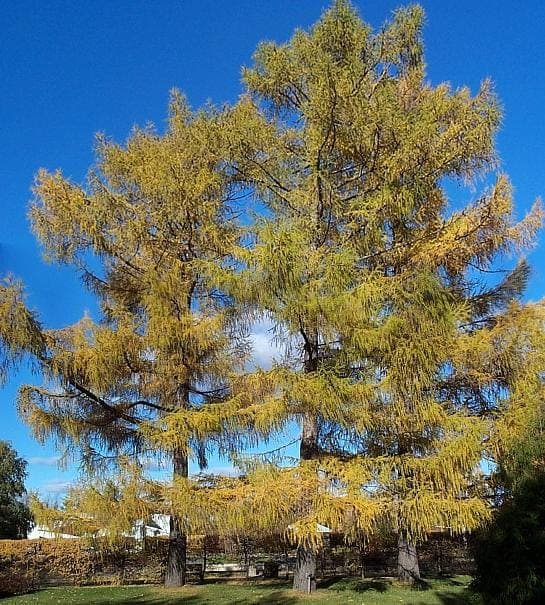
Montréalais / CC BY-SA 3.0, via Wikimedia Commons
Siberian larch: complete guide
Larix sibirica
Want to see Siberian larch: complete guide in your garden?
1 minute, no credit card
Overview
The Siberian larch (Larix sibirica), native to northeastern Europe through Mongolia, is an impressive deciduous conifer of great ecological and practical importance. In Siberia, this tree forms extensive forests. In European gardens, it offers beauty, hardiness, and resilience. The tree has historically been used for timber and shipbuilding.
Appearance and bloom
The Siberian larch reaches 20-30 meters, occasionally to 40 meters under optimal conditions. The tree displays a regular, sturdy pyramidal form with densely branched structure. The needles are extremely fine (2-3 cm), soft, and green, clustered in groups. Early spring brings small reddish cones (female) and yellow flowers (male). Autumn brings spectacular golden-yellow coloring.
Ideal location
The Siberian larch thrives in full sun with at least 6-8 hours of direct sunlight. Plant in a location with sufficient vertical space for a tall tree. This tree is extremely hardy (USDA zones 2-6) and tolerates extreme cold. Wind and cold winters pose no problems.
Soil
The Siberian larch grows in diverse soils: sandy, loamy, and clayey. The optimal pH is 5.5-7.5. The tree accepts less nutrient-rich soils. Drainage is less critical than for the Japanese larch.
Free design
Want to see Siberian larch: complete guide in your garden? Make a free design now.
Watering
During the growing season, water regularly, especially the first two years. Provide 2-3 liters weekly during dry periods. Once established, the tree shows drought sensitivity, so watering during very dry summers is beneficial.
Pruning
Minimal pruning required. Remove dead branches or severely damaged branches in late winter (February-March). Retain the natural form; this tree develops its own elegant structure.
Maintenance calendar
- February-March: Check for winter damage; prune damaged branches
- April-May: Planting recommended; begin watering
- June-September: Regular watering during dry spells; apply fertilizer
- October-November: Continue watering; autumn needles turn yellow
- December-January: Winter rest; no maintenance
Winter hardiness
The Siberian larch is extremely hardy down to -45°C (USDA zones 2-6). This is a true survivor. The tree tolerates Siberian winter conditions.
Companion plants
The Siberian larch combines well with other hardy conifers. Underplant with hardy ground covers. In mixed borders, dark-green spruces provide contrast.
Closing
The Siberian larch is the ultimate choice for those wanting a majestic, hardy deciduous conifer in large gardens. This is not a tree for small spaces, but for those who appreciate unmatched winter hardiness. Discover growing sites for large trees on gardenworld.app. Plan your garden with trees that last decades on gardenworld.app.
Want to see Siberian larch: complete guide in your garden? Make a free design now.
Upload a photo, pick a style, and get a photorealistic design with plant list in under a minute.
No credit card required


Similar plants
Dahurian larch: complete guide
Larix gmelinii
Dahurian larch (Larix gmelinii) is an elegant deciduous conifer with soft needles turning golden in autumn. Perfect for large gardens with cold winters.
Japanese larch: complete guide
Larix kaempferi
Japanese larch (Larix kaempferi) is a refined conifer with delicate feathery needles. The tree sheds needles in autumn with stunning golden-yellow hues.
Eastern larch (Tamarack): complete guide
Larix laricina
Eastern larch (Larix laricina), also called tamarack, is a hardy deciduous conifer that thrives in wet, boggy soils. Ideal for difficult wet locations.