
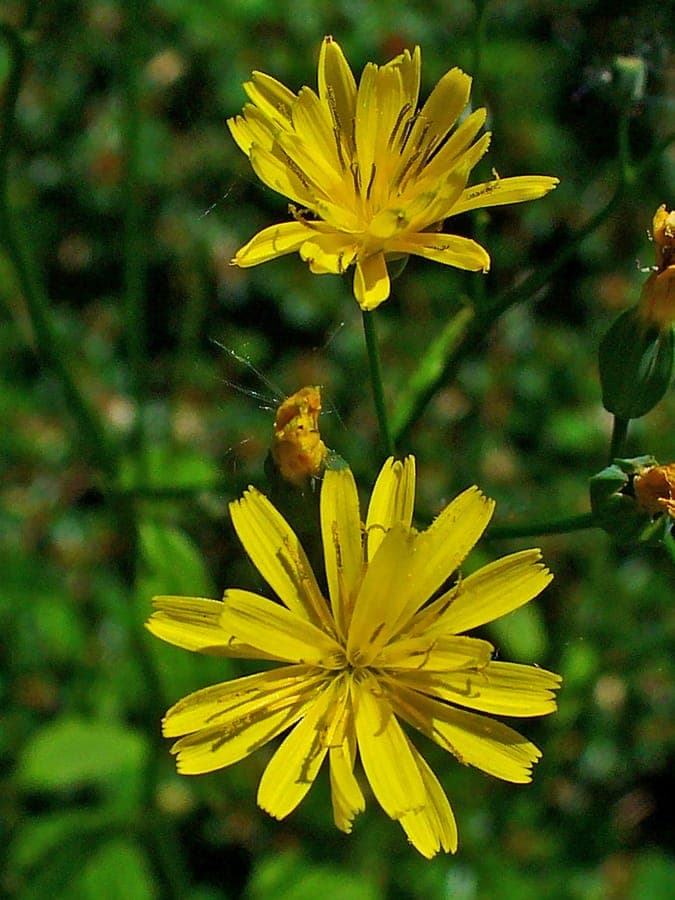
H. Zell / CC BY-SA 3.0, via Wikimedia Commons
Hawk's-beard: complete guide
Lapsana communis
Want to see Hawk's-beard: complete guide in your garden?
1 minute, no credit card
Overview
Hawk's-beard (Lapsana communis) is a valuable wildflower from the Asteraceae family occurring naturally from Europe to Siberia. This native plant is useful for bird gardens and natural settings, particularly as birds and small animals relish its seeds. The plant combines practical bird feeding with subtle yellow flowers.
In gardenworld.app philosophy, we choose hawk's-beard for bird-rich gardens and ecologically conscious garden designs. It is a modest but valuable addition to wild borders and woodland edges.
Appearance and Bloom
Hawk's-beard reaches heights of 30-90 cm depending on growing conditions. Stems are fine and branched. Foliage features large, lyrate leaves with coarse margins. Flowers appear in summer and autumn (June-October) as small, yellow florets in loose clusters, highly attractive to bees and butterflies.
The most distinctive feature is the seeds: these are small, black, and nutritious, beloved by birds, especially goldfinches and other small fowl. The plant produces seeds abundantly, providing natural bird feeding.
Ideal Location
Hawk's-beard thrives optimally in sunny to partially shaded locations. It prefers at least 4-5 hours of direct sun daily but accepts more shade. The plant grows naturally in woodland edges and open spaces, where its flexibility suits any garden setting.
Place it in open borders, wild corners, and woodland edges where bird feeding is central. It is highly suitable for ecological gardens where spontaneous growth is possible.
Soil Type
Hawk's-beard grows in virtually all soil types provided reasonable moisture. The plant tolerates heavy clay, sandy soils, and loam well, provided water drains adequately. pH of neutral to slightly acidic (6.0-7.5) is optimal.
The plant is very flexible and thrives even in moderately nutrient-poor soils. Compost addition improves growth but is not essential. Good drainage is important; waterlogging causes root rot.
Watering
Hawk's-beard has moderate water needs and prefers moist soils. Water regularly during growing periods, especially in dry summers. The plant also accepts dry periods, especially once established.
Ensure soil does not dry completely, but prevent waterlogging. During very warm periods, check regularly. In fall and winter, reduce watering as the plant minimizes activity.
Free design
Want to see Hawk's-beard: complete guide in your garden? Make a free design now.
Pruning and Maintenance
Hawk's-beard requires minimal pruning. After flowering, spent flower panicles can be gently removed, but for bird feeding, seed plants can remain intact through autumn. This encourages bird visits.
If unwanted seed spread occurs, remove plants carefully. For natural seed dispersal, allow abundant seed ripening. No fertilizer needed, only water and drainage.
Maintenance Calendar
April-May: Growth accelerates; initial flowering preparation; regular watering. June-July: Bloom starts; abundant bee and butterfly visits; seed formation begins. August-September: Full seed development; peak bird feeding; flowers present. October-November: Seeds ripen; birds feed actively; final flower panicles. December-February: Winter dormancy; seeds remain present; ongoing bird feeding. March: Preparation for new season; self-sown seedlings possible.
Winter Hardiness
Hawk's-beard is completely winter hardy to USDA zone 4 (-30°C). The plant grows naturally throughout Europe to Siberia and withstands frost without problem. Seeds can tolerate frost and germinate in spring.
In the Netherlands, Belgium, and France no protection needed. The plant survives all normal frost periods without damage. Extreme snow pressure may damage fragile seed heads, but this minimally affects bird feeding.
Companion Planting
Hawk's-beard pairs well with other bird-feeding plants. Group with thistles, cornflowers, sunflowers, and other seed producers for optimal bird feeding. Below larger wild shrubs it works perfectly.
With evening primrose, galium, and mallow it forms beautiful natural borders. For complete bird feeding, add berry-producing shrubs (boxwood, holly, elderberry). Multifunctional bird gardens provide seeds, berry food, and insects.
Closing Thoughts
Hawk's-beard is essential for bird-rich gardens. At gardenworld.app, we enjoy using it in natural borders and bird gardens where feeding birds is central. Its minimal maintenance requirements and highly valuable bird food value make it a smart choice.
With natural growth and minimal pruning, you create a self-renewing food source. Goldfinches, tits, and other small fowl will gratefully frequent your garden.
Want to see Hawk's-beard: complete guide in your garden? Make a free design now.
Upload a photo, pick a style, and get a photorealistic design with plant list in under a minute.
No credit card required


Similar plants
Calendula stellata: complete guide
Calendula stellata
Complete guide to Calendula stellata, the star-flowered marigold from Sicily: location, soil, watering and companion planting tips.
Korean chrysanthemum: complete guide
Chrysanthemum x rubellum
Chrysanthemum x rubellum is a hardy autumn perennial with single pink to copper flowers from August to November. Care and combinations.
Helianthus divaricatus: complete guide
Helianthus divaricatus
Helianthus divaricatus is a North American woodland sunflower with yellow summer blooms, ideal for naturalistic borders and shady edges.