
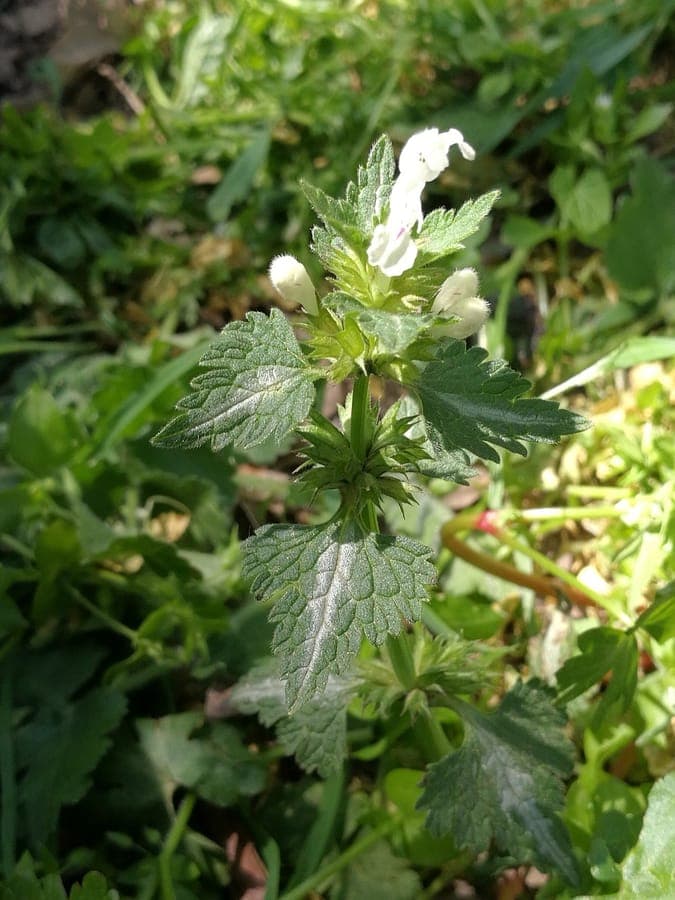
(c) Mattia Menchetti, some rights reserved (CC BY) / CC BY 4.0, via Wikimedia Commons
Bifid Deadnettle (Lamium bifidum): complete guide
Lamium bifidum
Want to see Bifid Deadnettle (Lamium bifidum): complete guide in your garden?
1 minute, no credit card
Overview
Bifid Deadnettle (Lamium bifidum) is a charming, low-growing perennial from the Mediterranean region. This plant belongs to the mint family (Lamiaceae) and is also known as Lamier bifide. Bifid Deadnettle grows wild in rocky mountain areas across Southern Europe, particularly in Italian, Spanish and Greek Mediterranean zones.
Although less well-known than related species like common deadnettle, Lamium bifidum is a beautiful low-growing plant ideal for rock gardens, Mediterranean borders and dry gardens. The plant produces delicate white flowers from March to June and grows only 20-30 cm tall.
Appearance and Bloom
Bifid Deadnettle is a compact, low-growing shrublet usually no taller than 20-30 cm. The stems are square in cross-section, characteristic of the mint family, and bear small, softly hairy leaves. The leaves are oblong, approximately 15-25 mm long, and have subtle hairiness.
The flowers are the highlight: delicate white florets arranged in short spikes along the stem. Each flower has two lips and appears from March to June, depending on location and weather conditions. The flowers are highly attractive to bees and other pollinators.
Ideal Location
Bifid Deadnettle grows best in sunny to partially shaded locations. Place the plant where it receives at least 4-6 hours of direct sunlight daily. In very hot climates some afternoon shade can be beneficial, but generally the plant loves full sun.
The plant thrives well on steep slopes and in rock gardens where drainage is excellent. In containers you should place it in a sunny, well-draining spot.
Soil
Bifid Deadnettle prefers well-draining soil. Plant this species in stony ground, possibly mixed with some compost for extra nutrition. The plant tolerates neutral to slightly acidic soil.
In containers use a mixture of regular potting soil and perlite in a 50/50 ratio for optimal drainage.
Watering
Once established, bifid deadnettle is quite drought-tolerant. Water regularly in the first season so the plant becomes well-rooted. After establishment you can drastically reduce watering. During dry periods the plant accepts limited water.
Excessive watering should be avoided, especially in winter, as this can lead to root rot.
Free design
Want to see Bifid Deadnettle (Lamium bifidum): complete guide in your garden? Make a free design now.
Pruning
Pruning is not much needed for bifid deadnettle. After flowering you can lightly cut back the plant to maintain a compact form. Also remove spent flowers and damaged leaves.
The plant grows naturally compact and does not need heavy pruning.
Maintenance Calendar
Spring (March-May): Planting time. Water regularly as the plant becomes established. Enjoy the flowers. No feeding needed.
Summer (June-August): Minimal water during dry periods. Remove spent flowers. Feeding not needed.
Autumn (September-November): Gradually reduce watering. Pruning of previous season growth. Very minimal watering.
Winter (December-February): Almost no watering. Protect from heavy rainfall with good drainage. No feeding.
Winter Hardiness
Bifid Deadnettle is hardy to about -15 degrees Celsius (zones 6-7). In many European gardens it overwinters without problems in open ground, as long as drainage is good. In very wet winters it can sometimes die from root rot.
In containers protection from heavy rain and frost is good, as the root system is more sensitive to extreme moisture.
Plant Characteristics
Bifid Deadnettle attracts many bees and other pollinators. This makes it excellent for bee gardens. The plant also contains certain compounds traditionally used in Mediterranean herbal medicine.
The plant is also very attractive for rock and alpine gardens with its compact growth and delicate flowers.
Closing
Bifid Deadnettle is a charming choice for dry, sunny gardens and rock plantings. With its minimal care requirements and delicate flowers, it will provide years of pleasure. The plant is ideal for Mediterranean garden styles and dry landscapes.
If you are seeking a low-growing Mediterranean plant with white flowers, bifid deadnettle is an excellent choice. With gardenworld.app you can design the perfect spot for your Mediterranean plant collection. With gardenworld.app you effortlessly create a dry, sunny growing style.
Want to see Bifid Deadnettle (Lamium bifidum): complete guide in your garden? Make a free design now.
Upload a photo, pick a style, and get a photorealistic design with plant list in under a minute.
No credit card required


Similar plants
Apple mint (Mentha x villosa): complete guide
Mentha x villosa
Meet apple mint (Mentha x villosa): a fruity-scented kitchen herb with woolly leaves, perfect for tea and mojitos.
Salvia peyronii: complete guide
Salvia peyronii
Discover Salvia peyronii, a rare Lebanese mountain sage. Growing tips, hardiness, and companion planting for a Mediterranean gravel garden.
Bigleaf mint (Mentha x rotundifolia): complete guide
Mentha x rotundifolia
Discover bigleaf mint: cultivation, care tips, and garden uses. Learn how to grow this aromatic herb with soft, hairy leaves.