
The original uploader was Lokenrc at English Wikipedia. / CC BY 2.5, via Wikimedia Commons
Queen's Crape-Myrtle (Lagerstroemia speciosa): complete guide
Lagerstroemia speciosa
Want to see Queen's Crape-Myrtle (Lagerstroemia speciosa): complete guide in your garden?
1 minute, no credit card
Overview
The Queen's Crape-Myrtle (Lagerstroemia speciosa), also known as Pride-of-India, is a stunning flowering tree from tropical Asia. Originally from regions spanning China to Indonesia, this tree is now grown in warm climates worldwide. The tree is prized for its massive, long-lasting flowers in shades of pink, purple or red, and can reach 20-30 meters in ideal conditions.
The tree belongs to the Lythraceae family and is renowned for its spectacular blooming period during summer and early autumn. With its elegant broad-leaved growth and striking flowers, Lagerstroemia speciosa is an excellent choice for warm climate zones where it can thrive.
Appearance and Bloom
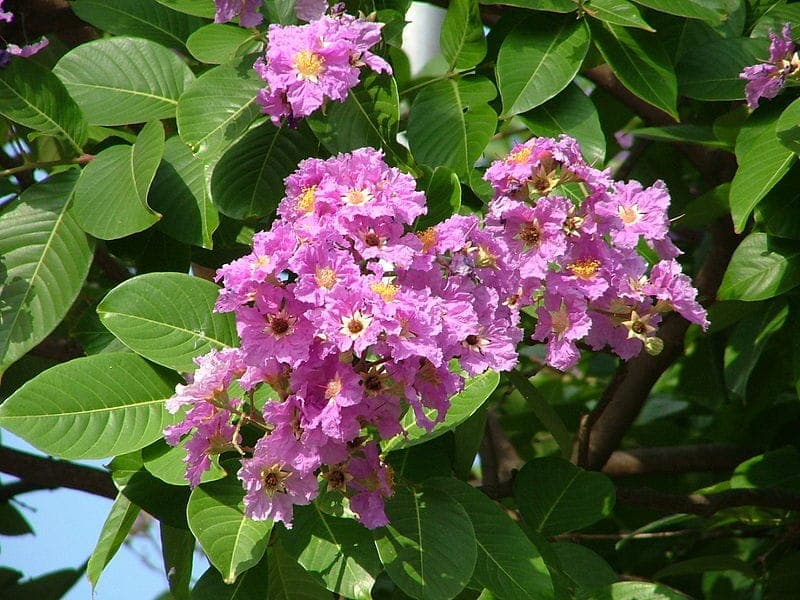
The Queen's Crape-Myrtle is a medium-sized tree with a light, open crown. The trunk is particularly distinctive: smooth, with papery bark that naturally exfoliates to reveal beautifully colored underlayers. The leaves are large, approximately 15-25 cm long, oblong-oval and deep green in color.
The flowers are the highlight of this tree. They appear in large, showy flower clusters at the branch tips. The flowers have 6 ruffled petals and are typically pink, purple or deep red. The blooming period extends from June to September, providing a mesmerizing spectacle.
Ideal Location
The Queen's Crape-Myrtle thrives in a warm, sunny location. Plant the tree where it receives at least 6-8 hours of direct sunlight daily. The tree is drought-tolerant and actually grows better in warm, dry conditions than in humid areas.
In temperate climates the tree can grow in a sheltered location, but will likely succumb to winter if temperatures drop below -5 degrees Celsius. In warmer regions it grows outdoors as a full-size tree; in cooler zones it is better cultivated in large containers.
Soil
The Queen's Crape-Myrtle is not fussy about soil but prefers well-draining medium. Plant this tree in loose, nutrient-rich soil mixed with compost or peat. The tree tolerates both acidic and neutral soil, and can even grow in fairly poor soils.
In containers use universal potting soil mixed with perlite for extra drainage.
Watering
During the growing season, water regularly, especially during dry periods. The tree likes to be consistently moist but not waterlogged. Once the root system is well-established, it tolerates dry periods better.
In winter, especially in cold climates, significantly reduce watering. In containers be more careful to avoid excessive dryness since the root system is limited.
Free design
Want to see Queen's Crape-Myrtle (Lagerstroemia speciosa): complete guide in your garden? Make a free design now.
Pruning
Pruning helps keep the tree more compact and fuller. In late winter, before new growth starts, prune the tree to maintain shape and encourage branching. Cutting back spent flower clusters after blooming can also stimulate a second bloom.
Controlled pruning is not strictly necessary but results in more attractive trees.
Maintenance Calendar
Spring (March-May): Resume regular watering. Plant young trees before it becomes very hot. Apply balanced fertilizer monthly. Previous season pruning can be done.
Summer (June-August): Monitor moisture carefully, especially during hot periods. Enjoy the blooms. Continue monthly feeding for flower production.
Autumn (September-November): Lower watering as temperatures drop. Increased feeding can extend blooming. Collect seeds from ripening fruits.
Winter (December-February): Minimal watering in cold climates. No feeding. Protect from frost with mulch or fleece blanket.
Winter Hardiness
The Queen's Crape-Myrtle is not winter-hardy in temperate climates and will die at temperatures below -5 degrees Celsius. In temperate zones (8-10), it may sometimes survive with protection. In warm zones (11+) it grows as a full-size tree.
In cold climates the best strategy is to cultivate it in containers and move indoors before winter or to a protected greenhouse.
Plant Characteristics
The Queen's Crape-Myrtle attracts many insects, especially butterflies and bees. This makes it excellent for insect-friendly gardens. The tree also produces winged seeds that spread easily.
The rough bark exfoliation of the trunk is also highly decorative and adds visual interest during winter.
Closing
The Queen's Crape-Myrtle is an impressive choice for warm climate zones where it can reach full beauty. With basic care and frost protection, you will enjoy its beautiful flowers for many years. The tree is somewhat more challenging to cultivate than Lagerstroemia indica, but certainly worthwhile for those wanting something spectacular.
If you are seeking a flowering tree with exotic character, the Queen's Crape-Myrtle is an excellent choice. Find them in warm areas through specialized tree growers. With gardenworld.app you can design the perfect spot for your exotic tree. With gardenworld.app you effortlessly create a tropical garden style.
Want to see Queen's Crape-Myrtle (Lagerstroemia speciosa): complete guide in your garden? Make a free design now.
Upload a photo, pick a style, and get a photorealistic design with plant list in under a minute.
No credit card required


Similar plants
Winged loosestrife: complete guide
Lythrum alatum
Everything about Lythrum alatum, the winged loosestrife. Care, location, pruning and garden pairings for this native North American wetland perennial.
Dnieper loosestrife: complete guide
Lythrum borysthenicum
Everything about Lythrum borysthenicum, the Dnieper loosestrife: location, bloom season, care in pond margins and bog gardens. Full growing guide included.
Grand redstem: complete guide
Ammannia robusta
Everything about Ammannia robusta: pond margins, bog gardens, soil, care and propagation. Practical advice for water garden enthusiasts in temperate climates.