
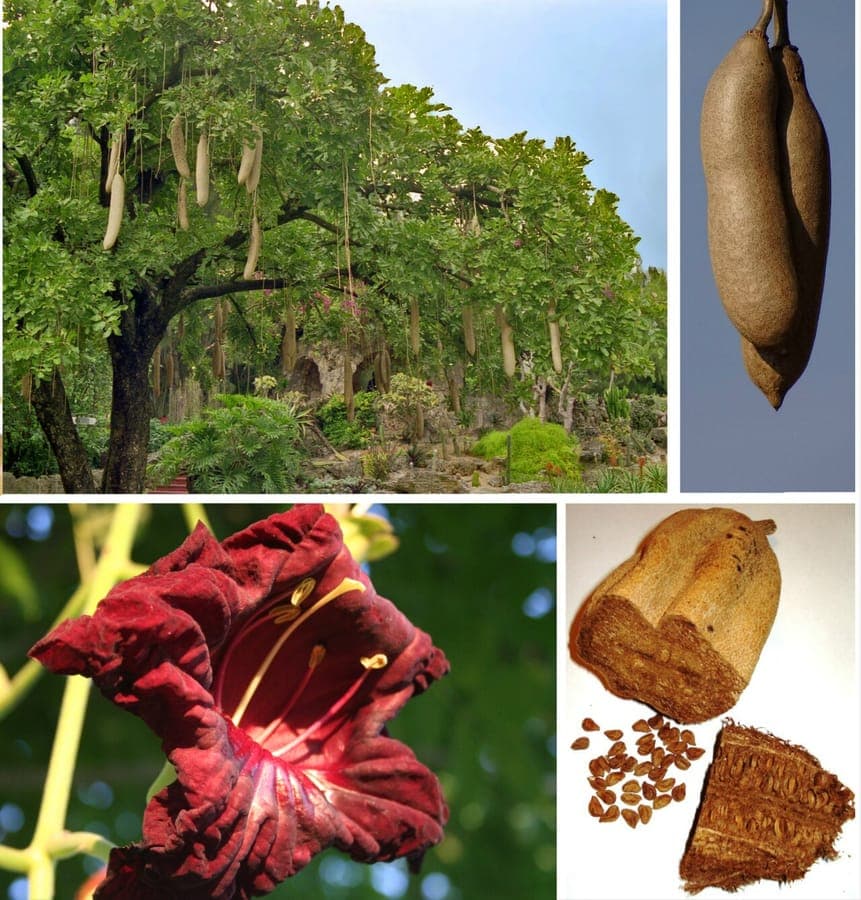
Photographs: Ettore Balocchi (upper left), Bjørn Christian Tørrissen (upper right), Marco Schmidt (bottom left), Genet (bottom right). Montage by RoRo / CC BY-SA 3.0, via Wikimedia Commons
Kigelia africana: complete guide
Kigelia africana
Want to see Kigelia africana: complete guide in your garden?
1 minute, no credit card
Overview
Kigelia africana, commonly known as the African sausage tree or saucissonnier, is an impressive tropical specimen from Africa. This tree is celebrated for its spectacular red tubular flowers and highly distinctive elongated fruits that genuinely resemble sausages. In the wild, it grows throughout tropical African regions and is becoming increasingly popular in warm-climate gardens worldwide.
The sausage tree reaches impressive dimensions and can develop into a magnificent canopy tree. With its unique fruiting and flowering display, this plant offers visual interest throughout the year. In cooler climates, it is often cultivated in greenhouses or conservatories.
Appearance and Bloom
Kigelia africana is an impressive tree with an open, spreading crown. The leaves are compound and green, creating a fine foliage texture that contrasts beautifully with the flowers.
The flowering display is truly spectacular: long, hanging clusters of bright red to orange tubular flowers appear in late summer through fall. These blooms are highly conspicuous and attract butterflies and hummingbirds. Following the flowers come the highly characteristic fruits: elongated, sausage-like pods that can grow up to 60 centimeters long with a uniform brown-green coloration.
Ideal Location
The African sausage tree thrives in sunny positions with abundant direct light. Ensure the tree receives at least 6 to 8 hours of sun daily. A southwest-facing exposure is ideal for optimal growth and flowering.
Allow plenty of space for the tree to expand, as it develops a large canopy. Position it away from buildings or water features, as fruits can become heavy and fall. In regions with mild winters, outdoor cultivation is possible, but harsh climates require protection. In northern Europe, indoor cultivation in a greenhouse or conservatory is typically necessary.
Soil
Kigelia africana prefers well-draining soil types. Sandy and gritty soils are ideal, as are slightly clayey soils with good permeability. Avoid heavy, waterlogged soils that cause stagnation.
When cultivating in pots, prepare a growing medium of 40% garden soil, 40% sand, and 20% organic matter. A pH between 6.0 and 7.5 is suitable. Work compost or organic fertilizer into the soil annually to maintain fertility.
Watering
The sausage tree has moderate water requirements. During the growing season (spring and summer), water regularly but allow the soil to dry superficially between waterings. Ensure the soil never becomes waterlogged.
In autumn and winter, reduce watering significantly. In temperate climates, the tree needs only minimal water during winter. Check soil moisture regularly with your finger: if the top 3-5 centimeters are dry, water again.
During very dry periods, mist the foliage on cool mornings or evenings for additional moisture.
Free design
Want to see Kigelia africana: complete guide in your garden? Make a free design now.
Pruning
The African sausage tree naturally develops an attractive form, so extensive pruning is unnecessary. Remove dead, damaged, or crossing branches in late winter or early spring.
To encourage compact growth, prune young trees by removing the growing tip. This stimulates branching and fuller form. Avoid heavy pruning on mature trees, as this can cause tangled new growth.
General shaping can be done in spring before the growing season begins.
Maintenance Calendar
Spring (March-May): Resume watering after dormancy. Begin monthly fertilization as growth commences. Check for pests and diseases. Perform light pruning and shaping if needed.
Summer (June-August): Ensure regular watering and weekly fertilization. Monitor for signs of water stress or unwanted insects. Flowers may begin appearing.
Fall (September-November): Gradually reduce watering. Lower fertilization. Enjoy the spectacular bloom and fruit formation. Ensure good ventilation around the plant.
Winter (December-February): Keep the plant dry and cool. Minimal watering. No fertilization needed. This dormancy is essential for next year's flowering.
Winter Hardiness
Kigelia africana is sensitive to frost and tolerates temperatures below 10-15 degrees Celsius poorly. In tropical and subtropical regions, the tree grows outdoors, but in northern Europe, it must be kept indoors or very well protected.
When cultivated indoors in a greenhouse or conservatory, it thrives best at winter temperatures of 15-18 degrees Celsius. Avoid sudden temperature fluctuations and drafts.
In very mild winter areas, the tree can grow outdoors with protection from reed screens or burlap around the trunk.
Companion Plants
The African sausage tree works well with other tropical specimens. Combine with:
- Exotic palms for full tropical atmosphere
- Ficus species for structure and shade
- Hibiscus for additional flowers
- Bougainvillea for complementary colors
- Low ornamental grasses at the base
Ensure companion plants have similar warmth and light requirements. Varying heights and foliage textures create maximum visual impact.
Closing
Kigelia africana is truly a statement plant for warm-climate gardens or protected indoor spaces. With its spectacular red flowers and unique fruits, it guarantees to attract attention. While not suitable for all climates, every tropical plant enthusiast will want to grow this tree.
With proper care and attention to right growing conditions, you will enjoy years of this impressive tropical beauty. Find seeds and young trees from specialized nurseries or via gardenworld.app for everything you need to design your dream garden.
Want to see Kigelia africana: complete guide in your garden? Make a free design now.
Upload a photo, pick a style, and get a photorealistic design with plant list in under a minute.
No credit card required


Similar plants
Tabebuia pallida: complete guide
Tabebuia pallida
Full growing guide for Tabebuia pallida: location, soil, watering, pruning, hardiness and companion plants for this tropical trumpet tree.
Northern catalpa: complete guide
Catalpa speciosa
Everything about northern catalpa (Catalpa speciosa): bold white flowers, fast growth, and how to grow this striking tree in your garden.
Desert willow: complete guide to Chilopsis linearis
Chilopsis linearis
Complete growing guide for desert willow (Chilopsis linearis): sun, soil, flowering, pruning, and winter care for this spectacular flowering small tree.