Dinkum / CC0, via Wikimedia Commons
Felt bush (Kalanchoe beharensis): care guide
Kalanchoe beharensis
Want to see Felt bush (Kalanchoe beharensis): care guide in your garden?
Full design in HD: €7.99
Look after your Felt bush with the GardenWorld app
Identify plants with your camera and get a care calendar with reminders for this plant.


Overview
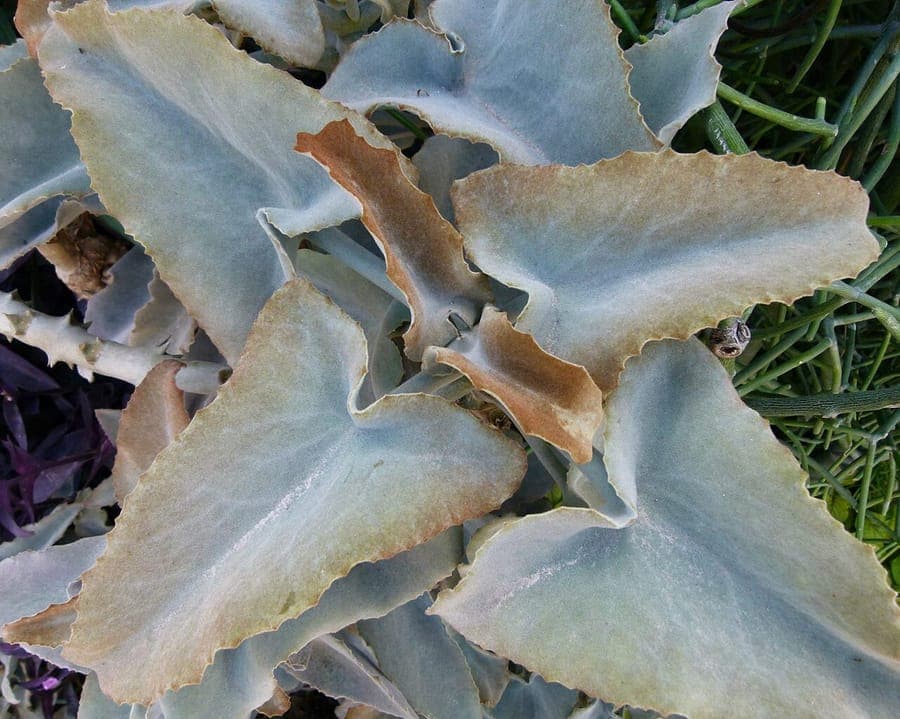
Kalanchoe beharensis is no windowsill trinket but a succulent that grows into a proper shrub. It produces large, triangular to arrow-shaped leaves covered on both sides with a dense felt of tiny hairs, so that touching one feels somewhere between velvet and suede. Its English names, felt bush and velvet elephant ear, sum it up nicely: soft, big and a little bit elephantine.
The species comes from southern Madagascar, where it grows in dry scrub on rocky and sandy ground. In the wild it becomes a multi-stemmed shrub or small tree several metres tall. In a pot it stays smaller, usually 1 to 1.5 m, but it still claims a good amount of space. Like other kalanchoes it belongs to the stonecrop family, Crassulaceae, yet in almost every respect it is the opposite of the compact flowering kalanchoe sold in supermarkets. It holds the Royal Horticultural Society's Award of Garden Merit as a plant for a heated glasshouse or conservatory.
This is a plant for a bright conservatory, a large picture window or a sunny patio in summer. Give it room and you get a sculptural specimen with almost graphic foliage that looks good all year round.
Appearance and flowering
On mature plants the leaves reach 15 to 30 cm long and sit in opposite pairs, each pair at right angles to the last, on thick, woody stems. The edges are wavy and coarsely toothed, giving the plant a slightly wild outline. Young leaves at the centre are often covered in rust-brown or cinnamon hairs, as in the photo, and the felt fades to silver-grey or greyish green as they age.
Lower down the stem, the older leaves gradually fall away. They leave prominent, knobbly scars, so that after a few years the trunk takes on a character of its own, almost reptilian. That is entirely normal and no sign of neglect.
A few cultivars exist. 'Fang' has small, tooth-like projections on the underside of the leaves, while 'Oak Leaf' has more deeply cut, oak-like foliage. Flowering in pots in our climate is rare and only happens on older, larger specimens: in late winter or spring a tall branched stem appears, carrying small tubular flowers in yellowish green tones. Unlike Kalanchoe luciae, the plant does not die after flowering.
Position and light
The felt bush wants plenty of light. A spot right next to a south or west-facing window, in a conservatory or a bright porch, is ideal. It copes well with direct sun, though a plant moved straight out from indoors can scorch in summer. In a dim position the stems grow long and thin, the leaves get smaller and the plant starts to fall apart.
From late May to late September it can stand outside on a sheltered, sunny patio. Give it a week in light shade first to acclimatise. Beware of strong winds, because the large leaves act like sails and stems can snap. A spot under cover also helps because the felt stays wet for a long time after rain, which the plant does not appreciate.
Compost and repotting
Use a free-draining succulent compost mixed with a generous amount of coarse material such as pumice or grit. Because the plant becomes large and top-heavy, choose a heavy terracotta or concrete pot with a broad base. A drainage hole is essential.
Repot young plants every spring into the next size up, and older specimens every two to three years. With large plants it helps to have a second pair of hands, as the stems are more brittle than they look. Feed once a month from April to August with a half-strength succulent fertiliser. If you would rather keep the plant smaller, you can leave it in the same pot and simply replace the top few centimetres of compost.
Free preview
Want to see Felt bush (Kalanchoe beharensis): care guide in your garden? Make a free preview of your design.
Watering and rest
Water thoroughly once the compost has mostly dried out. In summer, for a large pot, that is roughly once every seven to ten days. Kalanchoe beharensis tolerates drought extremely well, but it grows more handsomely with regular water during the growing season. Always water the compost and never the leaves: water lingers in the felt and can cause marks or rot.
In winter, from November to February, the plant is happiest at 10 to 15 °C with little water, about once every three to four weeks. In a warm room it can have a little more, but always keep the compost on the dry side rather than wet. The felt collects dust, so brush it gently now and then with a soft paintbrush rather than wiping the leaves with a damp cloth.
Pruning and propagation
An older plant sometimes becomes bare and lopsided. In spring you can cut it back without hesitation: shorten the stems to the height you want, just above a leaf pair or scar. The plant will reshoot there and become bushier. Use the trimmed tips as cuttings. Leave them for a week until the cut has sealed, then insert them in dry succulent compost.
Kalanchoe beharensis can also be propagated from leaf cuttings, something that works far less reliably with Kalanchoe luciae. Cut off a healthy leaf with its stalk, let it dry for a few days and push the stalk a few centimetres into slightly moist compost, or lay the leaf flat. After a few weeks or months, new plantlets appear at the base. It takes patience, but one plant can give you a whole family of offspring.
Toxicity
Kalanchoe beharensis also contains bufadienolides, heart-active compounds found throughout the genus Kalanchoe, which makes it toxic to cats and dogs. Animals that eat the leaves usually suffer drooling, vomiting and diarrhoea, and larger amounts can upset the heart rhythm. The felted leaves are not especially tempting to chew, fortunately, but young and curious animals will try anything.
Place the plant where pets cannot reach it, and call your vet if your animal has eaten some all the same. It is not edible for people either, so keep young children away from it. Handling it during routine care is perfectly safe.
Maintenance calendar
March–April: Cut back if needed, repot and take cuttings. Increase watering gradually.
May–June: After the last frost, move outdoors to a sheltered, sunny spot, starting with a week in light shade.
July–August: Water regularly once dry, half-strength feed once a month. Keep the leaves dry.
September–October: Stop feeding. Bring indoors as soon as nights drop below 8 °C.
November–February: Cool, bright and dry. Brush the felt clean from time to time.
The planting calendar on gardenworld.app lists jobs like these for all your plants and sends you a reminder at the right moment.
Winter hardiness
Kalanchoe beharensis is not hardy. Damage to leaves and stems begins around 0 °C and frost is fatal, so in Britain and north-west Europe it is grown as a container plant that spends October to mid-May indoors. A bright, cool room at 10 to 15 °C is ideal. An ordinary sitting room will do as well, but then it needs your brightest window, or the new leaves will come out small and pale.
Companion plants
As a large single specimen, the felt bush is the focal point of any group of pots. Surround it with smaller succulents with contrasting leaf shapes. Kalanchoe tomentosa, with its small and equally felted leaves, is a playful relative in miniature. Euphorbia trigona brings strict upright columns, Aloe arborescens and Agave attenuata add rosette shapes, and Portulacaria afra contributes fine, round leaves. Together they make a Mediterranean-style corner that can stand outdoors in summer and in the conservatory in winter.
If you would like to see how pots like these could work best in your garden or on your patio, you can have a garden design made on gardenworld.app.
Final thoughts
Kalanchoe beharensis is a succulent for anyone looking for something large and unusual: felted, wavy leaves, a scarred trunk with stories to tell and a silhouette that grows more striking every year. It asks for light, dry roots, a frost-free winter and a spot out of reach of pets. And with a single leaf or a trimmed tip, you will soon have a second plant to pass on.
Frequently asked questions about Felt bush
Is Felt bush winter hardy?
Kalanchoe beharensis is not hardy. Damage to leaves and stems begins around 0 °C and frost is fatal, so in Britain and north-west Europe it is grown as a container plant that spends October to mid-May indoors.
When and how do you prune Felt bush?
An older plant sometimes becomes bare and lopsided. In spring you can cut it back without hesitation: shorten the stems to the height you want, just above a leaf pair or scar.
How much water does Felt bush need?
Water thoroughly once the compost has mostly dried out. In summer, for a large pot, that is roughly once every seven to ten days.

See it in your garden
See Felt bush in your garden
One photo of your garden and a few questions. You see the result in about a minute.
Try it with a photoIdentify this plant in your own garden. Identify a plant
Similar plants
Kalanchoe tomentosa: complete guide
Kalanchoe tomentosa Baker
Panda plant (Kalanchoe tomentosa) is a fuzzy-leaved succulent from Madagascar with woolly foliage and purple flowers. Perfect for living rooms, windowsills, and dry zones.
Euphorbia trigona: complete guide
Euphorbia trigona
Euphorbia trigona, African milktree, is striking succulent with triangular stems. Native Africa. Minimum 5C, full sun, extremely drought-tolerant.
Portulacaria afra: complete guide
Portulacaria afra
Discover the Elephant bush - a nutritious African succulent with dense, light green foliage. Ideal for arid gardens and indoor plant combinations.
