
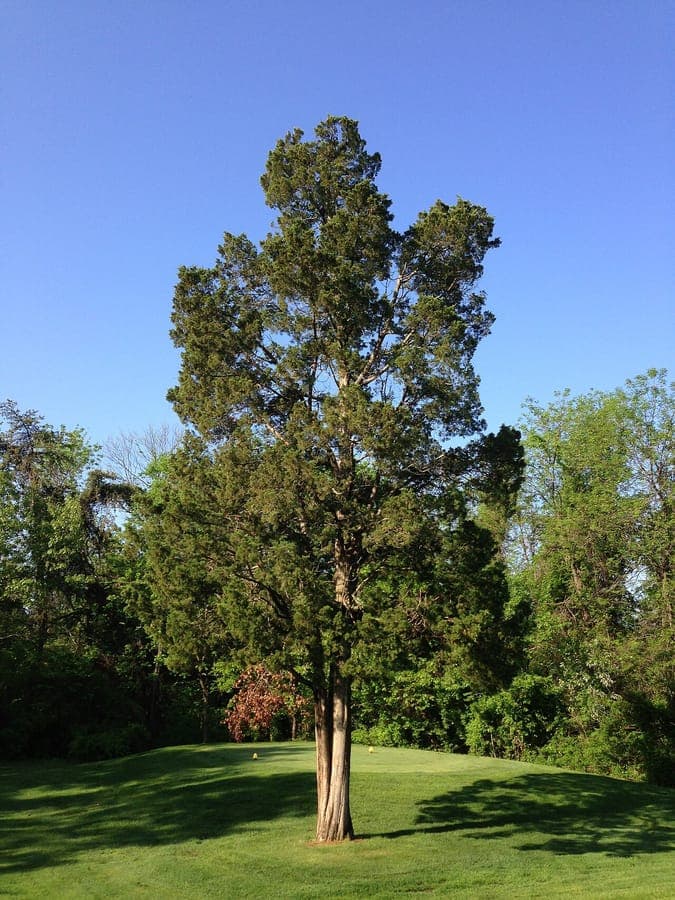
Famartin / CC BY-SA 3.0, via Wikimedia Commons
Red juniper: complete guide
Juniperus virginiana
Want to see Red juniper: complete guide in your garden?
1 minute, no credit card
Overview
Juniperus virginiana, commonly known as red juniper, is a rugged, long-lived evergreen tree native to eastern North America. Though not a true cedar, it belongs to the cypress family (Cupressaceae) and thrives in USDA hardiness zones 3 through 9 - making it an excellent choice for temperate gardens. In landscapes, it's valued for its upright, columnar form, reaching 6 to 12 meters in height with a spread of 1.5 to 2.5 meters over time. Growth is steady but not aggressive - about 20–30 cm per year - so it won't overwhelm smaller garden spaces too quickly.
This juniper is ideal for hedges, windbreaks, or as a sculptural focal point. It's also great for screening or noise reduction along driveways and property lines. On gardenworld.app, you can design a custom planting scheme that accounts for spacing, mature width, and visual impact when integrating red juniper into your garden.
Appearance & bloom cycle
The red juniper has dense, scale-like foliage that hugs the stems tightly, giving it a clean, architectural look. Juvenile growth often features prickly needle-like leaves, which mature into flatter, overlapping scales. The bark is one of its most distinctive features - fibrous, cinnamon to reddish-brown, and peeling in vertical strips, adding strong winter interest.
Red juniper is dioecious, meaning male and female flowers grow on separate plants. Male plants produce small, yellow-green pollen cones in spring (April–May), while female plants develop tiny, round cones that ripen into berry-like, blue-black 'juniper berries' by autumn (October–November). These persist through winter, attracting birds like cedar waxwings and robins. While often called berries, they're actually modified cones.
Ideal location
Full sun is essential - at least 6 hours of direct sunlight daily. In partial shade, growth becomes leggy and sparse, reducing density and visual impact. The tree tolerates urban pollution, coastal winds, and exposed sites, making it suitable for tough garden spots.
Use red juniper as a standalone specimen on the lawn, in formal hedges, or as part of a native woodland edge. It works well in modern, minimalist landscapes too. On gardenworld.app, you can test different layout options to see how a row of red junipers spaced 60 cm apart creates a dense, year-round screen.
Soil requirements
This species is highly adaptable to soil types - from sandy loam to heavy clay - as long as drainage is adequate. It tolerates pH levels from 4.7 to 8.0, so it grows in acidic, neutral, and mildly alkaline soils alike. Avoid waterlogged sites; prolonged wet feet lead to root rot. If planting in compacted clay, amend with grit or compost to improve aeration.
Free design
Want to see Red juniper: complete guide in your garden? Make a free design now.
Watering
Young trees need regular watering during their first 1–2 growing seasons. Provide 10 litres per plant, once or twice weekly during dry spells. Once established, red juniper is extremely drought-tolerant thanks to its deep, spreading root system. Mature trees rarely need supplemental watering, even in extended dry periods.
Avoid frequent light watering - it encourages shallow roots and reduces drought resilience.
Pruning
Minimal pruning is required. If used in hedges, trim once a year in late spring or early summer (June) to maintain shape. Use sharp, clean shears and avoid cutting into old wood, as junipers won't sprout new growth from bare branches. This results in permanent bare patches.
Never shear in winter or early spring when growth is dormant or just beginning.
Maintenance calendar
- January: Check for winter burn; remove severely damaged branches if needed.
- February: No action required unless heavy snow bends branches - shake off gently.
- March: Monitor soil moisture; water young plants if dry.
- April: Inspect for pests or fungal issues; male cones appear.
- May: Continue watering young trees in dry weather.
- June: Best time for light pruning of hedges.
- July–August: Established trees need no extra water; young plants may require weekly watering.
- September: Observe birds feeding on 'berries'.
- October: Leave fallen debris; it can serve as natural mulch.
- November: No maintenance needed.
- December: Watch for winter desiccation; protect young trees with burlap in harsh climates.
Winter hardiness
Hardy to USDA zone 3 (-40°C), red juniper handles cold winters with ease. In milder zones, it's virtually maintenance-free. Young trees may suffer winter burn in exposed, sunny spots due to freeze-thaw cycles. Shield them with burlap wraps for the first two winters.
Companion plants
Pair red juniper with other sun-loving, drought-tolerant perennials: lavender (Lavandula angustifolia), coneflower (Echinacea purpurea), stonecrop (Sedum spectabile), or black-eyed Susan (Rudbeckia fulgida). For woodland edges, consider native oaks (Quercus spp.) or serviceberry (Amelanchier spp.) at a distance.
Avoid moisture-loving plants like hostas or ferns, which create conflicting water needs.
Closing
Red juniper is a dependable, low-maintenance evergreen that brings year-round structure and wildlife value to the garden. Whether you're building a privacy hedge, windbreak, or sculptural accent, it delivers. Just plant in full sun, ensure good drainage, and give young trees a little extra care. Available at most garden centres, typically as 60–80 cm specimens in 10-litre containers.
Want to see Red juniper: complete guide in your garden? Make a free design now.
Upload a photo, pick a style, and get a photorealistic design with plant list in under a minute.
10,000+ gardens designed already
No credit card required


Similar plants
Cupressus macnabiana: complete guide
Cupressus macnabiana
The Fragrant Cypress offers elegant growth with fine, aromatic foliage. Perfect for temperate climates and as specimen trees in contemporary gardens.
Cupressus guadalupensis: complete guide
Cupressus guadalupensis
The Guadalupe cypress: an elegant conifer for gardens. Complete cultivation guide for this Mexican cypress. Information about care, location, form and maintenance.
Austrocedrus chilensis: complete guide
Austrocedrus chilensis
Discover Austrocedrus chilensis, the Chilean Cedar ornamental conifer. Elegant specimen with fine foliage and columnar form for permanent structure.