
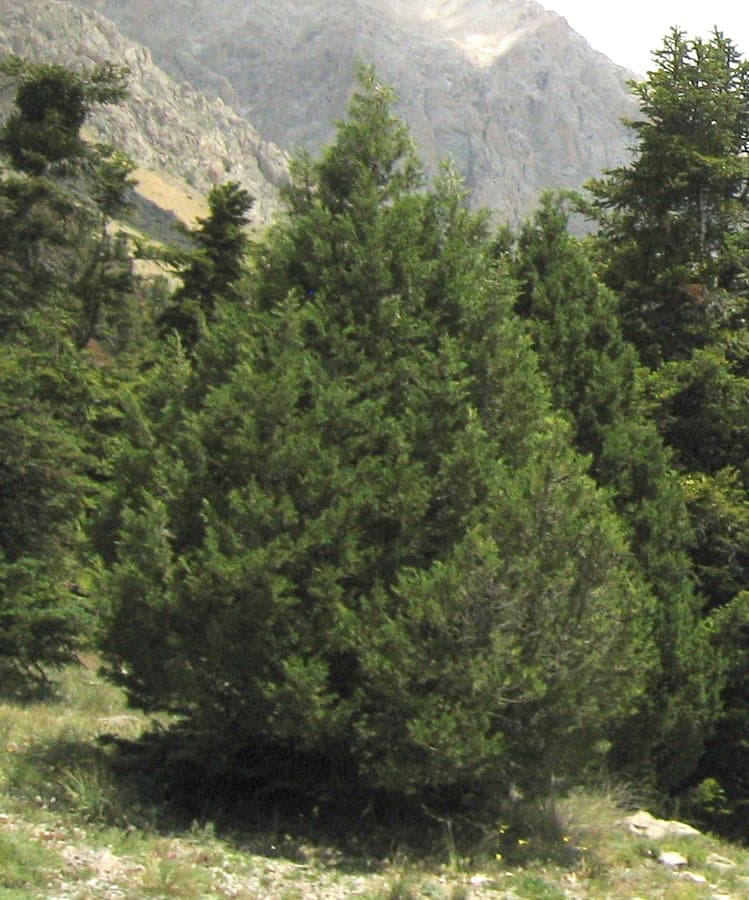
Vince Smith from London, United Kingdom / CC BY-SA 2.0, via Wikimedia Commons
Stinking juniper: complete guide
Juniperus foetidissima
Want to see Stinking juniper: complete guide in your garden?
1 minute, no credit card
Overview
Juniperus foetidissima, commonly known as stinking juniper, is a rugged, slow-growing evergreen tree that brings structure and year-round interest to gardens with minimal care. Despite its off-putting common name, this juniper is a resilient and valuable addition to landscapes, especially in dry, sunny areas with poor soil. Native to southeastern Europe and parts of western Asia - including Greece, Turkey, Iran, and Lebanon - it thrives in rocky, well-drained slopes and limestone-rich soils. In the garden, it matures into a broad, conical tree reaching 6 to 10 meters in height over time, with a spread of 3 to 4 meters. Its slow growth rate of 10–15 cm per year makes it manageable even in smaller gardens.
This species is not widely available in standard garden centres, but specialty nurseries and online retailers often stock it. If you're designing a xeriscape or Mediterranean-style garden, the stinking juniper fits perfectly. You can use gardenworld.app to visualize how this tree will grow and integrate into your space over the next 10–15 years, helping you avoid overcrowding.
Appearance & bloom cycle
The stinking juniper has stiff, needle-like foliage that grows in whorls of three to four. The leaves are dark green, sometimes with a silvery underside, and emit a pungent, resinous odour when crushed - hence the name. This scent is strong and can be off-putting to some, but it's a natural deterrent to deer and rabbits.
In late winter to early spring, male plants produce small yellow pollen cones at the tips of branches. Female plants, if present, develop fleshy, berry-like cones that turn purplish-brown by autumn. These 'berries' are not edible and can cause stomach upset if ingested. The bark becomes rough and fissured with age, adding visual texture to the trunk and older branches.
Growth is steady but slow. Expect a young plant to reach about 2.5 meters in 10 years under good conditions. Full maturity takes decades, so patience is key. Its evergreen nature ensures it provides shelter and screening all year.
Ideal location
Plant in full sun - aim for at least 7 hours of direct sunlight daily. This juniper thrives in hot, dry conditions and performs best on south- or southwest-facing slopes. Avoid shaded areas or spots beneath large trees that block light and steal moisture. Good air circulation is essential to prevent fungal issues, so don't crowd it with other plants.
If you're in a region with harsh winters, protect young trees from wind scorch by planting near a wall or windbreak. In exposed gardens, consider staking the first few years. Use gardenworld.app to map sun exposure and airflow in your garden, so you position your juniper exactly where it will thrive.
Soil requirements
Well-drained, slightly alkaline soil is crucial. The ideal pH range is 6.5 to 7.0. Heavy clay soils must be amended with sharp sand, grit, or gravel to improve drainage. Avoid water-retentive soils - Juniperus foetidissima is highly susceptible to root rot in soggy conditions.
If your soil is acidic (below pH 6.5), add garden lime to raise the pH. Test your soil with a kit from a garden centre before amending. This juniper prefers lean soils and doesn't need rich organic matter, which can actually encourage excess soft growth and disease.
Free design
Want to see Stinking juniper: complete guide in your garden? Make a free design now.
Watering
Once established, this juniper is extremely drought-tolerant. During the first two growing seasons, water deeply every 10–14 days during dry spells - about 10 litres per plant. After that, natural rainfall is usually sufficient. Overwatering is a common mistake; it leads to shallow roots and increases the risk of fungal infections.
Water at the base, not overhead, to keep foliage dry. Morning watering is best, allowing any moisture to evaporate quickly. Avoid frequent light watering - instead, soak the root zone thoroughly but infrequently.
Pruning
Pruning is rarely necessary. This juniper naturally maintains a pleasing shape. If needed, light trimming can be done in late spring or early summer to control size or remove dead wood. Never cut into old, leafless wood - junipers do not regenerate well from bare branches.
Use sharp, clean tools and disinfect between plants to prevent disease spread. Always step back and assess the shape before cutting. A light hand goes a long way.
Maintenance calendar
- January: Check for storm damage and broken branches.
- February: No action needed unless heavy snow; gently shake it off.
- March: Remove debris and old mulch; clear around the base.
- April: Apply a light dose of balanced fertiliser if growth is slow.
- May: Monitor for pests; ensure good airflow.
- June: Optional light pruning.
- July: Water young plants during prolonged drought.
- August: Let plant rest; avoid pruning now.
- September: Observe for disease; improve drainage if needed.
- October: Final check on soil compaction.
- November: Protect young trees from deer with a tree guard.
- December: Minimal care; inspect for winter damage.
Winter hardiness
Juniperus foetidissima is hardy in USDA zones 6 to 9 (-23°C to -4°C). In colder zones, young trees may suffer from desiccation due to winter winds. Use burlap wraps or windbreaks for the first 2–3 winters. Ensure the soil is well-drained to prevent ice buildup around roots.
Companion plants
Pair with drought-tolerant species like Cistus, Euphorbia, or Santolina. Low-growing thymes (Thymus serpyllum) or sedums work well as ground cover. Avoid moisture-loving plants such as hostas or ferns. For contrast, consider silver-foliaged plants like Artemisia or Stachys byzantina.
Closing
The stinking juniper is a low-maintenance, architectural tree perfect for sunny, dry gardens. Its strong scent may not appeal to everyone, but its resilience and beauty make it worth considering. Purchase from reputable suppliers like garden centres with a conifer selection or online specialty nurseries. When planning your layout, use gardenworld.app to simulate growth patterns and spacing - ensuring your juniper has room to shine for decades.
Want to see Stinking juniper: complete guide in your garden? Make a free design now.
Upload a photo, pick a style, and get a photorealistic design with plant list in under a minute.
No credit card required


Similar plants
Cupressus macnabiana: complete guide
Cupressus macnabiana
The Fragrant Cypress offers elegant growth with fine, aromatic foliage. Perfect for temperate climates and as specimen trees in contemporary gardens.
Cupressus guadalupensis: complete guide
Cupressus guadalupensis
The Guadalupe cypress: an elegant conifer for gardens. Complete cultivation guide for this Mexican cypress. Information about care, location, form and maintenance.
Austrocedrus chilensis: complete guide
Austrocedrus chilensis
Discover Austrocedrus chilensis, the Chilean Cedar ornamental conifer. Elegant specimen with fine foliage and columnar form for permanent structure.