
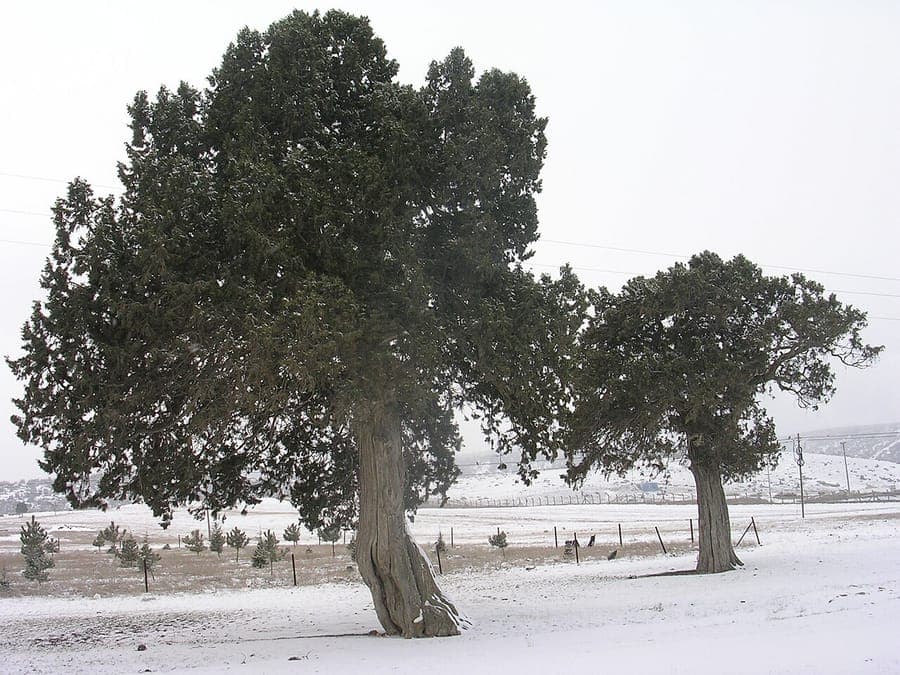
Honacan / CC BY-SA 3.0, via Wikimedia Commons
Crimean juniper: complete guide
Juniperus excelsa
Want to see Crimean juniper: complete guide in your garden?
1 minute, no credit card
Overview
Juniperus excelsa, commonly known as the Crimean juniper, is a resilient evergreen shrub or small tree that brings structure and year-round interest to gardens. Native to regions like Greece, Turkey, Cyprus, and the Caucasus, it's well adapted to harsh, dry, and rocky environments. In cultivation, it typically reaches 4 to 6 meters in height over time, with a broad, spreading habit that can span 3 to 5 meters wide. Unlike fast-growing conifers, it grows slowly to moderately, making it manageable even in medium-sized gardens.
One of its most appealing traits is its rugged beauty - the trunk often develops a gnarled, picturesque form as it ages, while the branches spread horizontally, creating a layered silhouette. This makes it a favorite for informal hedges, rock gardens, or as a standalone feature in xeriscaped designs.
On gardenworld.app, you can explore design ideas that integrate Juniperus excelsa into drought-tolerant or Mediterranean-style landscapes. Whether you're dealing with a hot, dry bank or a coastal site with poor soil, this juniper holds its own.
Appearance & bloom cycle
The foliage of Juniperus excelsa is fine-textured and ranges from silvery-green to blue-green, with needle-like leaves arranged in whorls of three or four. Each needle is about 8–12 mm long, stiff to the touch, and emits a faint resinous scent when crushed. In full sun, the color becomes brighter and more metallic, enhancing its visual appeal.
As a dioecious species, male and female reproductive structures appear on separate plants. Male plants produce small, yellow-brown pollen cones in spring (April–May), while female plants develop seed cones that mature into round, bluish-black, waxy 'berries' after two to three years. These aren't true berries but fleshy cone scales - and while they're used in small amounts for flavouring, they're toxic in large quantities to humans and pets.
Though not showy, these berries attract birds like thrushes, which help disperse the seeds. The plant doesn't flower in the traditional sense, but its subtle seasonal changes add quiet interest.
Ideal location
Full sun is essential - aim for at least 6 hours of direct sunlight daily. The plant becomes leggy and sparse in too much shade. It performs best on south- or southwest-facing slopes, rock gardens, or dry borders where air circulation is good and water doesn't pool.
It tolerates coastal exposure, strong winds, and high temperatures, but young plants benefit from some shelter during their first winter. Avoid low-lying, damp areas, especially in colder climates where wet soil combined with frost increases the risk of root rot.
Use the sun exposure planner on gardenworld.app to map out the best spot in your garden. Knowing your light patterns ensures your Crimean juniper gets the conditions it needs.
Free design
Want to see Crimean juniper: complete guide in your garden? Make a free design now.
Soil requirements
Well-drained soil is non-negotiable. Sandy, gravelly, or loamy soils with a pH between 6.0 and 7.8 are ideal. It thrives in poor soils and doesn't need rich organic matter - in fact, too much fertility can lead to weak, floppy growth.
If you're planting in heavy clay, create a raised bed or amend the planting hole with coarse sand and gravel. A drainage layer of 15–20 cm at the bottom of a 40 cm deep hole helps prevent waterlogging.
Watering
Water newly planted junipers weekly during the first growing season - about 8–10 litres per plant. Once established (after 12–18 months), it's highly drought tolerant and rarely needs supplemental watering, even in hot summers.
Only water during prolonged dry spells (over 4 weeks without rain), and always give a deep soak rather than frequent light sprinklings. Overwatering is a common cause of failure, especially in winter.
Pruning
Pruning isn't usually needed. Its natural form is attractive and architectural. If shaping is desired, do it in early spring (February–March) before new growth starts.
Remove only dead, damaged, or crossing branches. Never cut into old wood without foliage - junipers won't regenerate from bare stems. Limit pruning to no more than 20% of the canopy per year.
Maintenance calendar
- Jan: Check for winter damage, brush off heavy snow
- Feb: Light pruning if needed, inspect for pests
- Mar: Monitor for new growth
- Apr: Water young plants if dry
- May: No action required
- Jun: Watch for scale or spider mites
- Jul: No watering needed unless extreme drought
- Aug: Check for dieback
- Sep: Final watering check for young plants
- Oct: Ideal time for planting or transplanting
- Nov: No maintenance
- Dec: Protect young plants from winter wind with burlap wrap
Winter hardiness
Hardy in USDA zones 6b to 8 (down to -20°C). In zone 6, mulch the base and shield from wind to prevent desiccation. Older plants handle cold well, but new growth in late autumn can be vulnerable to frost.
Avoid de-icing salts near paths - junipers are sensitive to salt spray and soil salinity.
Companion plants
Pair with other drought-tolerant perennials like lavender (Lavandula angustifolia), sedum (Sedum spectabile), Russian sage (Perovskia atriplicifolia), or feather grass (Stipa tenuissima). Use silver-foliaged plants like Artemisia or Cineraria for contrast.
Keep aggressive spreaders like mint or bamboo at a distance. Allow at least 1.5 meters clearance around the plant to accommodate its spread.
Closing
Juniperus excelsa is a tough, stylish evergreen that earns its place in low-maintenance and water-wise gardens. With minimal care, it provides decades of structure and texture. Buy healthy specimens from reputable garden centres, such as those found at OBI, Hornbach, Truffaut, Jardiland, or local garden centres. Look for plants with firm, green foliage and no signs of browning or pests. With the right start, your Crimean juniper will thrive and become a lasting feature in your landscape.
Want to see Crimean juniper: complete guide in your garden? Make a free design now.
Upload a photo, pick a style, and get a photorealistic design with plant list in under a minute.
No credit card required


Similar plants
Cupressus macnabiana: complete guide
Cupressus macnabiana
The Fragrant Cypress offers elegant growth with fine, aromatic foliage. Perfect for temperate climates and as specimen trees in contemporary gardens.
Cupressus guadalupensis: complete guide
Cupressus guadalupensis
The Guadalupe cypress: an elegant conifer for gardens. Complete cultivation guide for this Mexican cypress. Information about care, location, form and maintenance.
Austrocedrus chilensis: complete guide
Austrocedrus chilensis
Discover Austrocedrus chilensis, the Chilean Cedar ornamental conifer. Elegant specimen with fine foliage and columnar form for permanent structure.