
jmgvalles / Public domain, via Wikimedia Commons
Andys: complete guide
Juniperus drupacea
Want to see Andys: complete guide in your garden?
1 minute, no credit card
Overview
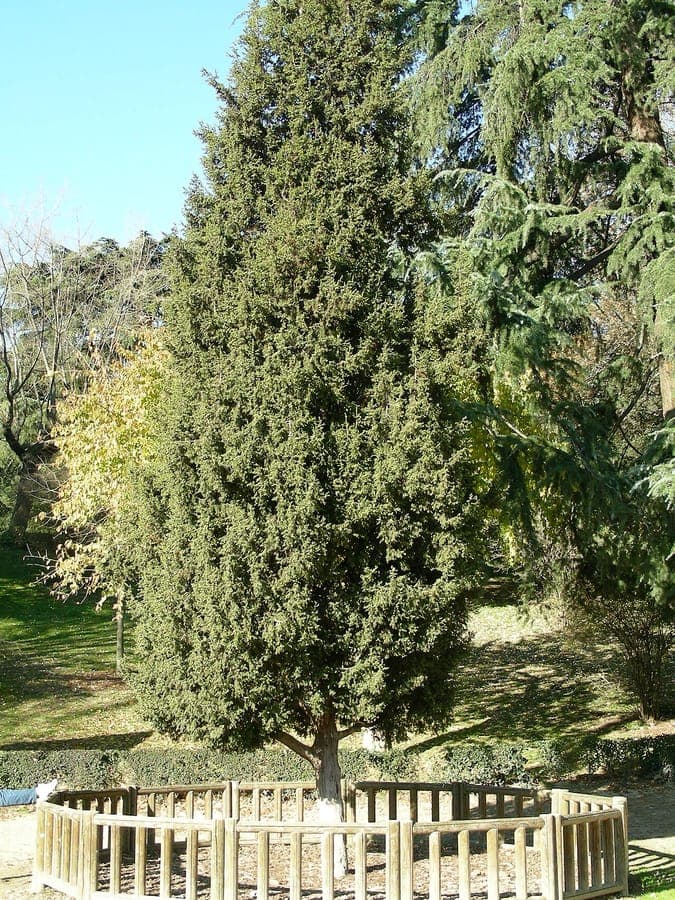
Juniperus drupacea, commonly known as Andys, is a striking evergreen conifer that brings architectural presence and Mediterranean flair to gardens. Native to mountainous regions of Greece, Turkey, and Lebanon-Syria, this tree thrives in dry, sunny conditions and is surprisingly adaptable to temperate climates when given the right start. In the UK and similar zones, it grows slowly into a tall, columnar tree, reaching up to 15 meters over decades, making it ideal as a focal point or vertical accent.
This isn't a plant you'll often find at standard garden centres, but specialist nurseries and online retailers like OBI and Hornbach occasionally stock it, especially in spring. Planning its placement is key-Andys demands space to develop its natural shape. On gardenworld.app, you can visualise how this tree fits into your garden layout, particularly in drought-tolerant or low-maintenance designs.
Appearance & bloom cycle
Andys stands out with its dense, dark green foliage and unique, plum-like cones-hence the species name drupacea. These fleshy cones are 1–2 cm long, starting green and maturing to deep purple-brown over a year. They appear on female plants only, typically after the tree reaches 5–10 years of age.
The foliage is scale-like, tightly packed, and arranged in overlapping rows along the stems, giving the plant a dense, almost sculptural quality. Young growth may have a slight silvery sheen. The bark on mature trunks becomes rough and grey, adding textural interest.
Unlike flowering plants, Andys doesn't bloom in the traditional sense. In spring (April–May), male plants produce small yellowish pollen cones at the tips of branches. Since it's dioecious, you'll need a female specimen to get the ornamental fruit-so confirm the sex when purchasing.
Ideal location
Full sun is non-negotiable for Juniperus drupacea. It needs at least 6–8 hours of direct sunlight daily. In partial shade, the interior branches thin out, and the tree becomes leggy and sparse.
This juniper works well in modern, structural gardens, gravel schemes, or Mediterranean-style plantings. Its upright habit makes it perfect for lining driveways, flanking entryways, or standing alone as a specimen. Avoid overcrowding-give it at least 2–3 meters of clearance on all sides to allow for full development.
While wind-tolerant, young trees in exposed coastal or windy inland sites may benefit from temporary windbreaks during the first two winters.
Soil requirements
Perfect drainage is essential. Andys hates wet feet and will quickly succumb to root rot in heavy clay or poorly drained soils. The ideal mix is sandy, gritty, or loamy with a pH between 6.0 and 7.5.
When planting, amend heavy soil with horticultural grit or sharp sand-about 30% by volume. Avoid rich composts or manures; this species evolved in nutrient-poor, rocky terrain and doesn't need fertile conditions.
In containers, use a mix for alpines or conifers, with added perlite or pumice. Choose a pot at least 40 cm wide with excellent drainage holes. Elevate it on feet to prevent waterlogging.
Free design
Want to see Andys: complete guide in your garden? Make a free design now.
Watering
Once established, Andys is highly drought-tolerant. During the first growing season, water deeply once a week during dry spells to help roots settle. After that, supplemental watering is rarely needed, even in hot summers.
When you do water, soak the root zone thoroughly rather than light sprinkling. This encourages deep root development and reduces stress. Overwatering is a common mistake-let the soil dry out between waterings.
Container-grown plants need more attention. Check the top 5–7 cm of soil; water only when dry.
Pruning
Pruning is minimal. Only remove dead, damaged, or crossing branches in late winter or early spring (February–March). Avoid cutting into old wood, as junipers don't regenerate well from bare stems.
If shaping is necessary, lightly trim the terminal shoots to maintain form. Never shear the plant like a hedge-this ruins its natural texture. Use sharp, clean secateurs and disinfect between cuts to prevent disease spread.
Maintenance calendar
- January: Inspect for winter damage. Keep mulch away from the trunk.
- February: Light pruning if needed. Check for pests.
- March: Prepare for growth. Remove any dead material.
- April: New growth begins. Water young plants in dry weather.
- May: Male cones release pollen. Monitor soil moisture.
- June–August: Minimal care. No feeding. Water only in prolonged drought.
- September: Watch for fungal spots or scale insects.
- October: Clear fallen cones if desired. No pruning.
- November: Ensure drainage is clear before winter rains.
- December: Protect container plants from freezing soil.
Winter hardiness
Andys is hardy to USDA zone 7 (-15°C). In the UK (zones 8–9), it survives most winters well, provided the soil drains freely. Wet, cold winters are the biggest threat-especially to young plants.
Potted specimens are more vulnerable. Wrap the container in hessian or bubble wrap during freezes, and place it on pot feet to improve drainage.
Companion plants
Pair Andys with other drought-tolerant, sun-loving plants. Excellent companions include Lavandula angustifolia, Rosmarinus officinalis, Cistus x hybridus, and Euphorbia characias. Low-growers like Sedum spectabile or Thymus serpyllum make good ground cover.
Avoid moisture-loving perennials such as Heuchera or Astilbe-they demand conditions that conflict with Andys' needs.
On gardenworld.app, you can design a planting scheme that balances Andys with complementary textures and colours, ensuring a cohesive look year-round.
Closing
Juniperus drupacea is not a fast or flashy plant, but a slow, dignified tree that rewards patience. With minimal care, it can become a long-lived garden feature, bringing structure, year-round greenery, and a touch of the Mediterranean. Choose the right spot, give it space, and let it grow-it's a legacy plant for the thoughtful gardener.
Want to see Andys: complete guide in your garden? Make a free design now.
Upload a photo, pick a style, and get a photorealistic design with plant list in under a minute.
No credit card required


Similar plants
Cupressus macnabiana: complete guide
Cupressus macnabiana
The Fragrant Cypress offers elegant growth with fine, aromatic foliage. Perfect for temperate climates and as specimen trees in contemporary gardens.
Cupressus guadalupensis: complete guide
Cupressus guadalupensis
The Guadalupe cypress: an elegant conifer for gardens. Complete cultivation guide for this Mexican cypress. Information about care, location, form and maintenance.
Austrocedrus chilensis: complete guide
Austrocedrus chilensis
Discover Austrocedrus chilensis, the Chilean Cedar ornamental conifer. Elegant specimen with fine foliage and columnar form for permanent structure.